Institute of Microbiology, College of Life Sciences, Zhejiang University, Hangzhou 310058, China.
Int J Mol Sci. 2022 Jan 17;23(2):979. doi: 10.3390/ijms23020979.
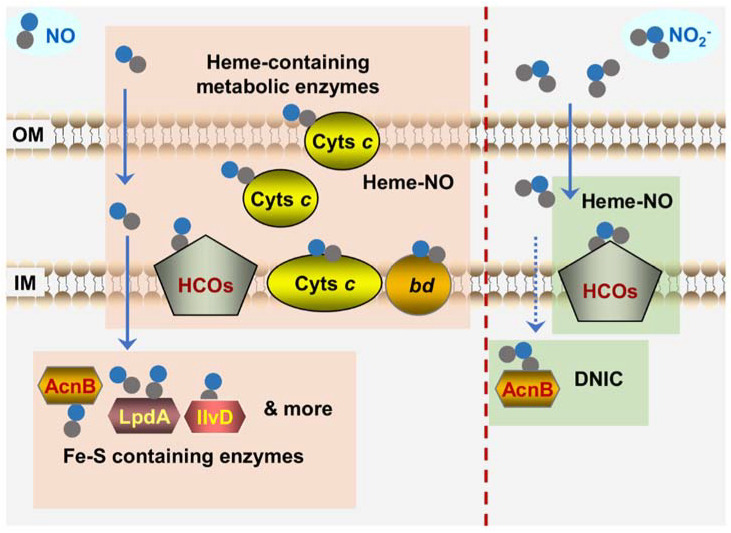
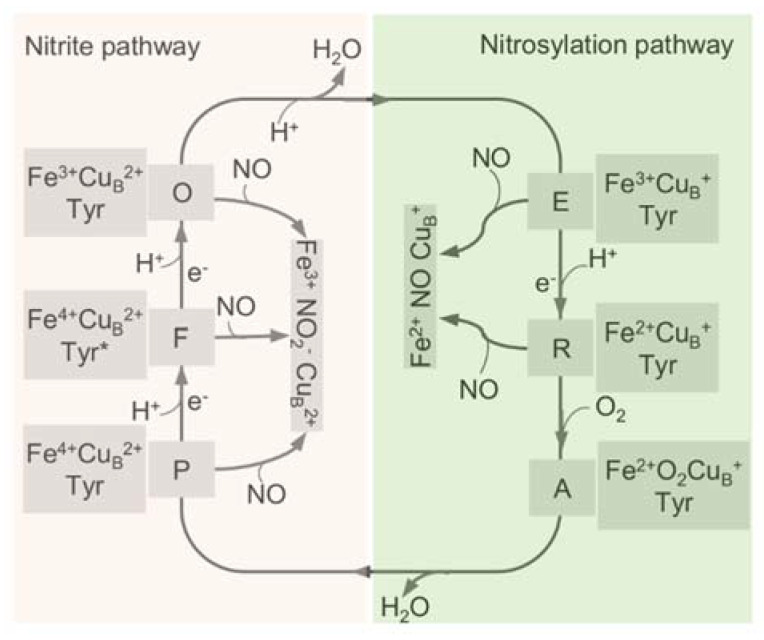
Nitrite and nitric oxide (NO), two active and critical nitrogen oxides linking nitrate to dinitrogen gas in the broad nitrogen biogeochemical cycle, are capable of interacting with redox-sensitive proteins. The interactions of both with heme-copper oxidases (HCOs) serve as the foundation not only for the enzymatic interconversion of nitrogen oxides but also for the inhibitory activity. From extensive studies, we now know that NO interacts with HCOs in a rapid and reversible manner, either competing with oxygen or not. During interconversion, a partially reduced heme/copper center reduces the nitrite ion, producing NO with the heme serving as the reductant and the cupric ion providing a Lewis acid interaction with nitrite. The interaction may lead to the formation of either a relatively stable nitrosyl-derivative of the enzyme reduced or a more labile nitrite-derivative of the enzyme oxidized through two different pathways, resulting in enzyme inhibition. Although nitrite and NO show similar biochemical properties, a growing body of evidence suggests that they are largely treated as distinct molecules by bacterial cells. NO seemingly interacts with all hemoproteins indiscriminately, whereas nitrite shows high specificity to HCOs. Moreover, as biologically active molecules and signal molecules, nitrite and NO directly affect the activity of different enzymes and are perceived by completely different sensing systems, respectively, through which they are linked to different biological processes. Further attempts to reconcile this apparent contradiction could open up possible avenues for the application of these nitrogen oxides in a variety of fields, the pharmaceutical industry in particular.
亚硝酸盐和一氧化氮(NO)是两种活性且关键的氮氧化物,它们将硝酸盐与氮气在广泛的氮生物地球化学循环中联系起来,能够与氧化还原敏感蛋白相互作用。这两种物质与血红素铜氧化酶(HCOs)的相互作用不仅为氮氧化物的酶促相互转化提供了基础,也为抑制活性提供了基础。通过广泛的研究,我们现在知道,NO 可以与 HCOs 快速且可逆地相互作用,与氧气竞争或不竞争。在相互转化过程中,部分还原的血红素/铜中心还原亚硝酸盐离子,产生 NO,血红素作为还原剂,铜离子提供路易斯酸与亚硝酸盐相互作用。这种相互作用可能导致酶还原的相对稳定的亚硝酰衍生物或酶氧化的更不稳定的亚硝酸盐衍生物的形成,从而导致酶抑制。尽管亚硝酸盐和 NO 表现出相似的生化性质,但越来越多的证据表明,细菌细胞在很大程度上将它们视为不同的分子。NO 似乎与所有血红素蛋白无差别地相互作用,而亚硝酸盐对 HCOs 表现出高度特异性。此外,作为生物活性分子和信号分子,亚硝酸盐和 NO 直接影响不同酶的活性,分别通过完全不同的感应系统感知,通过这些感应系统,它们与不同的生物过程相关联。进一步尝试解决这一明显的矛盾,可能为这些氮氧化物在各种领域的应用开辟途径,特别是在制药工业中。