Lourenço Caroline de Matos, Susi Manoela Dias, do Nascimento Mariah Cristina Antunes, Serafim Junior Vilson, Vila Ana Paula Simedan, Rodrigues-Flemming Gabriela Helena, Goloni-Bertollo Eny Maria, Silva Ana Elizabete, de Oliveira-Cucolo Juliana Garcia
Department of Graduate-Level Research, Sacred Heart University, Bauru, São Paulo 17011-970, Brazil.
Department of Molecular Biology, São José do Rio Preto School of Medicine, São José do Rio Preto, São Paulo 15090-000, Brazil.
World J Gastrointest Oncol. 2020 May 15;12(5):535-548. doi: 10.4251/wjgo.v12.i5.535.
Toll-like receptor-2 () is responsible for recognizing () and activating the immune response. Polymorphisms in may modulate gastric carcinogenesis.
To evaluate whether the (rs3804099) and - (rs111200466) polymorphisms contribute to gastric carcinogenesis in the Brazilian population, and to determine the influence of both polymorphisms and infection on mRNA expression.
DNA was extracted from 854 peripheral blood leukocyte or gastric tissue samples [202 gastric cancer (GC), 269 chronic gastritis (CG), and 383 control/healthy (C)] and genotyped by allele-specific PCR or restriction fragment length polymorphism (RFLP)-PCR. Quantitative polymerase chain reaction by Man assay was used to quantify mRNA levels in fresh gastric tissues (48 GC, 36 CG, and 14 C).
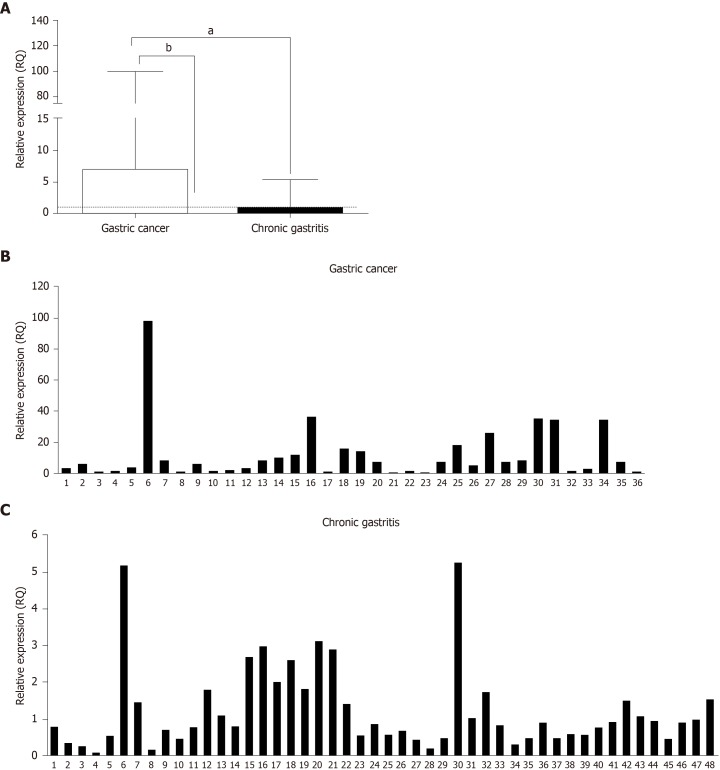
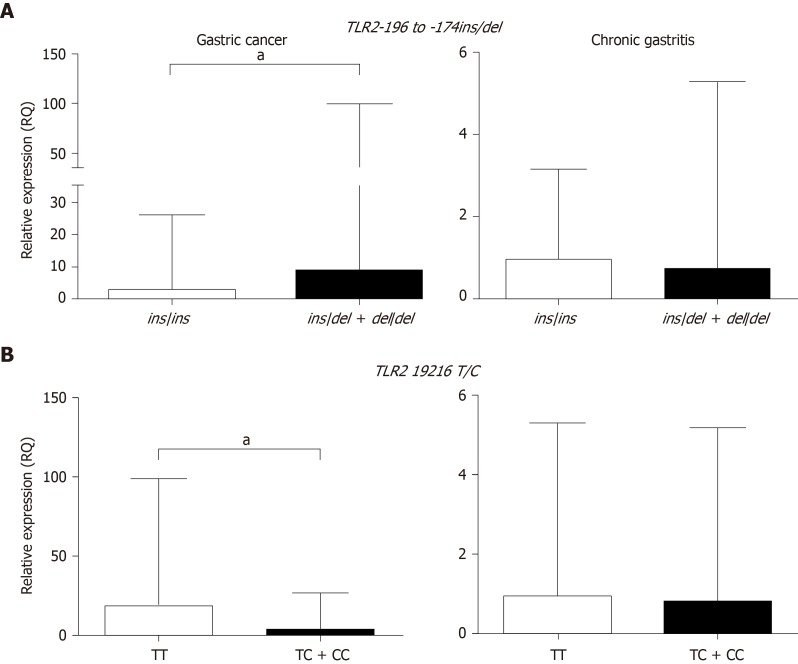
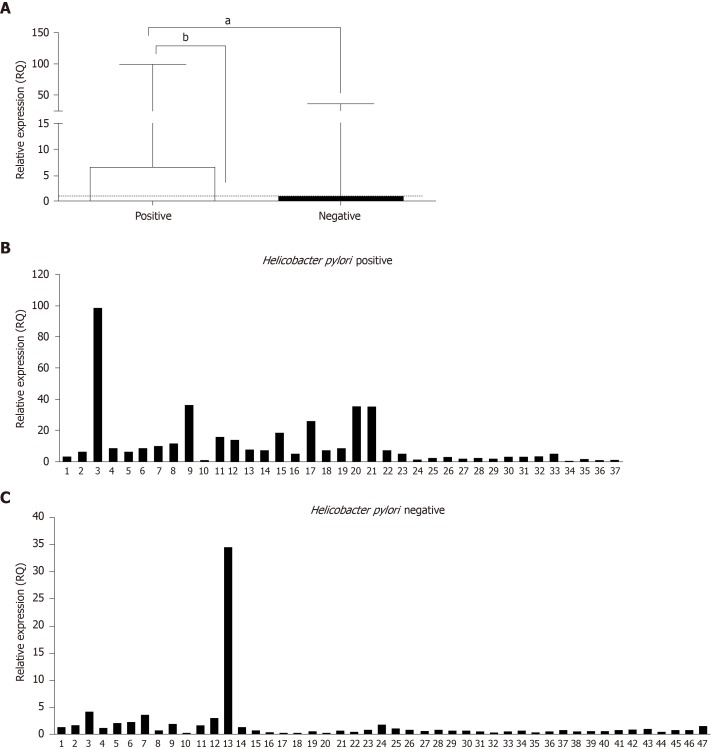
Regarding the TLR2 -196 to -174 polymorphism, the and genotypes were associated with a higher risk of GC by comparison with the C in all of the analyzed inheritance models (codominant, dominant, recessive, overdominant and log-additive; < 0.0001). Similarly, an increased risk was observed when comparing the GC and CG groups [codominant ( < 0.0001), dominant ( < 0.0001), recessive ( = 0.0260), overdominant ( < 0.0001) and log-additive ( < 0.0001)]. In contrast, was associated with a protective effect in the GC group compared to the C group [dominant ( = 0.0420) and log-additive ( = 0.0300)]. Regarding the association of polymorphisms with infection, individuals infected with and harboring the TLR2 -196 to -174 ins/del polymorphism had an increased risk of gastric carcinogenesis [codominant ( = 0.0120), dominant ( = 0.0051), overdominant ( = 0.0240) and log-additive ( = 0.0030)], while was associated with a protective effect [codominant ( = 0.0039), dominant ( < 0.0001), overdominant ( = 0.0097) and log-additive ( = 0.0021)]. mRNA levels were significantly increased in the GC group (median RQ = 6.95) compared to the CG group (RQ = 0.84, < 0.0001) and to the normal mucosa group (RQ = 1.0). In addition, both infection ( < 0.0001) and the presence of the polymorphic del ( = 0.0010) and ( = 0.0004) alleles influenced mRNA expression.
The -196 to -174 and polymorphisms are strongly associated with GC. mRNA expression levels are upregulated in neoplastic tissues and influenced by both the presence of and variant genotypes.
Toll样受体2(TLR2)负责识别细菌脂蛋白(BLP)并激活免疫反应。TLR2基因多态性可能会调节胃癌的发生。
评估TLR2基因(rs3804099)和TLR2 - 24838A>G(rs111200466)多态性是否与巴西人群胃癌发生有关,并确定这两种多态性及幽门螺杆菌(Hp)感染对TLR2 mRNA表达的影响。
从854份外周血白细胞或胃组织样本中提取DNA[202例胃癌(GC)、269例慢性胃炎(CG)和383例对照/健康者(C)],采用等位基因特异性PCR或限制性片段长度多态性(RFLP)-PCR进行基因分型。用实时荧光定量聚合酶链反应法对新鲜胃组织(48例GC、36例CG和14例C)中TLR2 mRNA水平进行定量分析。
关于TLR2 -196至 -174多态性,在所有分析的遗传模型(共显性、显性、隐性、超显性和对数加性模型;P<0.0001)中,与C基因型相比TT和CT基因型与GC风险增加相关。同样,比较GC组和CG组时也观察到风险增加[共显性(P<0.0001)、显性(P<0.0001)、隐性(P = 0.0260)、超显性(P<0.0001)和对数加性(P<0.0001)]。相比之下,与C组相比,TLR2 - 24838A>G多态性在GC组中具有保护作用[显性(P = 0.0420)和对数加性(P = 0.0300)]。关于多态性与Hp感染的关联,感染Hp且携带TLR2 -196至 -174插入/缺失多态性的个体胃癌发生风险增加[共显性(P = 0.0120)、显性(P = 0.0051)、超显性(P = 0.0240)和对数加性(P = 0.0030)],而TLR2 - 24838A>G多态性具有保护作用[共显性(P = 0.0039)、显性(P<0.0001)、超显性(P = 0.0097)和对数加性(P = 0.0021)]。与CG组(RQ = 0.84,P<0.0001)和正常黏膜组(RQ = 1.0)相比,GC组中TLR2 mRNA水平显著升高(中位RQ = 6.95)。此外,Hp感染(P<0.0001)以及多态性del(P = 0.0010)和A>G(P = 0.0004)等位基因的存在均影响TLR2 mRNA表达。
TLR2 -196至 -174 TT和CT多态性与GC密切相关。肿瘤组织中TLR2 mRNA表达水平上调,且受Hp感染和变异基因型的影响。