Waller Georgina, Dolby Melissa, Steele James, Fisher James P
School of Sport Health and Social Sciences, Solent University, Southampton, United Kingdom.
PeerJ. 2020 May 14;8:e9144. doi: 10.7717/peerj.9144. eCollection 2020.
The body of literature considering caffeine as an ergogenic aid has primarily considered typically aerobic based exercise, male participants and moderate-to large-caffeine doses. With this in mind the aim of this project was to explore the effects of a low-caffeine dose upon maximal voluntary contraction (MVC) and muscular endurance (time to task failure, TTF) at heavier-and lighter-loads.
Nineteen physically active, habitual caffeine consuming females randomly performed four testing conditions; two with a low-dose of caffeine (100 mg equating to mean = 1.5 ± 0.18 mg·kg) and two placebo conditions, where they performed a maximal strength test (MVC) knee extension at 45° followed by a task of relative muscular endurance (sustained isometric contraction for TTF) using either heavier-(70% MVC) and lighter-(30% MVC) loads. Each participant performed each load condition following both caffeine and placebo consumption. Immediately following cessation of the muscular endurance test participants were asked to report their rating of perceived effort (RPE) and rating of perceived discomfort (RPD).
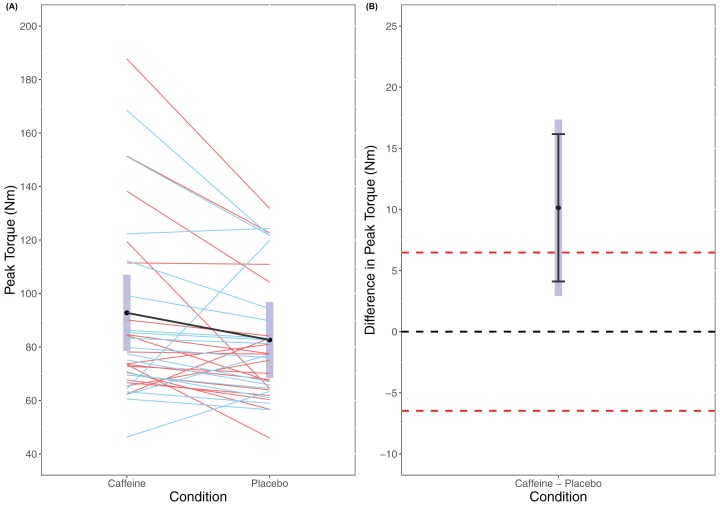
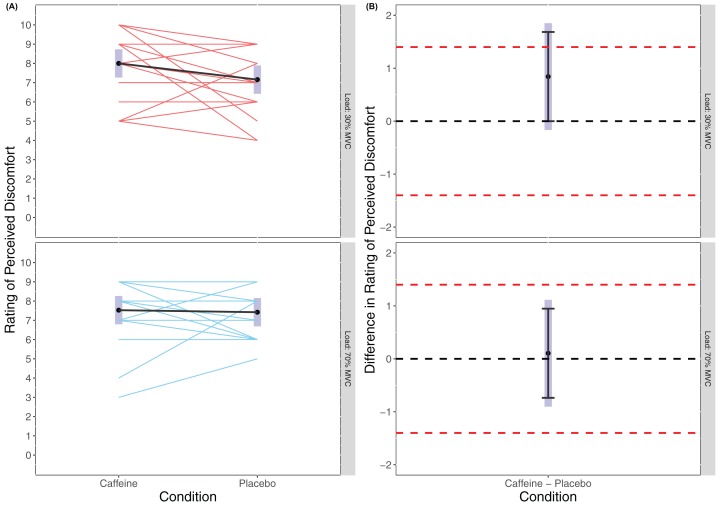
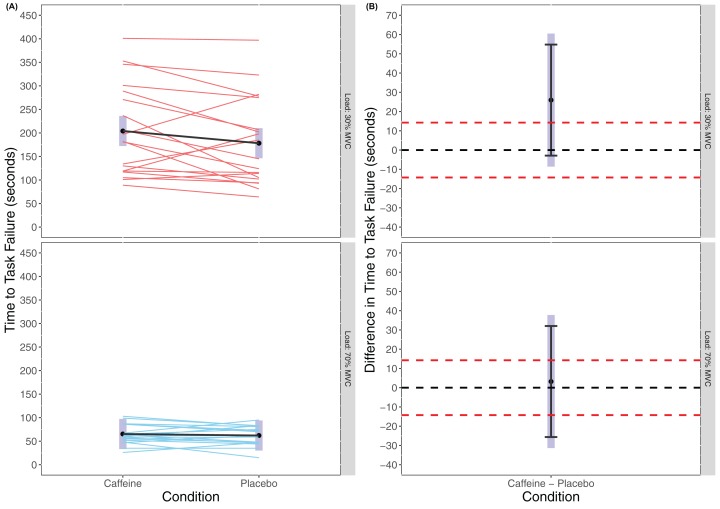
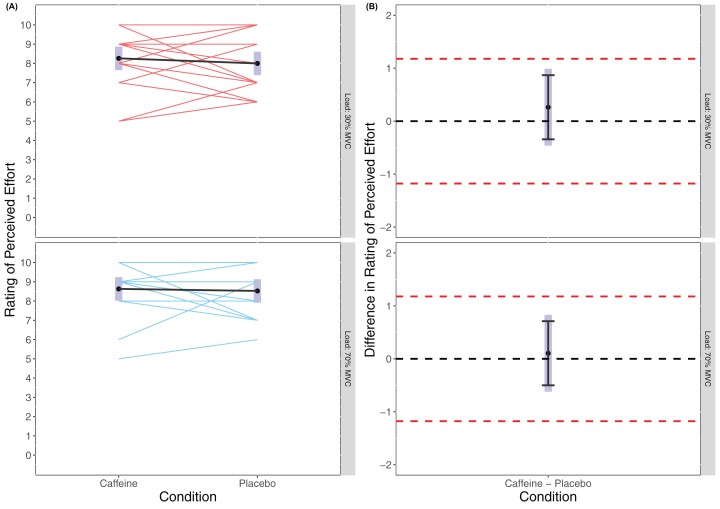
Analyses revealed a significant effect for caffeine upon MVC compared to placebo ( = 0.007). We also found a significantly greater TTF for the lighter-compared to the heavier-load condition ( < 0.0001); however, there was no significant effect comparing caffeine to placebo ( = 0.2368), but insufficient precision of estimates to infer equivalence in either lighter-( = 0.750) or heavier-load ( = 0.262) conditions. There were no statistically significant effects for caffeine compared with placebo, or lighter-compared with heavier-loads, for RPE and RPD (all > 0.05). RPE was statistically equivalent between caffeine and placebo for both lighter-( = 0.007) and heavier-load ( = 0.002) conditions and RPD for heavier-( = 0.006) but not lighter-load ( = 0.136).
This is the first study to demonstrate a positive effect on strength from a low caffeine dose in female participants. However, it is unclear whether caffeine positively impacts upon relative muscular endurance in either heavier-or lighter-loads. Further, both RPE and RPD appear to be relatively similar during isometric tasks performed to task failure independently of caffeine supplementation or load. These findings may have implications for persons wishing to avoid side-effects or withdrawal symptoms associated with larger caffeine doses whilst still attaining the positive strength responses.
将咖啡因视为一种提高运动能力辅助剂的文献主要关注的是典型的有氧运动、男性参与者以及中到大剂量的咖啡因。考虑到这一点,本项目的目的是探讨低剂量咖啡因对较重和较轻负荷下最大自主收缩(MVC)和肌肉耐力(任务失败时间,TTF)的影响。
19名有体育锻炼习惯且经常摄入咖啡因的女性随机进行四种测试条件;两种是低剂量咖啡因(100毫克,相当于平均 = 1.5 ± 0.18毫克·千克),两种是安慰剂条件,她们在45°进行最大力量测试(MVC)膝关节伸展,然后使用较重(70%MVC)和较轻(30%MVC)负荷进行相对肌肉耐力任务(持续等长收缩至TTF)。每位参与者在摄入咖啡因和安慰剂后分别进行每种负荷条件的测试。在肌肉耐力测试结束后,立即要求参与者报告他们的主观用力程度(RPE)和主观不适程度(RPD)。
分析显示,与安慰剂相比,咖啡因对MVC有显著影响( = 0.007)。我们还发现,与较重负荷条件相比,较轻负荷条件下的TTF显著更长( < 0.0001);然而,将咖啡因与安慰剂进行比较时没有显著影响( = 0.2368),但在较轻( = 0.750)或较重负荷( = 0.262)条件下估计精度不足,无法推断等效性。对于RPE和RPD,与安慰剂相比,咖啡因没有统计学上的显著影响,较轻与较重负荷相比也没有(所有 > 0.05)。在较轻( = 0.007)和较重负荷( = 0.002)条件下,咖啡因和安慰剂之间的RPE在统计学上等效,较重负荷( = 0.006)下的RPD等效,但较轻负荷( = 0.136)下不等效。
这是第一项证明低剂量咖啡因对女性参与者力量有积极影响的研究。然而,尚不清楚咖啡因在较重或较轻负荷下是否对相对肌肉耐力有积极影响。此外,在进行到任务失败的等长任务期间,无论是否补充咖啡因或负荷如何,RPE和RPD似乎相对相似。这些发现可能对那些希望避免与较大剂量咖啡因相关的副作用或戒断症状,同时仍能获得积极力量反应的人有影响。