Massachusetts General Hospital Cancer Center, Boston, Massachusetts, USA.
Harvard Medical School, Boston, Massachusetts, USA.
Oncologist. 2020 Aug;25(8):652-660. doi: 10.1634/theoncologist.2020-0127. Epub 2020 Jun 18.
We assessed the antitumor activity of cabozantinib, a potent multireceptor oral tyrosine kinase inhibitor, in patients with hormone receptor-positive breast cancer with bone metastases.
In this single-arm multicenter phase II study, patients received an initial starting dose of 100 mg, later reduced to 60 mg, per day. The primary endpoint was the bone scan response rate. Secondary endpoints included objective response rate by RECIST, progression-free survival (PFS), and overall survival (OS).
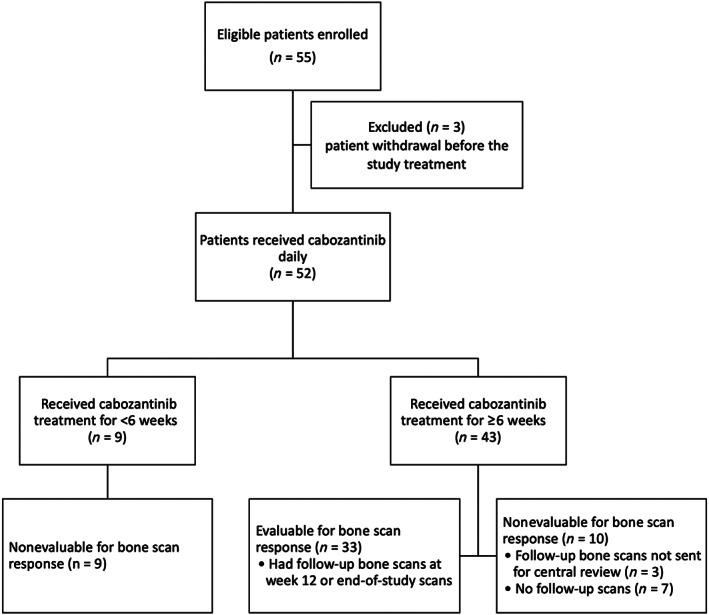
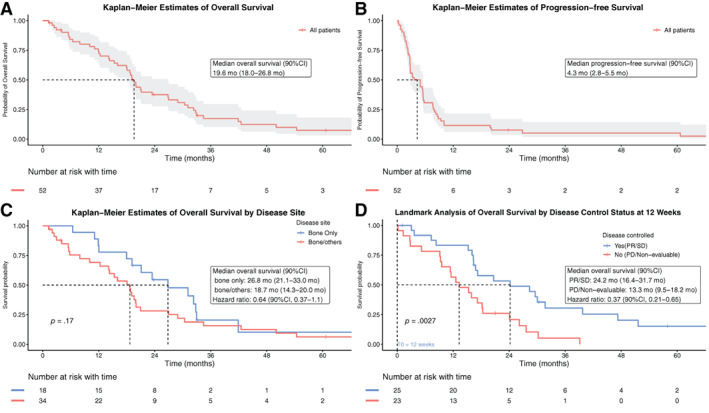
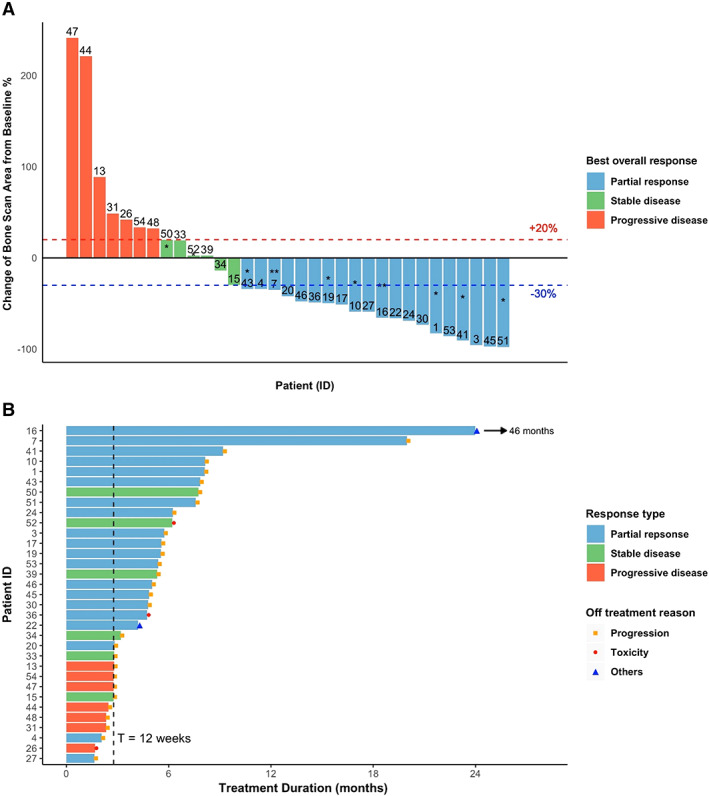
Of 52 women enrolled, 20 (38%) experienced a partial response on bone scan and 6 (12%) had stable disease. Prior to the first repeat bone scan at 12 weeks, 19 (35%) patients discontinued study treatment because of early clinical progression or unacceptable toxicity. RECIST evaluation based on best overall response by computed tomography revealed stable disease in extraosseous tissues in 26 patients (50%) but no complete or partial responses. In 25 patients with disease control on bone scan at 12 weeks, only 3 (12%) patients developed extraosseous progression. The median PFS was 4.3 months, and median OS was 19.6 months. The most common grade 3 or 4 toxicities were hypertension (10%), anorexia (6%), diarrhea (6%), fatigue (4%), and hypophosphatemia (4%).
Bone scans improved in 38% of patients with metastatic hormone receptor-positive breast cancer and remained stable in an additional 12% for a minimum duration of 12 weeks on cabozantinib. Further investigations should assess the activity of cabozantinib in combination with other hormonal and other breast cancer therapies and determine whether bone scan responses correlate with meaningful antitumor effects. ClinicalTrials.gov identifier. NCT01441947 IMPLICATIONS FOR PRACTICE: Most patients with metastatic hormone receptor-positive (HR+) breast cancer have bone involvement, and many have bone-only disease, which is difficult to evaluate for response. This phase II single-arm study evaluated the clinical activity of the small molecule MET/RET/VEGFR2 inhibitor cabozantinib in patients with metastatic HR+ breast cancer with bone metastases. This study met its primary endpoint, and cabozantinib treatment resulted in a significant bone scan response rate correlating with improved survival. This is the first study to use bone scan response as a primary endpoint in breast cancer. The results support further study of cabozantinib in HR+ breast cancer.
我们评估了多受体口服酪氨酸激酶抑制剂卡博替尼在激素受体阳性伴骨转移乳腺癌患者中的抗肿瘤活性。
在这项单臂多中心 2 期研究中,患者接受初始起始剂量为 100mg,随后减至 60mg/天。主要终点是骨扫描缓解率。次要终点包括 RECIST 客观缓解率、无进展生存期(PFS)和总生存期(OS)。
52 名女性中,20 名(38%)骨扫描有部分缓解,6 名(12%)病情稳定。在 12 周时首次重复骨扫描前,19 名(35%)患者因早期临床进展或不可接受的毒性而停止研究治疗。根据计算机断层扫描的最佳总体缓解情况,RECIST 评估显示,26 名患者(50%)骨骼外组织疾病稳定,但无完全或部分缓解。在 12 周时骨扫描疾病控制的 25 名患者中,仅 3 名(12%)患者出现骨骼外进展。中位 PFS 为 4.3 个月,中位 OS 为 19.6 个月。最常见的 3 级或 4 级毒性是高血压(10%)、厌食(6%)、腹泻(6%)、疲劳(4%)和低磷血症(4%)。
在转移性激素受体阳性乳腺癌患者中,38%的患者骨扫描改善,在至少 12 周的卡博替尼治疗后,另外 12%的患者骨扫描稳定。进一步的研究应评估卡博替尼与其他激素和其他乳腺癌治疗方法联合应用的活性,并确定骨扫描反应是否与有意义的抗肿瘤效果相关。临床试验.gov 标识符。NCT01441947。
大多数转移性激素受体阳性(HR+)乳腺癌患者有骨受累,许多患者有骨-only 疾病,难以评估其反应。这项 2 期单臂研究评估了小分子 MET/RET/VEGFR2 抑制剂卡博替尼在转移性 HR+乳腺癌伴骨转移患者中的临床活性。该研究达到了主要终点,卡博替尼治疗导致显著的骨扫描缓解率,与改善的生存相关。这是第一项使用骨扫描缓解作为乳腺癌主要终点的研究。结果支持进一步研究卡博替尼在 HR+乳腺癌中的应用。