Bloem Bastiaan R, Henderson Emily J, Dorsey E Ray, Okun Michael S, Okubadejo Njideka, Chan Piu, Andrejack John, Darweesh Sirwan K L, Munneke Marten
Donders Institute for Brain, Cognition and Behaviour and Department of Neurology, Centre of Expertise for Parkinson and Movement Disorders, Radboud University Medical Centre, Nijmegen, Netherlands.
Older People's Unit, Royal United Hospitals Bath NHS Foundation Trust, Bath, UK; Department of Population Health Sciences, Bristol Medical School, University of Bristol, Bristol, UK.
Lancet Neurol. 2020 Jul;19(7):623-634. doi: 10.1016/S1474-4422(20)30064-8. Epub 2020 May 25.
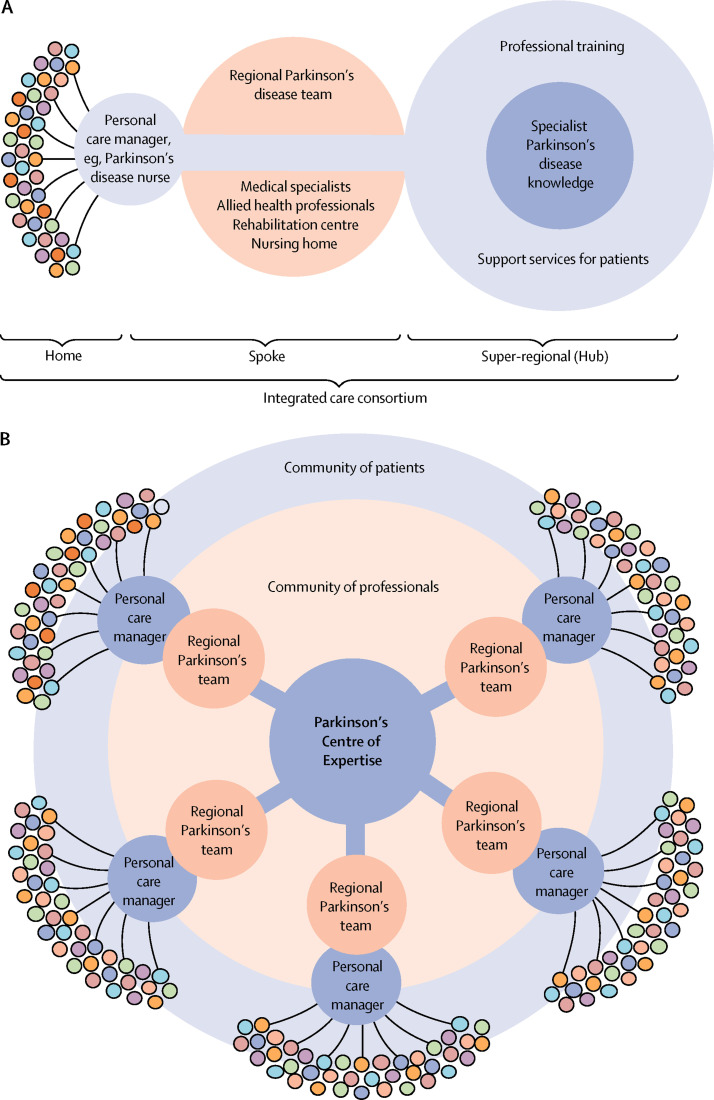
Chronic neurological diseases are the leading cause of disability globally. Yet, our health-care systems are not designed to meet the needs of many patients with chronic neurological conditions. Care is fragmented with poor interdisciplinary collaboration and lack of timely access to services and therapies. Furthermore, care is typically reactive, and complex problems are managed inadequately because of a scarcity of disease-specific expertise and insufficient use of non-pharmacological interventions. Treatment plans tend to focus on the disease rather than the individual living with it, and patients are often not involved in clinical decision making. By use of Parkinson's disease as a model condition, we show an integrated care concept with a patient-centred perspective that includes evidence-based solutions to improve health-care delivery for people with chronic neurological conditions. We anticipate that this integrated care model will improve the quality of life for patients, create a positive working environment for health-care professionals, and be affordable.
慢性神经疾病是全球致残的主要原因。然而,我们的医疗保健系统并非为满足许多慢性神经疾病患者的需求而设计。医疗护理分散,跨学科协作不佳,缺乏及时获得服务和治疗的机会。此外,护理通常是被动反应式的,由于缺乏特定疾病的专业知识和非药物干预措施使用不足,复杂问题得不到充分处理。治疗计划往往侧重于疾病而非患病个体,患者通常不参与临床决策。以帕金森病作为典型病症,我们展示了一种以患者为中心的综合护理理念,其中包括基于证据的解决方案,以改善慢性神经疾病患者的医疗服务提供。我们预计这种综合护理模式将提高患者的生活质量,为医疗保健专业人员创造积极的工作环境,并且具有可承受性。