Kundap Uday Praful, Paudel Yam Nath, Shaikh Mohd Farooq
Research Center of the University of Montreal Hospital Center (CRCHUM), Department of Neurosciences, Université de Montréal, Montréal, QC H2X 0A9, Canada.
Neuropharmacology Research Strength, Jeffrey Cheah School of Medicine and Health Sciences, Monash University Malaysia, Selangor 47500, Malaysia.
Pharmaceuticals (Basel). 2020 May 26;13(6):106. doi: 10.3390/ph13060106.
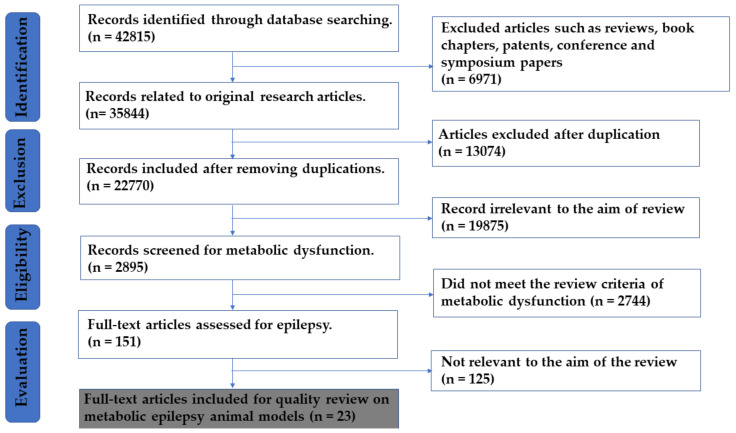
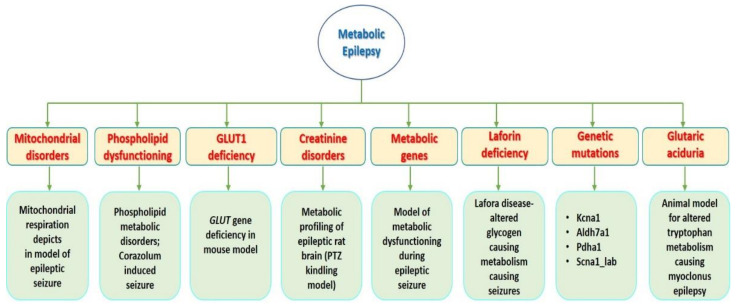
Epilepsy is a serious neurological disorder affecting around 70 million people globally and is characterized by spontaneous recurrent seizures. Recent evidence indicates that dysfunction in metabolic processes can lead to the alteration of neuronal and network excitability, thereby contributing to epileptogenesis. Developing a suitable animal model that can recapitulate all the clinical phenotypes of human metabolic epilepsy (ME) is crucial yet challenging. The specific environment of many symptoms as well as the primary state of the applicable neurobiology, genetics, and lack of valid biomarkers/diagnostic tests are the key factors that hinder the process of developing a suitable animal model. The present systematic review summarizes the current state of available animal models of metabolic dysfunction associated with epileptic disorders. A systematic search was performed by using the Preferred Reporting Items for Systematic Reviews and Meta-Analyses (PRISMA) model. A range of electronic databases, including google scholar, Springer, PubMed, ScienceDirect, and Scopus, were scanned between January 2000 and April 2020. Based on the selection criteria, 23 eligible articles were chosen and are discussed in the current review. Critical analysis of the selected literature delineated several available approaches that have been modeled into metabolic epilepsy and pointed out several drawbacks associated with the currently available models. The result describes available models of metabolic dysfunction associated with epileptic disorder, such as mitochondrial respiration deficits, Lafora disease (LD) model-altered glycogen metabolism, causing epilepsy, glucose transporter 1 (GLUT1) deficiency, adiponectin responsive seizures, phospholipid dysfunction, glutaric aciduria, mitochondrial disorders, pyruvate dehydrogenase (PDH) α-subunit gene (PDHA1), pyridoxine dependent epilepsy (PDE), BCL2-associated agonist of cell death (BAD), Kcna1 knock out (KO), and long noncoding RNAs (lncRNA) cancer susceptibility candidate 2 (lncRNA CASC2). Finally, the review highlights certain focus areas that may increase the possibilities of developing more suitable animal models and underscores the importance of the rationalization of animal models and evaluation methods for studying ME. The review also suggests the pressing need of developing precise robust animal models and evaluation methods for investigating ME.
癫痫是一种严重的神经系统疾病,全球约有7000万人受其影响,其特征是自发反复发作。最近的证据表明,代谢过程中的功能障碍可导致神经元和网络兴奋性的改变,从而促进癫痫的发生。开发一种能够重现人类代谢性癫痫(ME)所有临床表型的合适动物模型至关重要,但也具有挑战性。许多症状的特定环境以及适用的神经生物学、遗传学的主要状态,以及缺乏有效的生物标志物/诊断测试,是阻碍开发合适动物模型进程的关键因素。本系统综述总结了与癫痫障碍相关的代谢功能障碍现有动物模型的现状。使用系统评价和Meta分析的首选报告项目(PRISMA)模型进行了系统检索。在2000年1月至2020年4月期间扫描了一系列电子数据库,包括谷歌学术、施普林格、PubMed、ScienceDirect和Scopus。根据选择标准,选择了23篇符合条件的文章并在本综述中进行了讨论。对所选文献的批判性分析描述了几种已被建模为代谢性癫痫的可用方法,并指出了与当前可用模型相关的几个缺点。结果描述了与癫痫障碍相关的代谢功能障碍的可用模型,如线粒体呼吸缺陷、拉福拉病(LD)模型——改变糖原代谢导致癫痫、葡萄糖转运蛋白1(GLUT1)缺乏、脂联素反应性癫痫发作、磷脂功能障碍、戊二酸尿症、线粒体疾病、丙酮酸脱氢酶(PDH)α亚基基因(PDHA1)、吡哆醇依赖性癫痫(PDE)、细胞死亡相关的BCL2激动剂(BAD)、Kcna1基因敲除(KO)以及长链非编码RNA(lncRNA)癌症易感性候选基因2(lncRNA CASC2)。最后,综述强调了某些可能增加开发更合适动物模型可能性的重点领域,并强调了动物模型合理化和评估方法对于研究ME的重要性。综述还表明迫切需要开发精确可靠的动物模型和评估方法来研究ME。