School of Economics and Management, Jiangsu University of Science & Technology, Zhenjiang 212003, China.
Dean, Faculty of Computing & Engineering, University of Kotli Azad Jammu & Kashmir, Kotli 11100, Pakistan.
Int J Environ Res Public Health. 2020 May 26;17(11):3780. doi: 10.3390/ijerph17113780.
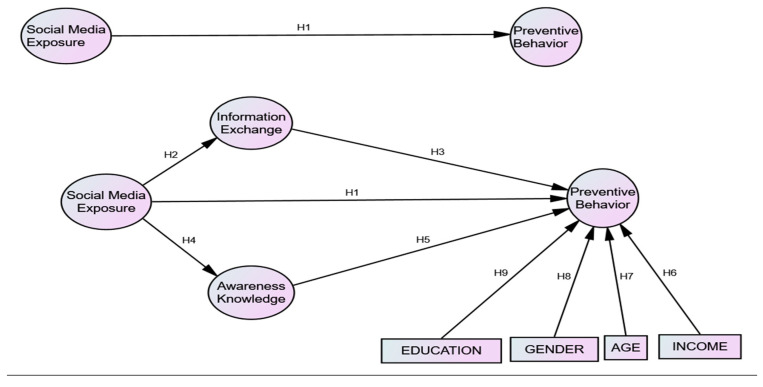
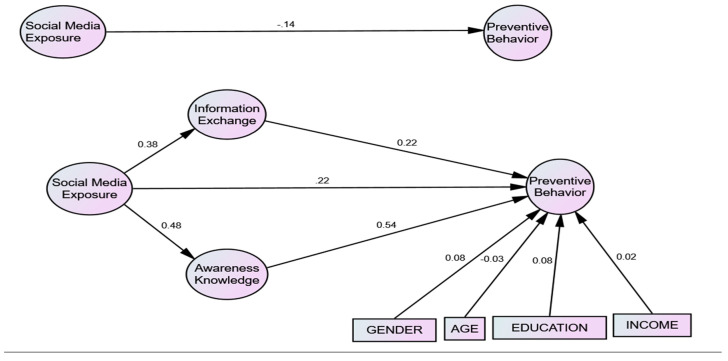
COVID-19 is appearing as one of the most fetal disease of the world's history and has caused a global health emergency. Therefore, this study was designed with the aim to address the issue of public response against COVID-19. The literature lacks studies on social aspects of COVID-19. Therefore, the current study is an attempt to investigate its social aspects and suggest a theoretical structural equation model to examine the associations between social media exposure, awareness, and information exchange and preventive behavior and to determine the indirect as well as direct impact of social media exposure on preventive behavior from the viewpoints of awareness and information exchange. The current empirical investigation was held in Pakistan, and the collected survey data from 500 respondents through social media tools were utilized to examine the associations between studied variables as stated in the anticipated study model. The findings of the study indicate that social media exposure has no significant and direct effect on preventive behavior. Social media exposure influences preventive behavior indirectly through awareness and information exchange. In addition, awareness and information exchange have significant and direct effects on preventive behavior. Findings are valuable for health administrators, governments, policymakers, and social scientists, specifically for individuals whose situations are like those in Pakistan. This research validates how social media exposure indirectly effects preventive behavior concerning COVID-19 and explains the paths of effect through awareness or information exchange. To the best of our knowledge, there is no work at present that covers this gap, for this reason the authors propose a new model. The conceptual model offers valuable information for policymakers and practitioners to enhance preventive behavior through the adoption of appropriate awareness strategies and information exchange and social media strategies.
COVID-19 是世界历史上最具危害性的疾病之一,已经引发了全球卫生紧急事件。因此,本研究旨在解决公众对 COVID-19 的反应问题。文献中缺乏关于 COVID-19 社会方面的研究。因此,本研究试图探讨其社会方面,并提出一个理论结构方程模型,以检验社交媒体接触、意识和信息交流与预防行为之间的关联,并确定社交媒体接触对预防行为的间接和直接影响,从意识和信息交流的角度来看。本实证研究在巴基斯坦进行,通过社交媒体工具收集了 500 名受访者的调查数据,以检验预期研究模型中研究变量之间的关联。研究结果表明,社交媒体接触对预防行为没有显著的直接影响。社交媒体接触通过意识和信息交流间接影响预防行为。此外,意识和信息交流对预防行为有显著的直接影响。研究结果对卫生管理人员、政府、政策制定者和社会科学家具有重要价值,特别是对那些情况类似于巴基斯坦的个人。本研究验证了社交媒体接触如何通过意识或信息交流间接地影响 COVID-19 的预防行为,并解释了影响的途径。据我们所知,目前没有任何工作涵盖这一空白,因此作者提出了一个新的模型。该概念模型为政策制定者和实践者提供了有价值的信息,通过采用适当的意识策略、信息交流和社交媒体策略来增强预防行为。