Children's Hospital Informatics Program, Children's Hospital Boston, Boston, Massachusetts, United States of America.
Dengue Branch, Division of Vector-Borne Diseases, Centers for Disease Control and Prevention, San Juan, Puerto Rico.
PLoS Negl Trop Dis. 2014 Feb 27;8(2):e2713. doi: 10.1371/journal.pntd.0002713. eCollection 2014 Feb.
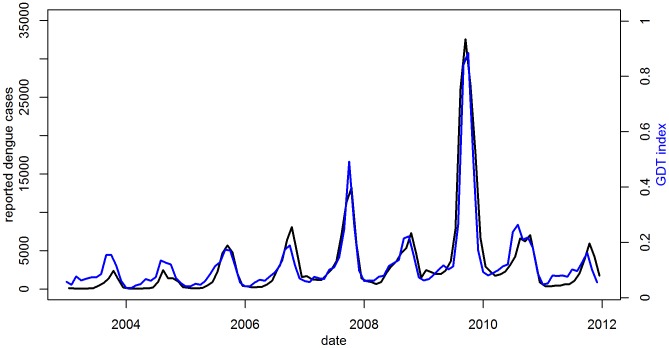
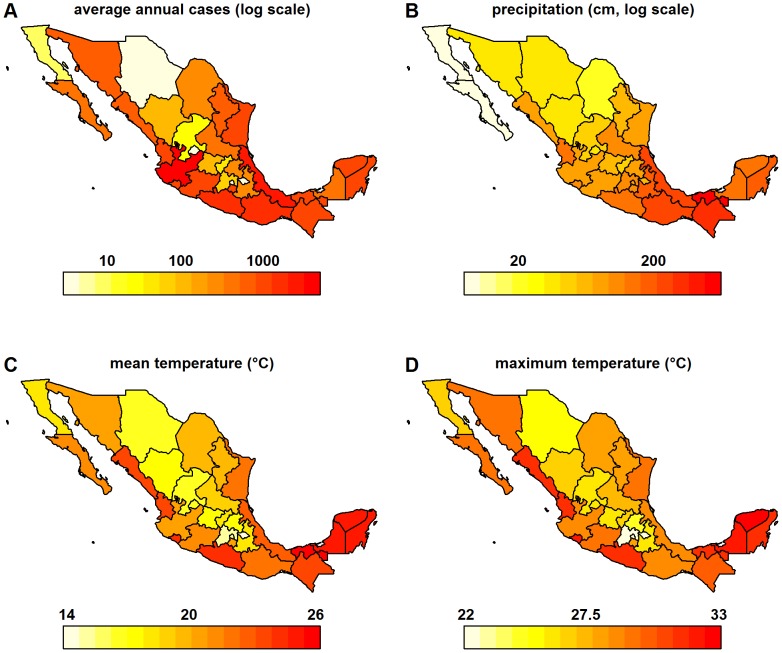
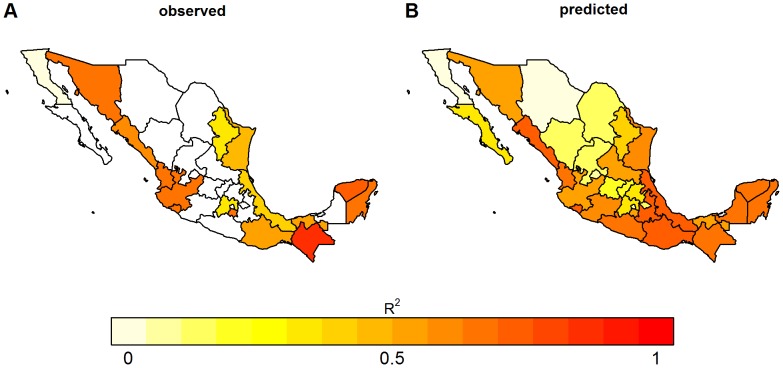
Dengue is a common and growing problem worldwide, with an estimated 70-140 million cases per year. Traditional, healthcare-based, government-implemented dengue surveillance is resource intensive and slow. As global Internet use has increased, novel, Internet-based disease monitoring tools have emerged. Google Dengue Trends (GDT) uses near real-time search query data to create an index of dengue incidence that is a linear proxy for traditional surveillance. Studies have shown that GDT correlates highly with dengue incidence in multiple countries on a large spatial scale. This study addresses the heterogeneity of GDT at smaller spatial scales, assessing its accuracy at the state-level in Mexico and identifying factors that are associated with its accuracy. We used Pearson correlation to estimate the association between GDT and traditional dengue surveillance data for Mexico at the national level and for 17 Mexican states. Nationally, GDT captured approximately 83% of the variability in reported cases over the 9 study years. The correlation between GDT and reported cases varied from state to state, capturing anywhere from 1% of the variability in Baja California to 88% in Chiapas, with higher accuracy in states with higher dengue average annual incidence. A model including annual average maximum temperature, precipitation, and their interaction accounted for 81% of the variability in GDT accuracy between states. This climate model was the best indicator of GDT accuracy, suggesting that GDT works best in areas with intense transmission, particularly where local climate is well suited for transmission. Internet accessibility (average ∼ 36%) did not appear to affect GDT accuracy. While GDT seems to be a less robust indicator of local transmission in areas of low incidence and unfavorable climate, it may indicate cases among travelers in those areas. Identifying the strengths and limitations of novel surveillance is critical for these types of data to be used to make public health decisions and forecasting models.
登革热是一个全球性的普遍且日益严重的问题,每年估计有 7000 万至 1.4 亿例。传统的、以医疗保健为基础、由政府实施的登革热监测需要大量资源且速度较慢。随着全球互联网使用量的增加,新型的基于互联网的疾病监测工具已经出现。谷歌登革热趋势(GDT)使用近乎实时的搜索查询数据来创建一个登革热发病率指数,该指数是传统监测的线性代理。多项研究表明,GDT 在多个国家的大空间尺度上与登革热发病率高度相关。本研究旨在探讨 GDT 在较小空间尺度上的异质性,评估其在墨西哥州一级的准确性,并确定与其准确性相关的因素。我们使用皮尔逊相关系数来估计 GDT 与墨西哥全国和 17 个墨西哥州的传统登革热监测数据之间的关联。在全国范围内,GDT 大约可以捕捉到报告病例 9 年研究期间的 83%的变异性。GDT 与报告病例之间的相关性因州而异,在南下加利福尼亚州捕捉到的变异性低至 1%,在恰帕斯州高达 88%,在登革热平均年发病率较高的州更为准确。一个包含年平均最高温度、降水及其相互作用的模型解释了各州 GDT 准确性差异的 81%。这个气候模型是 GDT 准确性的最佳指标,表明 GDT 在传播强度较高的地区效果最好,特别是在适合传播的当地气候条件下。互联网的可及性(平均约为 36%)似乎并不影响 GDT 的准确性。虽然在发病率较低和气候不利的地区,GDT 似乎是一种不太可靠的本地传播指标,但它可能表明在这些地区旅行者中有病例。确定新型监测的优势和局限性对于使用这些类型的数据做出公共卫生决策和预测模型至关重要。