Division of Hematology/Medical Oncology, Department of Medicine, Perelman School of Medicine, University of Pennsylvania, Philadelphia, Pennsylvania; Abramson Cancer Center, Perelman School of Medicine, University of Pennsylvania, Philadelphia, Pennsylvania.
Perelman School of Medicine, University of Pennsylvania, Philadelphia, Pennsylvania.
J Am Coll Cardiol. 2020 Jun 2;75(21):2726-2737. doi: 10.1016/j.jacc.2020.03.067.
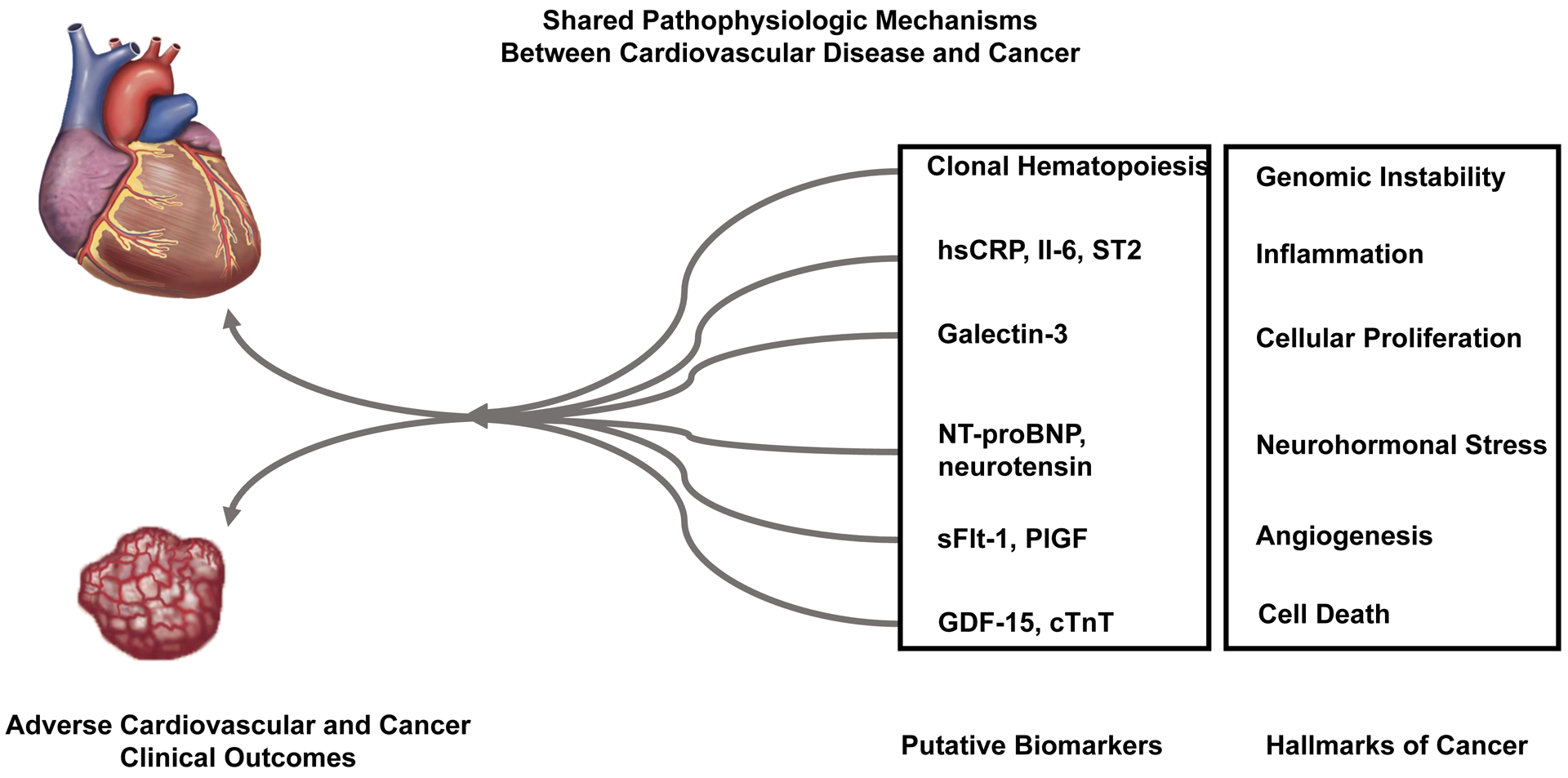
Cardiovascular disease (CVD) and cancer are leading causes of morbidity and mortality worldwide. Although conventionally managed as separate disease processes, recent research has lent insight into compelling commonalities between CVD and cancer, including shared mechanisms for disease development and progression. In this review, the authors discuss several pathophysiological processes common to both CVD and cancer, such as inflammation, resistance to cell death, cellular proliferation, neurohormonal stress, angiogenesis, and genomic instability, in an effort to understand common mechanisms of both disease states. In particular, the authors highlight key circulating and genomic biomarkers associated with each of these processes, as well as their associations with risk and prognosis in both cancer and CVD. The purpose of this state-of-the-art review is to further our understanding of the potential mechanisms underlying cancer and CVD by contextualizing pathways and biomarkers common to both diseases.
心血管疾病(CVD)和癌症是全球发病率和死亡率的主要原因。尽管传统上被视为两种独立的疾病过程,但最近的研究揭示了 CVD 和癌症之间存在引人注目的共同之处,包括疾病发展和进展的共同机制。在这篇综述中,作者讨论了几种与 CVD 和癌症都相关的病理生理过程,如炎症、细胞死亡抵抗、细胞增殖、神经激素应激、血管生成和基因组不稳定性,以了解这两种疾病状态的共同机制。特别是,作者强调了与这些过程相关的关键循环和基因组生物标志物,以及它们与癌症和 CVD 风险和预后的关联。本综述的目的是通过将两种疾病共有的途径和生物标志物置于上下文中,进一步了解癌症和 CVD 潜在的潜在机制。