Providence Cancer Institute, Earle A Chiles Research Institute, Providence Portland Medical Center, Portland, Oregon, USA
Providence Cancer Institute, Earle A Chiles Research Institute, Providence Portland Medical Center, Portland, Oregon, USA.
J Immunother Cancer. 2020 May;8(1). doi: 10.1136/jitc-2020-000773.
A pilot study of stereotactic body radiation therapy (SBRT) followed by high-dose interleukin-2 (IL-2) showed a higher than anticipated objective response rate (ORR) among patients with metastatic melanoma (MM). We performed a prospective randomized study to determine if the ORR of SBRT + IL-2 was greater than IL-2 monotherapy in patients with advanced melanoma.
Patients with MM who had adequate physiological reserve for IL-2 and at least one site suitable for SBRT were eligible. There was a 1:1 randomization to SBRT + IL-2 or IL-2 monotherapy. Patients received one or two doses of SBRT (20 Gy per fraction) with the last dose administered 3 days before starting the first cycle of IL-2. IL-2 (600,000 IU per kg via intravenous bolus infusion) was given every 8 hours for a maximum of 14 doses with a second cycle after a 2-week rest. Responding patients received up to six IL-2 cycles. Patients assigned to IL-2 monotherapy who exhibited progression of melanoma after cycle 2 were allowed to crossover and receive SBRT and additional IL-2. Response Evaluation Criteria in Solid Tumors 1.1 criteria were applied to non-irradiated lesions for response assessment.
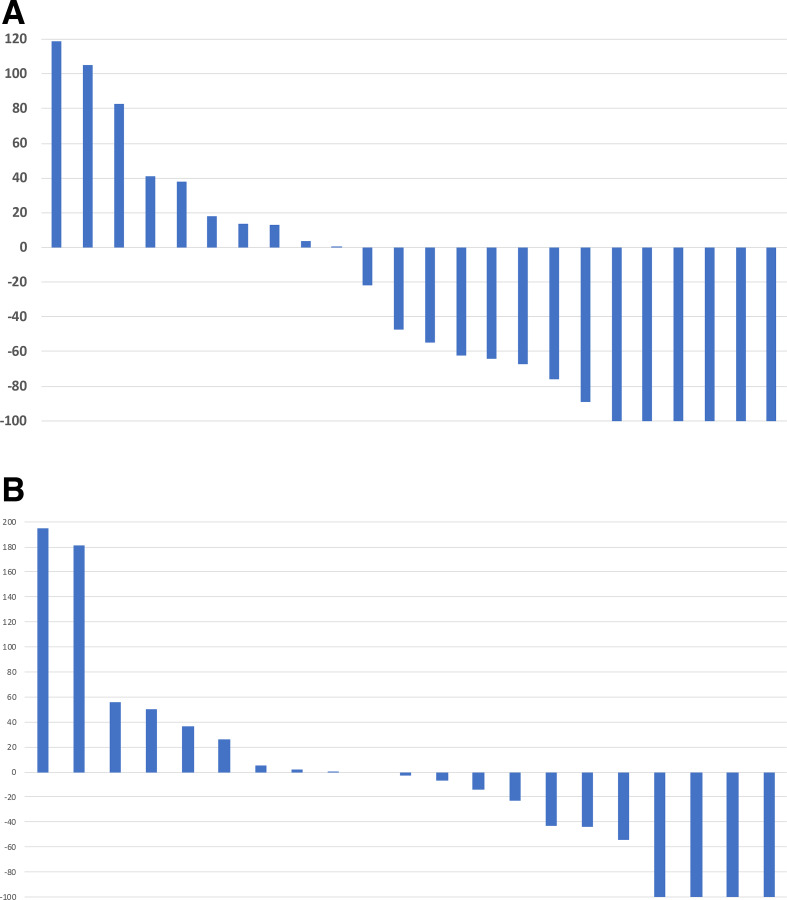
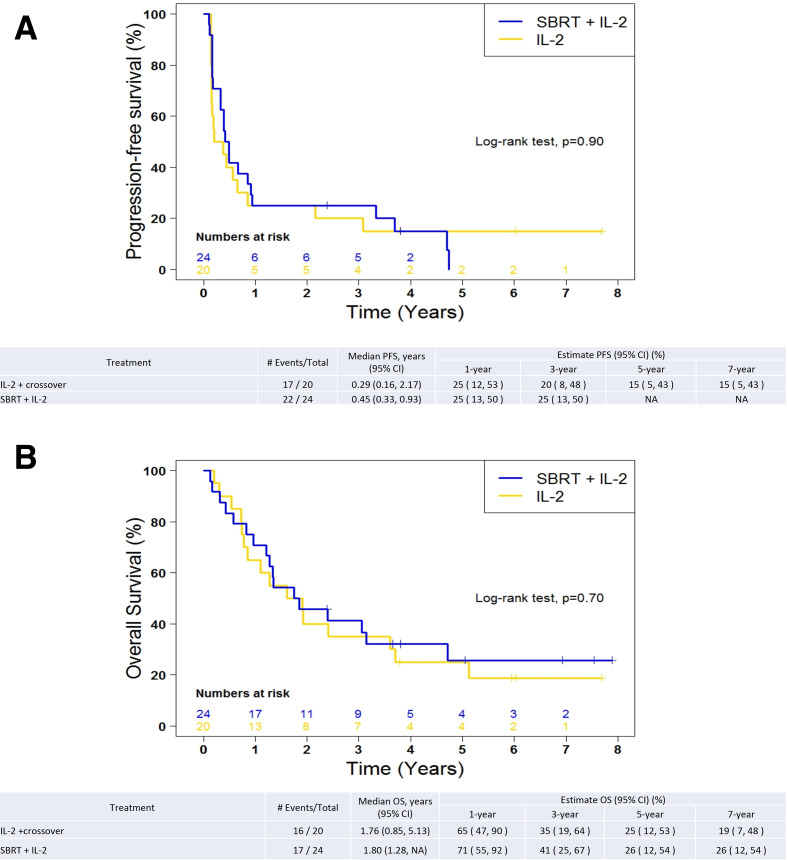
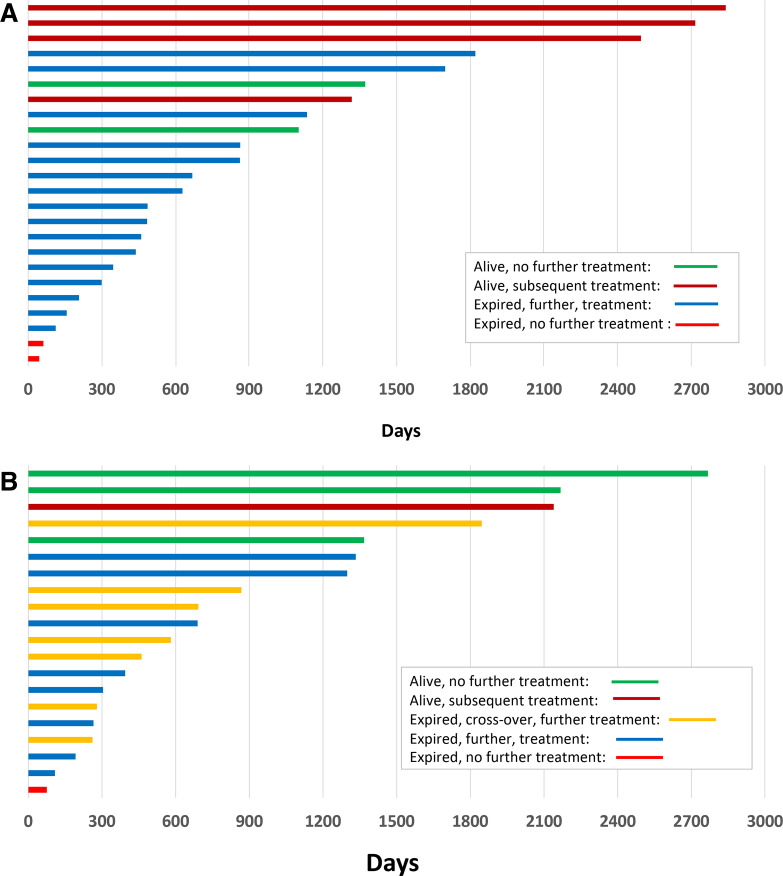
44 patients were included in the analysis. The ORR in the SBRT + IL-2 group was 54%: 21% complete response (CR), 33% partial response (PR), 21% stable disease (SD) and 25% progressive disease (PD). The ORR in patients receiving IL-2 monotherapy was 35%: 15% CR, 20% PR, 25% SD and 40% PD. Seven patients assigned to IL-2 subsequently received SBRT + IL-2. One CR and two PRs were observed in the crossover group. There was no difference in progression-free or overall survival (OS). At 5 years the OS was 26% in the SBRT + IL-2 group and 25% in the IL-2 monotherapy group. The disease control rate (DCR) was higher in the SBRT + IL-2 group (75% vs 60%, p=0.34).
SBRT + IL-2 induced more objective responses with a higher DCR compared to IL-2 monotherapy in MM. IL-2 monotherapy resulted in a significantly higher ORR than anticipated. Some patients in the crossover group also achieved objective responses.
NCT01416831.
立体定向体部放射治疗(SBRT)后序贯高剂量白细胞介素-2(IL-2)的初步研究显示,转移性黑色素瘤(MM)患者的客观缓解率(ORR)高于预期。我们进行了一项前瞻性随机研究,以确定 SBRT+IL-2 方案的 ORR 是否高于 IL-2 单药治疗在晚期黑色素瘤患者中的疗效。
适合接受 IL-2 治疗且至少有一处适合 SBRT 的 MM 患者有资格参加。按照 1:1 随机分为 SBRT+IL-2 或 IL-2 单药治疗。患者接受 1 或 2 次 SBRT(每次 20Gy 分割剂量),最后一次 SBRT 治疗后 3 天开始第一个 IL-2 周期。IL-2(600,000IU/kg 静脉推注)每 8 小时给予一次,最多 14 次,2 周休息后进行第二个周期。有缓解的患者接受最多 6 个 IL-2 周期。接受 IL-2 单药治疗的患者在第 2 个周期后出现黑色素瘤进展,允许交叉接受 SBRT 和额外的 IL-2。采用实体瘤反应评估标准 1.1 标准评估非放疗病灶的反应。
44 例患者纳入分析。SBRT+IL-2 组的 ORR 为 54%:21%完全缓解(CR),33%部分缓解(PR),21%疾病稳定(SD)和 25%疾病进展(PD)。接受 IL-2 单药治疗的患者 ORR 为 35%:15%CR,20%PR,25%SD 和 40%PD。7 例接受 IL-2 单药治疗的患者随后接受了 SBRT+IL-2。交叉组观察到 1 例 CR 和 2 例 PR。无无进展生存期(PFS)或总生存期(OS)差异。5 年时,SBRT+IL-2 组的 OS 为 26%,IL-2 单药治疗组为 25%。SBRT+IL-2 组的疾病控制率(DCR)高于 IL-2 单药治疗组(75%比 60%,p=0.34)。
与 IL-2 单药治疗相比,SBRT+IL-2 诱导了更多的客观缓解,DCR 更高。IL-2 单药治疗的 ORR 明显高于预期。交叉组的一些患者也获得了客观缓解。
NCT01416831。