Department of Oncology, Affiliated Hospital of Shaoxing University, Shaoxing, Zhejiang 312000, P.R. China.
Mol Med Rep. 2020 Aug;22(2):810-818. doi: 10.3892/mmr.2020.11176. Epub 2020 May 22.
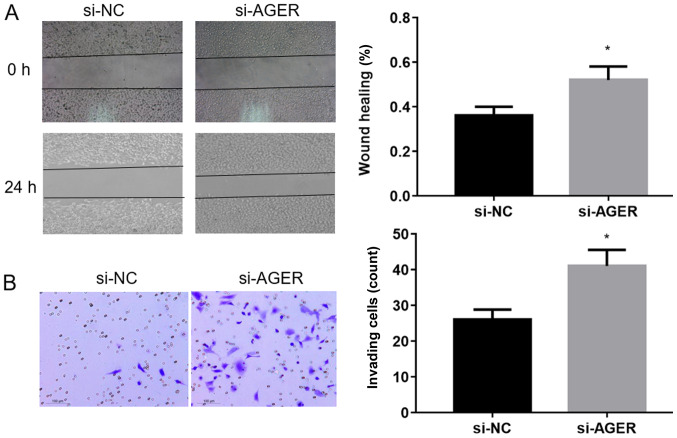
Advanced glycosylation end-product specific receptor (AGER) is a multi-ligand cell surface receptor abnormally expressed in lung cancer, and is a member of the immunoglobulin superfamily. Therefore, this study aimed to explore the effect of AGER on the biological behavior of non‑small cell lung cancer (NSCLC) H1299 cell line. A microarray‑based gene expression profiling analysis of the GSE27262 dataset from the Gene Expression Omnibus (GEO) database was conducted to identify differentially expressed genes, which were verified using The Cancer Genome Atlas (TCGA) database. The expression of AGER in the normal human lung BEAS‑2B cell line and NSCLC H1299 cell line was examined using reverse transcription‑quantitative PCR. Lentiviral interference and overexpression vectors of AGER were constructed and transfected into H1299 cells using Lipofectamine®. AGER expression and biological properties, including cell viability, apoptosis, migration and invasion abilities, in H1299 cells were investigated using MTT, flow cytometry, wound healing and Transwell assays. AGER was expressed at a low level in NSCLC tissues and H1299 cells (P<0.05). Compared with control cells, AGER overexpression cells displayed decreased cell viability, proliferation, migration and invasion abilities, and significantly increased levels of apoptosis. Furthermore, AGER overexpression increased the expression of Bax and decreased the expression of Bcl‑2 in H1299 cells (P<0.05), and AGER knockdown displayed the opposite effects on H1299 cells. Therefore, AGER overexpression decreased the proliferation, invasion and migration abilities of H1299 cells, and increased apoptosis. The present study suggested that AGER might serve as a potential molecular marker for NSCLC.
晚期糖基化终产物特异性受体(AGER)是一种在肺癌中异常表达的多配体细胞表面受体,属于免疫球蛋白超家族成员。因此,本研究旨在探讨 AGER 对非小细胞肺癌(NSCLC)H1299 细胞系生物学行为的影响。通过对基因表达综合数据库(GEO)数据库中 GSE27262 数据集进行基于微阵列的基因表达谱分析,鉴定差异表达基因,并使用癌症基因组图谱(TCGA)数据库进行验证。采用逆转录-定量 PCR 检测正常人类肺 BEAS-2B 细胞系和 NSCLC H1299 细胞系中 AGER 的表达。构建 AGER 的慢病毒干扰和过表达载体,并通过 Lipofectamine®转染到 H1299 细胞中。采用 MTT、流式细胞术、划痕愈合和 Transwell 实验检测 H1299 细胞中 AGER 表达及细胞活力、凋亡、迁移和侵袭能力等生物学特性。AGRE 在 NSCLC 组织和 H1299 细胞中低表达(P<0.05)。与对照细胞相比,过表达 AGER 的细胞显示出降低的细胞活力、增殖、迁移和侵袭能力,并且凋亡水平显著增加。此外,过表达 AGER 增加了 H1299 细胞中 Bax 的表达,降低了 Bcl-2 的表达(P<0.05),而 AGER 敲低对 H1299 细胞则产生相反的影响。因此,过表达 AGER 降低了 H1299 细胞的增殖、侵袭和迁移能力,并增加了凋亡。本研究表明,AGER 可能作为 NSCLC 的潜在分子标志物。