Bi Qiqing, Shen Lining, Evans Richard, Zhang Zhiguo, Wang Shimin, Dai Wei, Liu Cui
School of Medicine and Health Management, Tongji Medical College, Huazhong University of Science & Technology, Wuhan, China.
Hubei Provincial Research Center for Health Technology Assessment, Wuhan, China.
JMIR Med Inform. 2020 May 29;8(5):e17813. doi: 10.2196/17813.
There are more than 6000 rare diseases in existence today, with the number of patients with these conditions rapidly increasing. Most research to date has focused on the diagnosis, treatment, and development of orphan drugs, while few studies have examined the topics and emotions expressed by patients living with rare diseases on social media platforms, especially in online health communities (OHCs).
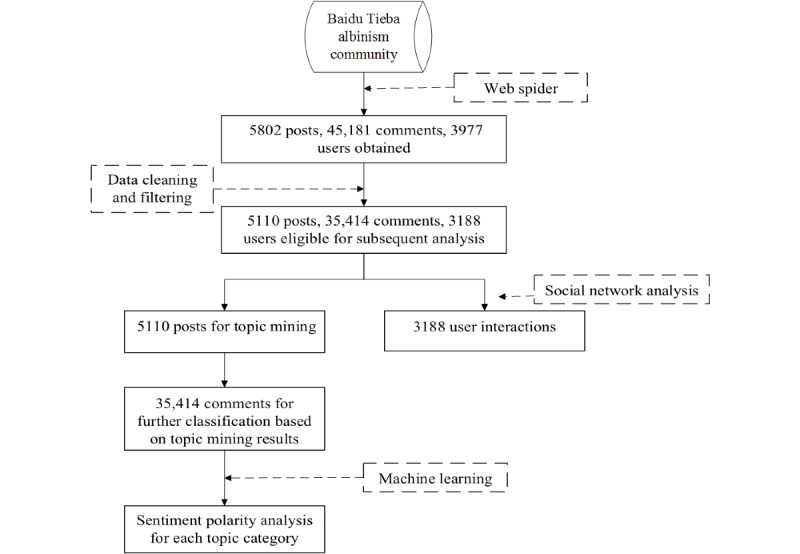
This study aimed to determine the topic categorizations and sentiment polarity for albinism in a Chinese OHC, Baidu Tieba, using multiple methods. The OHC was deeply mined using topic mining, social network analysis, and sentiment polarity analysis. Through these methods, we determined the current situation of community construction, identifying the ongoing needs and problems experienced by people with albinism in their daily lives.
We used the albinism community on the Baidu Tieba platform as the data source in this study. Term frequency-inverse document frequency, latent dirichlet allocation models, and naive Bayes were employed to mine the various topic categories. Social network analysis, which was completed using the Gephi tool, was employed to analyze the evolution of the albinism community. Sentiment polarity analysis was performed using a long short-term memory algorithm.
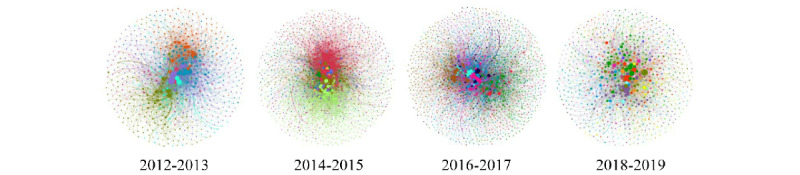
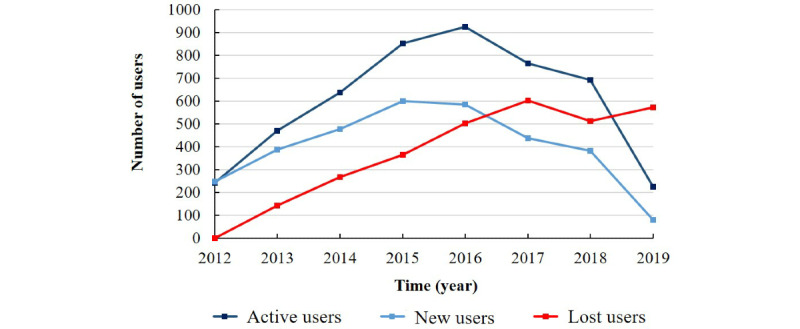
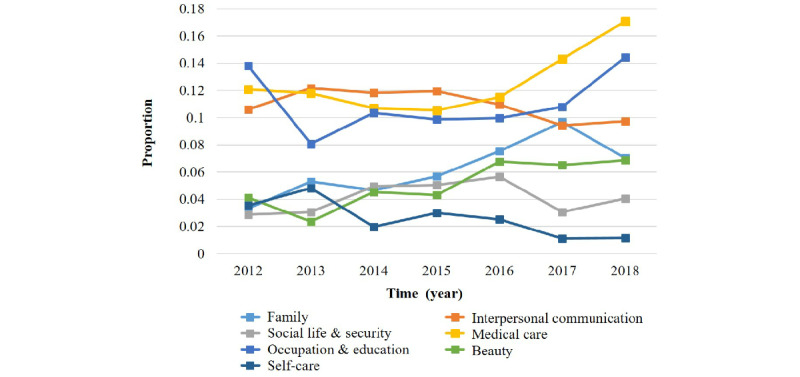
We identified 8 main topics discussed in the community: daily sharing, family, interpersonal communication, social life and security, medical care, occupation and education, beauty, and self-care. Among these topics, daily sharing represented the largest proportion of the discussions. From 2012 to 2019, the average degree and clustering coefficient of the albinism community continued to decline, while the network center transferred from core communities to core users. A total of 68.43% of the corpus was emotional, with 35.88% being positive and 32.55% negative. There were statistically significant differences in the distribution of sentiment polarity between topics (P<.001). Negative emotions were twice as high as positive emotions in the social life and security topic.
The study reveals insights into the emotions expressed by people with albinism in the Chinese OHC, Baidu Tieba, providing health care practitioners with greater appreciation of the current emotional support needed by patients and the patient experience. Current OHCs do not exert enough influence due to limited effective organization and development. Health care sectors should take greater advantage of OHCs to support vulnerable patients with rare diseases to meet their evidence-based needs.
目前存在6000多种罕见病,患病人数正在迅速增加。迄今为止,大多数研究都集中在罕见病的诊断、治疗和孤儿药研发上,而很少有研究探讨社交媒体平台上,尤其是在线健康社区(OHC)中,罕见病患者所表达的话题和情绪。
本研究旨在使用多种方法确定中国在线健康社区百度贴吧中白化病的话题分类和情感极性。通过主题挖掘、社会网络分析和情感极性分析对该在线健康社区进行深入挖掘。通过这些方法,我们确定了社区建设的现状,明确了白化病患者在日常生活中面临的持续需求和问题。
本研究以百度贴吧平台上的白化病社区作为数据源。使用词频-逆文档频率、潜在狄利克雷分配模型和朴素贝叶斯来挖掘各种主题类别。使用Gephi工具完成的社会网络分析用于分析白化病社区的演变。使用长短期记忆算法进行情感极性分析。
我们确定了社区中讨论的8个主要话题:日常分享、家庭、人际沟通、社会生活与安全、医疗保健、职业与教育、美容和自我护理。在这些话题中,日常分享占讨论的比例最大。从2012年到2019年,白化病社区的平均度和聚类系数持续下降,而网络中心从核心社区转移到了核心用户。语料库中共有68.43%带有情感,其中35.88%为积极情感,32.55%为消极情感。各话题之间的情感极性分布存在统计学显著差异(P<0.001)。在社会生活与安全话题中,消极情绪是积极情绪的两倍。
该研究揭示了中国在线健康社区百度贴吧中白化病患者所表达的情感,让医疗从业者更深入了解患者当前所需的情感支持和患者体验。当前的在线健康社区由于有效组织和发展有限而影响力不足。医疗保健部门应更好地利用在线健康社区来支持患有罕见病的弱势群体,以满足他们基于证据的需求。