Management Sciences for Health (MSH), Challenge TB Project, Addis Ababa, Ethiopia.
Harari Health Bureau, Harar, Ethiopia.
PLoS One. 2020 May 29;15(5):e0233730. doi: 10.1371/journal.pone.0233730. eCollection 2020.
To determine the yield of tuberculosis (TB) and the prevalence of Human Immuno-deficiency virus (HIV) among key populations in the selected hotspot towns of Ethiopia.
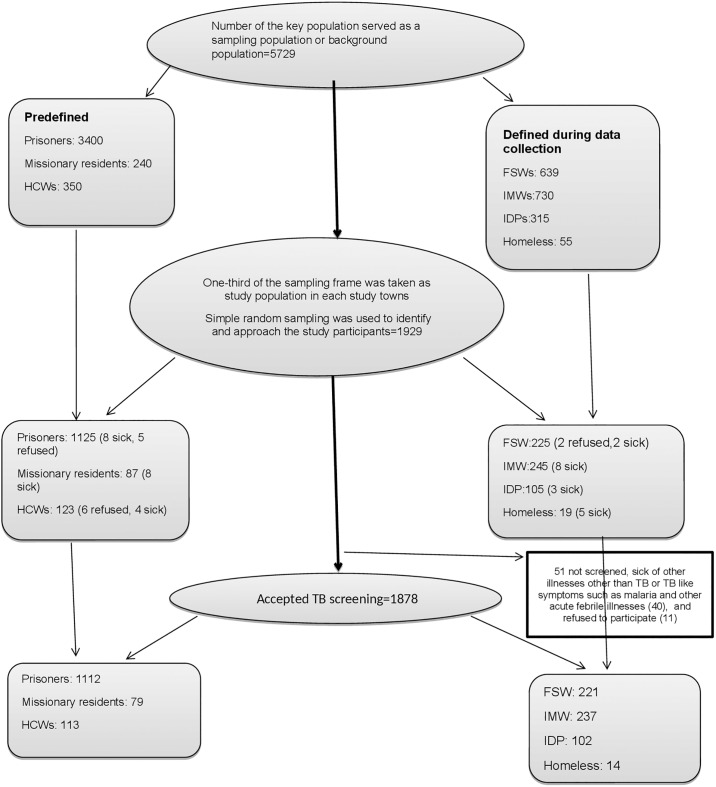
We undertook a cross-sectional implementation research during August 2017-January 2018. Trained TB focal persons and health extension workers (HEWs) identified female sex workers (FSWs), health care workers (HCWs), prison inmates, homeless, internally displaced people (IDPs), internal migratory workers (IMWs) and residents in missionary charities as key and vulnerable popuaiton. They carried out health education on the importance of TB screening and HIV testing prior to recruitment of the study participants. Symptomatic TB screening and HIV testing was done. The yield of TB was computed per 100,000 background key population.
A total of 1878 vulnerable people were screened, out of which 726 (38.7%) presumptive TB cases and 87 (4.6%) TB cases were identified. The yield of TB was 1519 (95% CI: 1218.1-1869.9). The highest proportion (19.5%) and yield of TB case (6,286 (95% CI: 3980.8-9362.3)) was among HCWs. The prevalence of HIV infection was 6%, 67 out of 1,111 tested. IMWs and FSWs represented 49.3% (33) and 28.4% (13) of the HIV infections, respectively. There was a statistically significant association of active TB cases with previous history of TB (Adjusted Odds Ratio (AOR): 11 95% CI, 4.06-29.81), HIV infection (AOR: 7.7 95% CI, 2.24-26.40), and being a HCW (AOR: 2.42 95% CI, 1.09-5.34).
The prevalence of TB in key populations was nine times higher than 164/100,000 national estimated prevalence rate. The prevalence of HIV was five times higher than 1.15% of the national survey. The highest yield of TB was among the HCWs and the high HIV burden was detected among the FSWs and IMWs. These suggest a community and health facility based integrated and enhanced case finding approaches for TB and HIV in hotspot settings.
确定选定热点城镇埃塞俄比亚的重点人群中的结核病(TB)发病率和人类免疫缺陷病毒(HIV)流行率。
我们在 2017 年 8 月至 2018 年 1 月期间进行了一项横断面实施研究。经过培训的结核病焦点人员和卫生推广工作者(HEWs)确定了女性性工作者(FSWs)、卫生保健工作者(HCWs)、囚犯、无家可归者、国内流离失所者(IDPs)、国内移民工人(IMWs)和传教慈善机构居民为关键和弱势群体。他们在招募研究参与者之前,就结核病筛查和 HIV 检测的重要性对他们进行了健康教育。对有症状的结核病进行了筛查和 HIV 检测。每 10 万背景重点人群中计算了结核病的发病率。
共筛查了 1878 名弱势群体,其中 726 例(38.7%)疑似结核病病例和 87 例(4.6%)结核病病例。结核病发病率为 1519(95%CI:1218.1-1869.9)。结核病发病率最高的是 HCWs(19.5%)和结核病发病率(6,286(95%CI:3980.8-9362.3))。HIV 感染率为 6%,111 人检测到 67 人。IMWs 和 FSWs 分别占 HIV 感染的 49.3%(33 人)和 28.4%(13 人)。活动性结核病病例与既往结核病病史(调整后的优势比(AOR):11 95%CI,4.06-29.81)、HIV 感染(AOR:7.7 95%CI,2.24-26.40)和 HCW (AOR:2.42 95%CI,1.09-5.34)之间存在统计学显著关联。
重点人群中的结核病患病率是全国估计患病率 164/100,000 的九倍。HIV 流行率是全国调查的 1.15%的五倍。结核病发病率最高的是 HCWs,而 HIV 负担最高的是 FSWs 和 IMWs。这表明在热点地区需要采用社区和卫生机构为基础的综合强化病例发现方法来治疗结核病和艾滋病。