Department of Urology, Changhai Hospital, Naval Medical University, Shanghai, China.
Bristol Urological Institute, Southmead Hospital, Bristol, UK.
BJU Int. 2020 Oct;126(4):472-480. doi: 10.1111/bju.15126. Epub 2020 Jul 24.
To characterise the clinical features and to discover predictive factors of adult males with nocturnal enuresis (NE).
A total of 43 eligible adult male patients (mean age was 57.8 years) were recruited prospectively over a 2-year period. After documentation of medical history, lower urinary tract symptoms (LUTS) were assessed using the International Consultation on Incontinence Modular Questionnaire-male LUTS (ICIQ-MLUTS), and a 3-day ICIQ-bladder diary (ICIQ-BD). Video-urodynamic studies (VUDS) were conducted conforming to the International Continence Society standards. Univariate and multivariate linear regressions were performed to determine potential predictive factors.
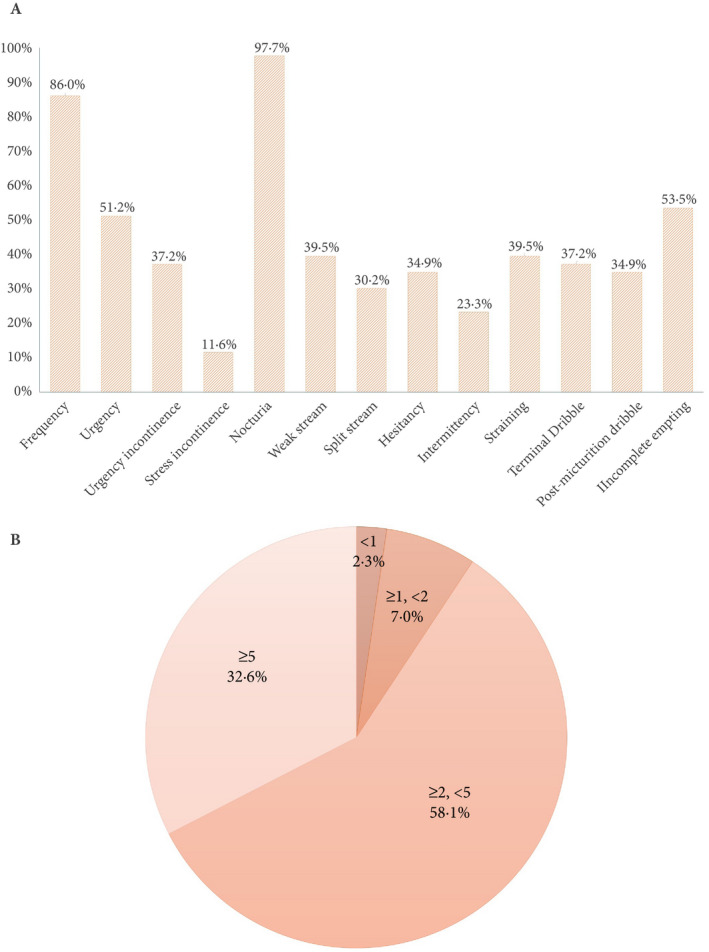
Patients with NE had a variety of LUTS and had a high incidence of obesity and comorbidities. On the ICIQ-BD, NE was associated with nocturnal polyuria (NP), reduced nocturnal bladder capacity (NBC), or a combination of both. Subgroup analysis indicated that patients with more frequent NE had: higher body mass index (BMI); more comorbidities; reduced daytime urinary frequency and urgency quality of life (QoL) sub-scores; and increased stress urinary incontinence (SUI) and nocturnal bedwetting sub-scores. Patients with reduced NBC only, had fewer NE episodes, while patients with NP, or with both NP and reduced NBC were more likely have frequent NE. Multivariate analysis confirmed that: BMI; neurogenic causes; sub-scores of SUI QoL and bedwetting domain; the presence of reduced NBC, and both NP and reduced NBC; and bladder outlet obstruction, were all independent predictive factors for the severity of NE.
NE n the adult male should be systemically assessed and treated, as obesity, neurogenic disorders, excessive urine production, bladder storage and emptying dysfunctions are risk factors. Bladder diaries and VUDS provide valuable information on potential pathophysiological causes, which could assist clinical evaluation and selection of focussed treatment.
描述成年男性遗尿症(NE)患者的临床特征,并发现其预测因素。
在为期 2 年的时间里,前瞻性地招募了 43 名符合条件的成年男性患者(平均年龄为 57.8 岁)。在记录病史后,使用国际尿控协会男性下尿路症状(LUTS)问卷模块(ICIQ-MLUTS)和 3 天的 ICIQ 膀胱日记(ICIQ-BD)评估下尿路症状(LUTS)。按照国际尿控协会的标准进行视频尿动力学研究(VUDS)。进行单变量和多变量线性回归以确定潜在的预测因素。
NE 患者有多种 LUTS,肥胖和合并症的发生率较高。在 ICIQ-BD 上,NE 与夜间多尿(NP)、夜间膀胱容量减少(NBC)或两者兼有有关。亚组分析表明,NE 发作更频繁的患者:BMI 更高;合并症更多;白天尿频率和尿急生活质量(QoL)亚评分降低;压力性尿失禁(SUI)和夜间遗尿亚评分增加。仅 NBC 减少的患者 NE 发作次数较少,而 NP 或 NP 伴 NBC 减少的患者更有可能出现频繁的 NE。多变量分析证实:BMI;神经源性病因;SUI QoL 和尿床域的亚评分;NBC 减少,以及 NP 和 NBC 减少的存在;以及膀胱出口梗阻,都是 NE 严重程度的独立预测因素。
对于成年男性的 NE 应进行系统评估和治疗,因为肥胖、神经源性疾病、过多的尿液产生、膀胱储存和排空功能障碍都是危险因素。膀胱日记和 VUDS 提供了潜在病理生理原因的有价值信息,可协助临床评估和选择针对性治疗。