Centre for Psychiatry Research, Department of Clinical Neuroscience, Karolinska Institutet and Stockholm Health Care Services, Region Stockholm, Sweden.
Department of Clinical Neuroscience, Karolinska Institutet, Stockholm, Sweden.
Transl Psychiatry. 2020 Jun 1;10(1):159. doi: 10.1038/s41398-020-0844-4.
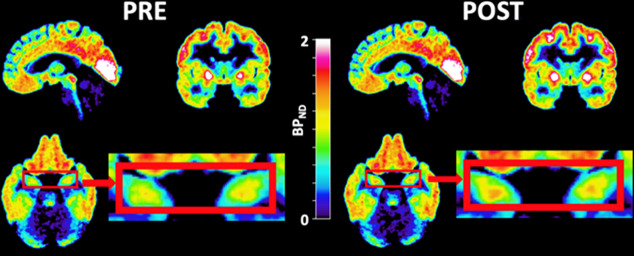
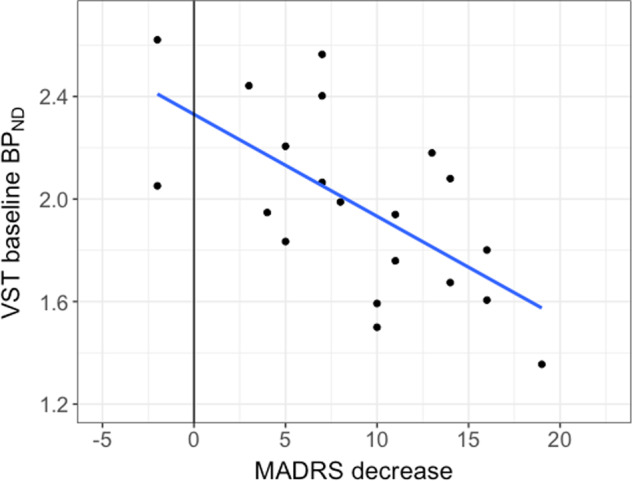
The glutamate N-methyl-D-aspartate receptor antagonist ketamine has a rapid antidepressant effect. Despite large research efforts, ketamine's mechanism of action in major depressive disorder (MDD) has still not been determined. In rodents, the antidepressant properties of ketamine were found to be dependent on both the α-amino-3-hydroxy-5-methylisoxazole-4-propionic acid (AMPA) and the serotonin (5-HT) receptor. Low 5-HT receptor binding in limbic brain regions is a replicated finding in MDD. In non-human primates, AMPA-dependent increase in 5-HT receptor binding in the ventral striatum (VST) has been demonstrated after ketamine infusion. Thirty selective serotonin reuptake inhibitor-resistant MDD patients were recruited via advertisement and randomized to double-blind monotherapy with 0.5 mg/kg ketamine or placebo infusion. The patients were examined with the 5-HT receptor selective radioligand [C]AZ10419369 and positron emission tomography (PET) before and 24-72 h after treatment. 5-HT receptor binding did not significantly alter in patients treated with ketamine compared with placebo. An increase in 5-HT receptor binding with 16.7 % (p = 0.036) was found in the hippocampus after one ketamine treatment. 5-HT receptor binding in VST at baseline correlated with MDD symptom ratings (r = -0.426, p = 0.019) and with reduction of depressive symptoms with ketamine (r = -0.644, p = 0.002). In conclusion, reduction of depressive symptoms in MDD patients after ketamine treatment is correlated inversely with baseline 5-HT receptor binding in VST. Further studies examining the role of 5-HT receptors in the antidepressant mechanism of action of ketamine should be conducted, homing in on the 5-HT receptor as an MDD treatment response marker.
谷氨酸 N-甲基-D-天冬氨酸受体拮抗剂氯胺酮具有快速抗抑郁作用。尽管进行了大量研究,但氯胺酮在重度抑郁症(MDD)中的作用机制仍未确定。在啮齿动物中,氯胺酮的抗抑郁特性被发现既依赖于α-氨基-3-羟基-5-甲基异恶唑-4-丙酸(AMPA)受体,也依赖于 5-羟色胺(5-HT)受体。在 MDD 中,发现边缘脑区的 5-HT 受体结合减少是一个被复制的发现。在非人类灵长类动物中,在氯胺酮输注后,腹侧纹状体(VST)中 AMPA 依赖性增加 5-HT 受体结合已经得到证明。通过广告招募了 30 名选择性 5-羟色胺再摄取抑制剂抵抗的 MDD 患者,并随机分为接受 0.5mg/kg 氯胺酮或安慰剂输注的双盲单药治疗。在治疗前和治疗后 24-72 小时,患者接受 5-HT 受体选择性放射性配体 [C]AZ10419369 和正电子发射断层扫描(PET)检查。与安慰剂相比,接受氯胺酮治疗的患者 5-HT 受体结合没有明显改变。单次氯胺酮治疗后,海马体 5-HT 受体结合增加 16.7%(p=0.036)。VST 中的 5-HT 受体结合在基线时与 MDD 症状评分相关(r=-0.426,p=0.019),与氯胺酮减轻抑郁症状相关(r=-0.644,p=0.002)。总之,MDD 患者在接受氯胺酮治疗后抑郁症状的减轻与 VST 中 5-HT 受体结合呈负相关。应进一步研究 5-HT 受体在氯胺酮抗抑郁作用机制中的作用,将 5-HT 受体作为 MDD 治疗反应标志物。