Robert Steiner MR Unit, Psychiatric Imaging Group, MRC London Institute of Medical Sciences (LMS), Hammersmith Hospital, London, UK.
Psychiatric Imaging Group, Faculty of Medicine, MRC London Institute of Medical Sciences (LMS), Imperial College London, London, UK.
Mol Psychiatry. 2018 Jan;23(1):59-69. doi: 10.1038/mp.2017.190. Epub 2017 Oct 3.
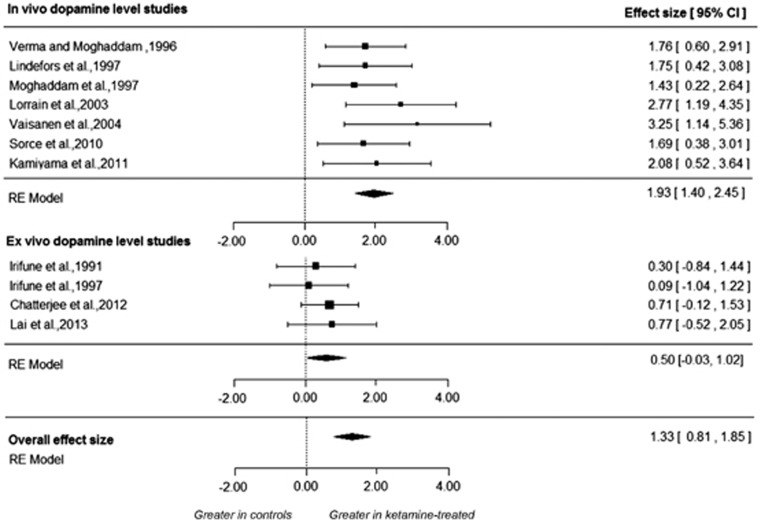
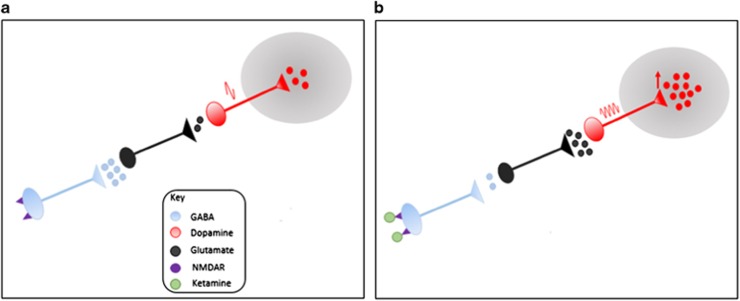
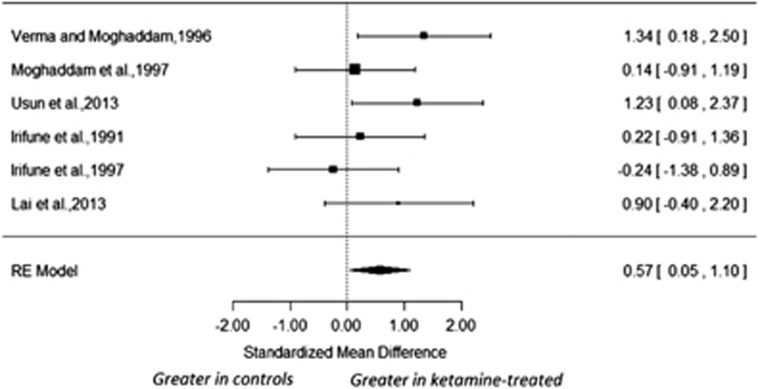
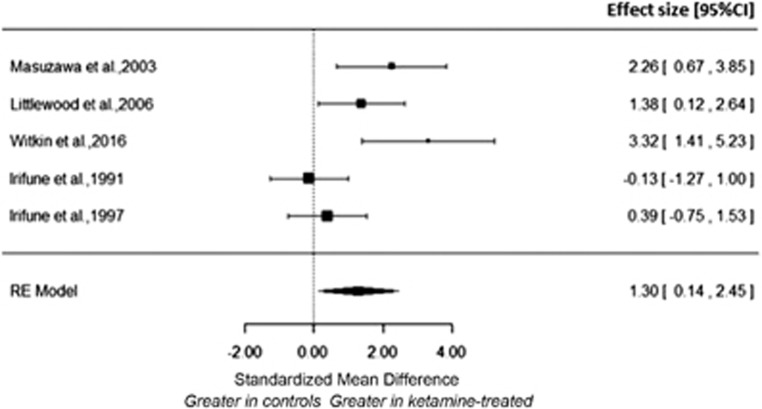
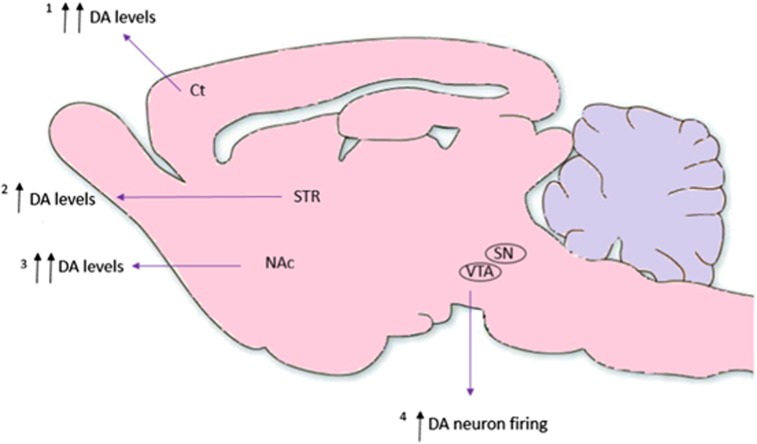
Ketamine is a non-competitive antagonist at the N-methyl-d-aspartate receptor. It has recently been found to have antidepressant effects and is a drug of abuse, suggesting it may have dopaminergic effects. To examine the effect of ketamine on the dopamine systems, we carried out a systematic review and meta-analysis of dopamine measures in the rodent, human and primate brain following acute and chronic ketamine administration relative to a drug-free baseline or control condition. Systematic search of PubMed and PsychInfo electronic databases yielded 40 original peer-reviewed studies. There were sufficient rodent studies of the acute effects of ketamine at sub-anaesthetic doses for meta-analysis. Acute ketamine administration in rodents is associated with significantly increased dopamine levels in the cortex (Hedge's g= 1.33, P<0.01), striatum (Hedge's g=0.57, P<0.05) and the nucleus accumbens (Hedge's g=1.30, P<0.05) compared to control conditions, and 62-180% increases in dopamine neuron population activity. Sub-analysis indicated elevations were more marked in in vivo (g=1.93) than ex vivo (g=0.50) studies. There were not enough studies for meta-analysis in other brain regions studied (hippocampus, ventral pallidum and cerebellum), or of the effects of chronic ketamine administration, although consistent increases in cortical dopamine levels (from 88 to 180%) were reported in the latter studies. In contrast, no study showed an effect of anaesthetic doses (>100 mg kg) of ketamine on dopamine levels ex vivo, although this remains to be tested in vivo. Findings in non-human primates and in human studies using positron emission tomography were not consistent. The studies reviewed here provide evidence that acute ketamine administration leads to dopamine release in the rodent brain. We discuss the inter-species variation in the ketamine induced dopamine release as well as the implications for understanding psychiatric disorders, in particular substance abuse, schizophrenia, and the potential antidepressant properties of ketamine, and comparisons with stimulants and other NMDA antagonists. Finally we identify future research needs.
氯胺酮是非竞争性 N-甲基-D-天冬氨酸受体拮抗剂。最近发现其具有抗抑郁作用,且是一种滥用药物,这表明它可能具有多巴胺能作用。为了研究氯胺酮对多巴胺系统的影响,我们对急性和慢性氯胺酮给药后啮齿动物、人类和灵长类动物大脑中的多巴胺测量值进行了系统评价和荟萃分析,将其与无药物基线或对照条件进行了比较。系统地搜索了 PubMed 和 PsychInfo 电子数据库,共获得了 40 项原始同行评议研究。有足够的啮齿动物研究表明,亚麻醉剂量的氯胺酮具有急性作用,可进行荟萃分析。与对照条件相比,急性氯胺酮给药可使皮质(Hedge's g=1.33,P<0.01)、纹状体(Hedge's g=0.57,P<0.05)和伏隔核(Hedge's g=1.30,P<0.05)中的多巴胺水平显著升高,多巴胺神经元群体活动增加 62-180%。亚分析表明,体内研究(g=1.93)比体外研究(g=0.50)的升高更为明显。在其他研究的脑区(海马体、腹侧苍白球和小脑),或慢性氯胺酮给药的影响方面,没有足够的研究进行荟萃分析,尽管在后一项研究中报告了皮质多巴胺水平的持续升高(从 88%增加到 180%)。相比之下,没有研究表明麻醉剂量(>100mg/kg)的氯胺酮对体外多巴胺水平有影响,尽管这在体内仍有待测试。非人类灵长类动物和使用正电子发射断层扫描的人类研究的结果并不一致。本文综述的研究提供了证据表明,急性氯胺酮给药可导致啮齿动物大脑中的多巴胺释放。我们讨论了不同物种之间氯胺酮诱导的多巴胺释放的差异,以及对理解精神疾病的影响,特别是物质滥用、精神分裂症,以及氯胺酮潜在的抗抑郁作用,以及与兴奋剂和其他 NMDA 拮抗剂的比较。最后,我们确定了未来的研究需求。