Cai Xin-Yi, Sun Meng-Si, Huang Yun-Peng, Liu Zi-Xuan, Liu Chun-Jie, Du Cheng-Fei, Yang Qiang
Tianjin Key Laboratory for Advanced Mechatronic System Design and Intelligent Control, School of Mechanical Engineering, Tianjin University of Technology, Tianjin, China.
National Demonstration Center for Experimental Mechanical and Electrical Engineering Education, Tianjin University of Technology, Tianjin, China.
Orthop Surg. 2020 Jun;12(3):917-930. doi: 10.1111/os.12703. Epub 2020 May 31.
To ascertain the biomechanical effects of a degenerated L -L segment on the lower lumbar spine through a comprehensive simulation of disc degeneration.
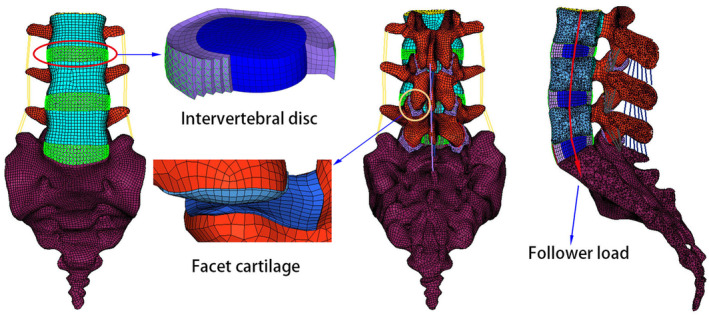
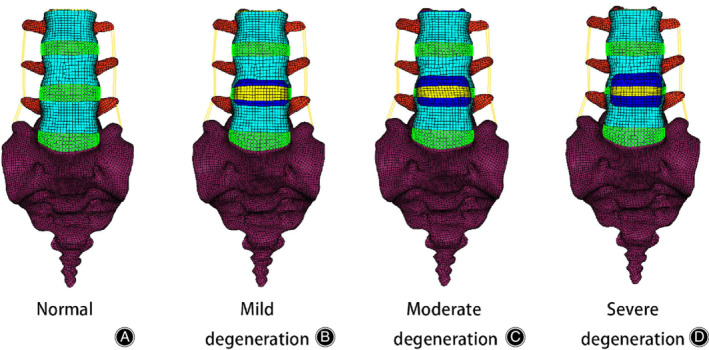
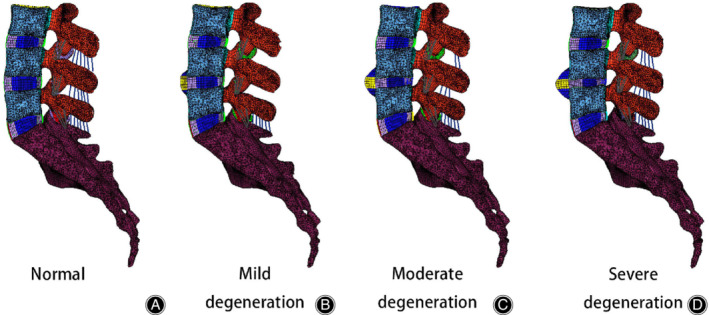
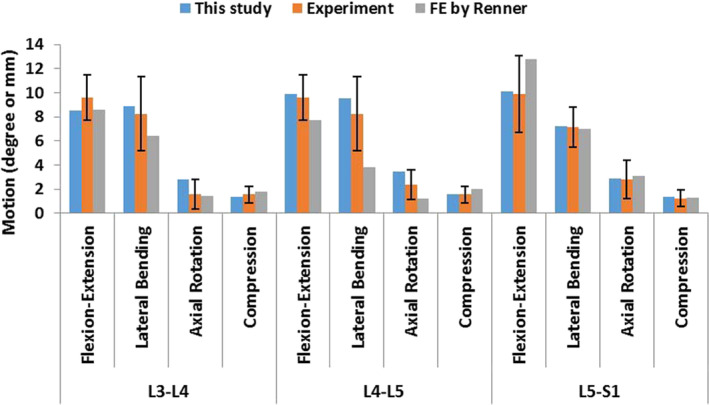
A three-dimensional nonlinear finite element model of a normal L -S lumbar spine was constructed and validated. This normal model was then modified such that three degenerated models with different degrees of degeneration (mild, moderate, or severe) at the L -L level were constructed. While experiencing a follower compressive load (500 N), hybrid moment loads were applied to all models to determine range of motion (ROM), intradiscal pressure (IDP), maximum von Mises stress in the annulus, maximum shear stress in the annulus, and facet joint force.
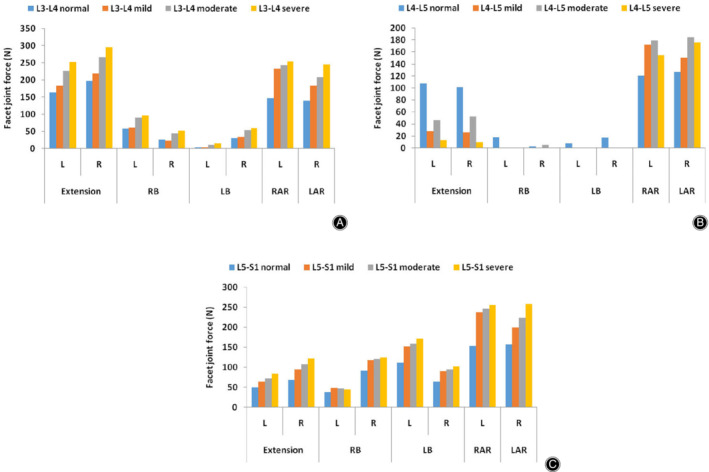
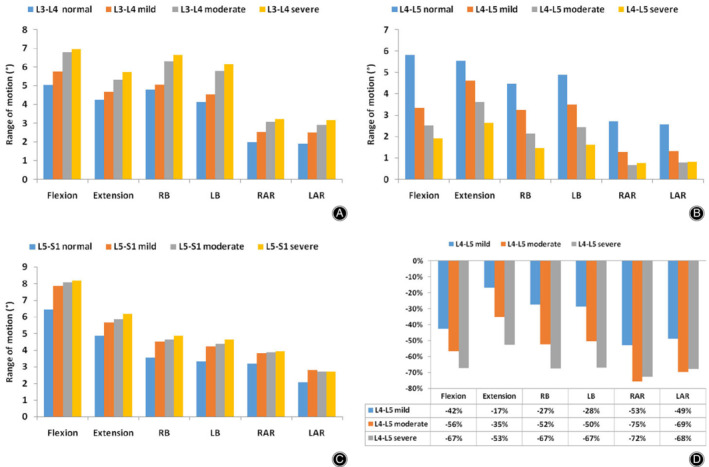
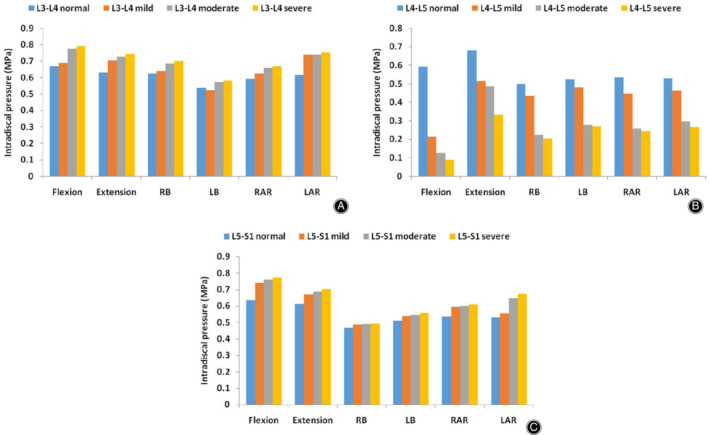
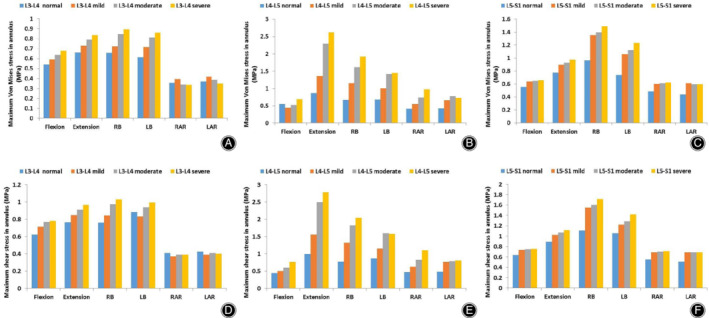
As the degree of disc degeneration increased, the ROM of the L -L degenerated segment declined dramatically in all postures (flexion: 5.79°-1.91°; extension: 5.53°-2.62°; right lateral bending: 4.47°-1.46°; left lateral bending: 4.86°-1.61°; right axial rotation: 2.69°-0.74°; left axial rotation: 2.69°-0.74°), while the ROM in adjacent segments increased (1.88°-8.19°). The largest percent decrease in motion of the L -L segment due to disc degeneration was in right axial rotation (75%), left axial rotation (69%), flexion (67%), right lateral bending (67%), left lateral bending right (67%), and extension (53%). The change in the trend of the IDP was the same as that of the ROM. Specifically, the IDP decreased (flexion: 0.592-0.09 MPa; extension: 0.678-0.334 MPa; right lateral bending: 0.498-0.205 MPa; left lateral bending: 0.523-0.272 MPa; right axial rotation: 0.535-0.246 MPa; left axial rotation: 0.53-0.266 MPa) in the L -L segment, while the IDP in adjacent segments increased (0.511-0.789 MPa). The maximum von Mises stress and maximum shear stress of the annulus in whole lumbar spine segments increased (L -L segment: 0.413-2.626 MPa and 0.412-2.783 MPa, respectively; adjacent segment of L -L : 0.356-1.493 MPa and 0.359-1.718 MPa, respectively) as degeneration of the disc progressively increased. There was no apparent regularity in facet joint force in the degenerated segment as the degree of disc degeneration increased. Nevertheless, facet joint forces in adjacent healthy segments increased as the degree of disc degeneration increased (extension: 49.7-295.3 N; lateral bending: 3.5-171.2 N; axial rotation: 140.2-258.8 N).
Degenerated discs caused changes in the motion and loading pattern of the degenerated segments and adjacent normal segments. The abnormal load and motion in the degenerated models risked accelerating degeneration in the adjacent normal segments. In addition, accurate simulation of degenerated facet joints is essential for predicting changes in facet joint loads following disc degeneration.
通过对椎间盘退变的全面模拟,确定L₄-L₅节段退变对下腰椎的生物力学影响。
构建并验证正常L₄-S₁腰椎的三维非线性有限元模型。然后对该正常模型进行修改,构建在L₄-L₅水平具有不同退变程度(轻度、中度或重度)的三个退变模型。在承受随动压缩载荷(500 N)的同时,对所有模型施加混合弯矩载荷,以确定活动范围(ROM)、椎间盘内压力(IDP)、纤维环最大von Mises应力、纤维环最大剪应力和小关节力。
随着椎间盘退变程度的增加,L₄-L₅退变节段在所有姿势下的ROM均显著下降(前屈:5.79°-1.91°;后伸:5.53°-2.62°;右侧弯:4.47°-1.46°;左侧弯:4.86°-1.61°;右侧轴向旋转:2.69°-0.74°;左侧轴向旋转:2.69°-0.74°),而相邻节段的ROM增加(1.88°-8.19°)。由于椎间盘退变导致L₄-L₅节段运动减少的最大百分比出现在右侧轴向旋转(75%)、左侧轴向旋转(69%)、前屈(67%)、右侧弯(67%)、左侧弯(67%)和后伸(53%)。IDP的变化趋势与ROM相同。具体而言,L₄-L₅节段的IDP下降(前屈:0.592-0.09 MPa;后伸:0.678-0.334 MPa;右侧弯:0.498-0.205 MPa;左侧弯:0.523-0.272 MPa;右侧轴向旋转:0.535-0.246 MPa;左侧轴向旋转:0.53-0.266 MPa),而相邻节段的IDP增加(0.511-0.789 MPa)。随着椎间盘退变逐渐加重,整个腰椎节段纤维环的最大von Mises应力和最大剪应力增加(L₄-L₅节段:分别为0.413-2.626 MPa和0.412-2.783 MPa;L₄-L₅相邻节段:分别为0.356-1.493 MPa和0.359-1.718 MPa)。随着椎间盘退变程度的增加,退变节段的小关节力没有明显规律。然而,随着椎间盘退变程度的增加,相邻健康节段的小关节力增加(后伸:49.7-295.3 N;侧弯:3.5-171.2 N;轴向旋转:140.2-258.8 N)。
退变椎间盘导致退变节段及相邻正常节段的运动和负荷模式发生改变。退变模型中的异常负荷和运动有加速相邻正常节段退变的风险。此外,准确模拟退变小关节对于预测椎间盘退变后小关节负荷的变化至关重要。