Department of Gastroenterology, The First Affiliated Hospital of Nanchang University, Nanchang 330006, Jiangxi Province, China.
World J Gastroenterol. 2020 May 14;26(18):2187-2193. doi: 10.3748/wjg.v26.i18.2187.
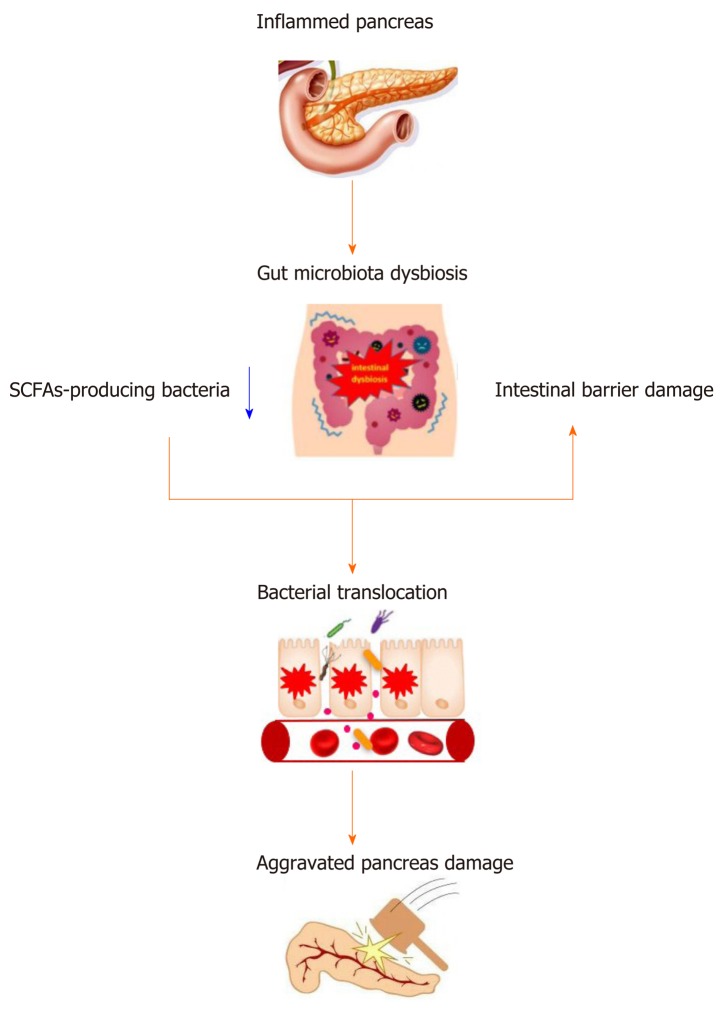
Acute pancreatitis (AP) is a common gastrointestinal disorder. Approximately 15%-20% of patients develop severe AP. Systemic inflammatory response syndrome and multiple organ dysfunction syndrome may be caused by the massive release of inflammatory cytokines in the early stage of severe AP, followed by intestinal dysfunction and pancreatic necrosis in the later stage. A study showed that 59% of AP patients had associated intestinal barrier injury, with increased intestinal mucosal permeability, leading to intestinal bacterial translocation, pancreatic tissue necrosis and infection, and the occurrence of multiple organ dysfunction syndrome. However, the real effect of the gut microbiota and its metabolites on intestinal barrier function in AP remains unclear. This review summarizes the alterations in the intestinal flora and its metabolites during AP development and progression to unveil the mechanism of gut failure in AP.
急性胰腺炎(AP)是一种常见的胃肠道疾病。约 15%-20%的患者会发展为重症 AP。重症 AP 早期大量炎症细胞因子的释放可导致全身炎症反应综合征和多器官功能障碍综合征,后期则出现肠道功能障碍和胰腺坏死。有研究显示,59%的 AP 患者存在相关的肠道屏障损伤,表现为肠黏膜通透性增加,导致肠道细菌易位、胰腺组织坏死和感染,以及多器官功能障碍综合征的发生。然而,肠道菌群及其代谢物对 AP 肠道屏障功能的真正影响尚不清楚。本综述总结了 AP 发展和进展过程中肠道菌群及其代谢物的变化,以期揭示 AP 中肠道衰竭的发生机制。