Di Pino Giovanni, Romano Daniele, Spaccasassi Chiara, Mioli Alessandro, D'Alonzo Marco, Sacchetti Rinaldo, Guglielmelli Eugenio, Zollo Loredana, Di Lazzaro Vincenzo, Denaro Vincenzo, Maravita Angelo
Research Unit of Neurophysiology and Neuroengineering of Human-Technology Interaction (NeXTlab), Università Campus Bio-Medico di Roma, Rome, Italy.
Psychology Department & NeuroMi, Milan Center for Neuroscience, University of Milan-Bicocca, Milan, Italy.
Front Neurosci. 2020 May 7;14:389. doi: 10.3389/fnins.2020.00389. eCollection 2020.
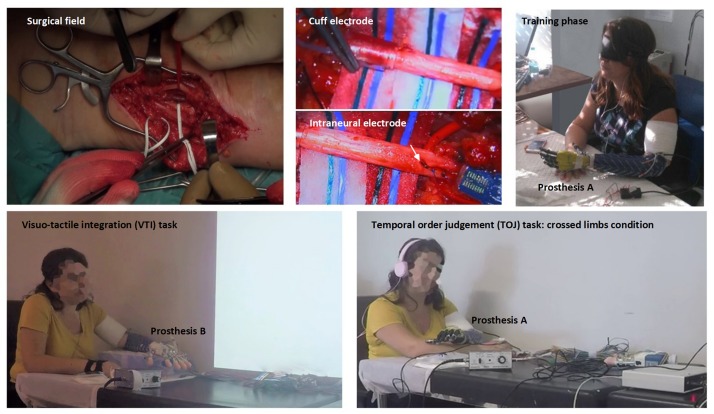
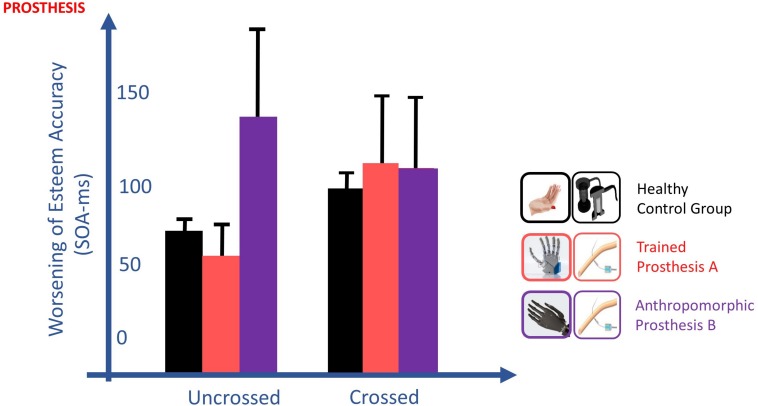
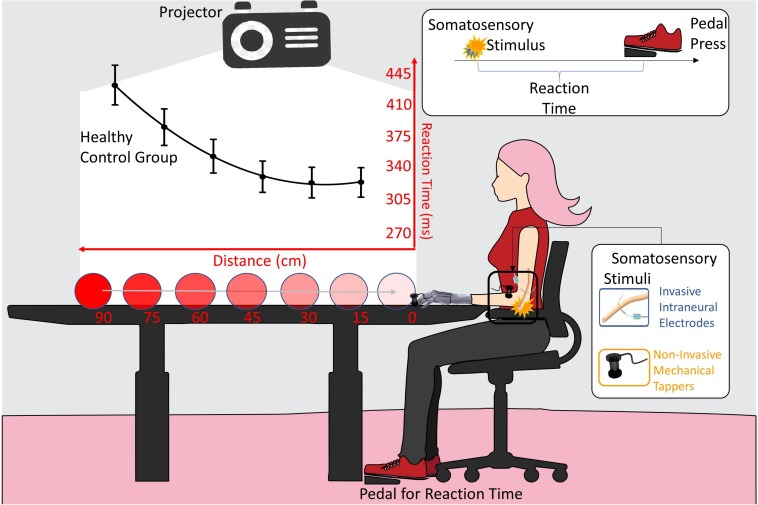
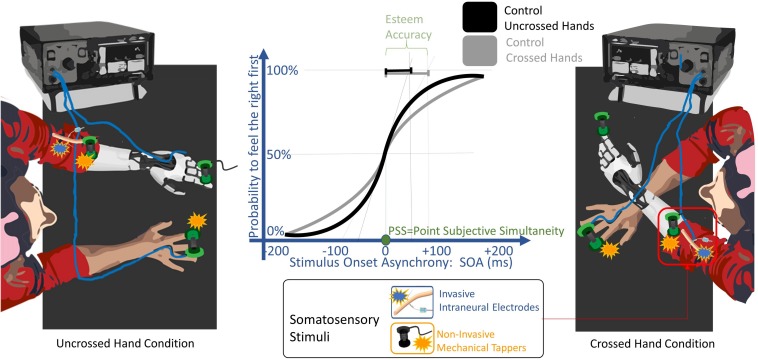
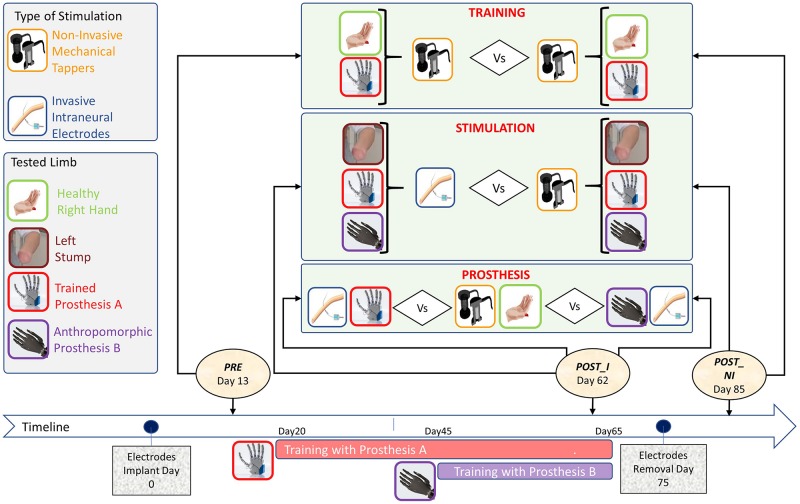
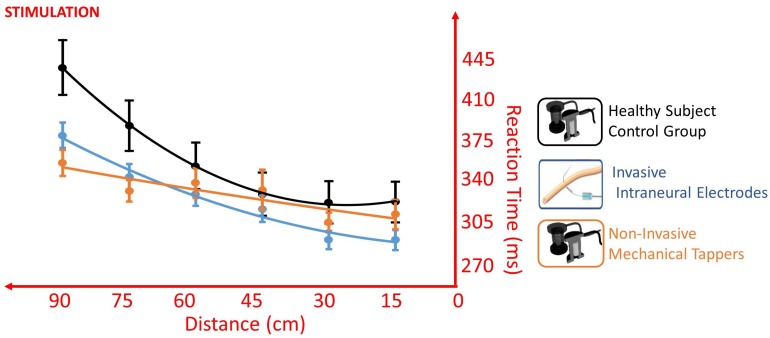
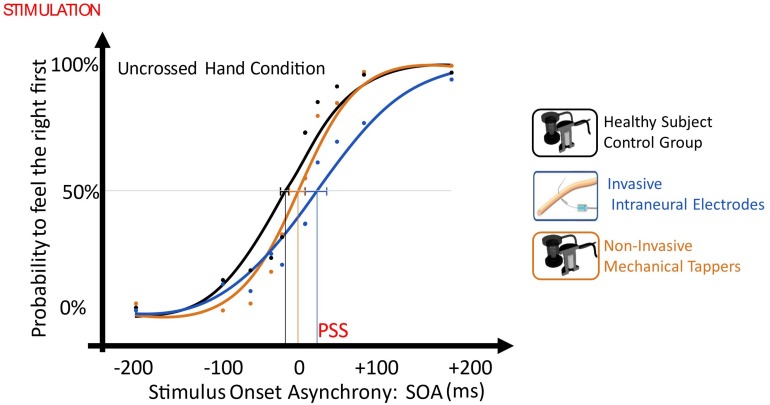
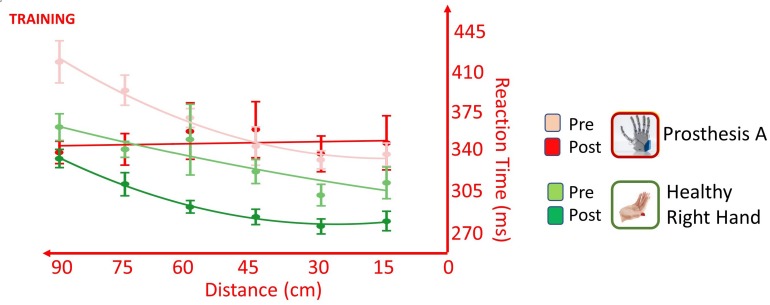
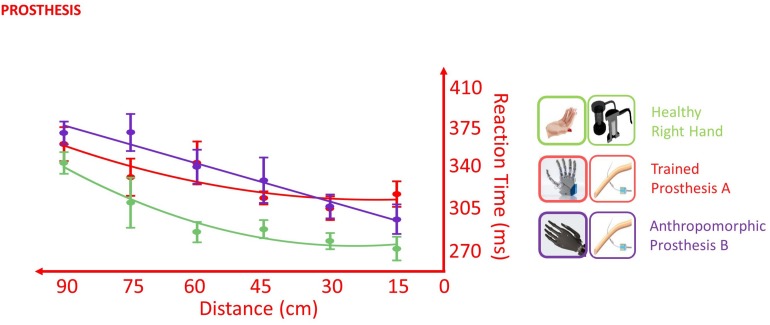
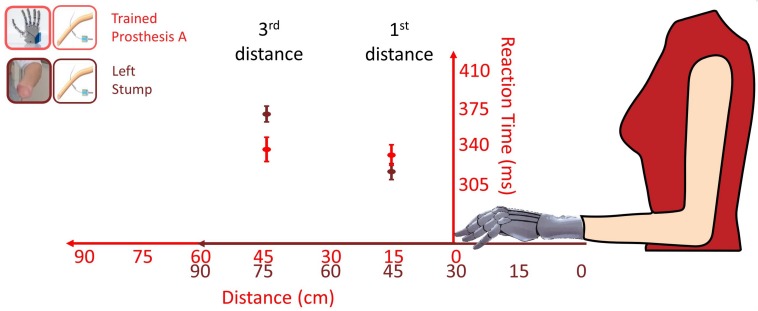
Embodiment is the percept that something not originally belonging to the self becomes part of the body. Feeling embodiment for a prosthesis may counteract amputees' altered image of the body and increase prosthesis acceptability. Prosthesis embodiment has been studied longitudinally in an amputee receiving feedback through intraneural and perineural multichannel electrodes implanted in her stump. Three factors-invasive (vs non-invasive) stimulation, training, and anthropomorphism-have been tested through two multisensory integration tasks: visuo-tactile integration (VTI) and crossing-hand effect in temporal order judgment (TOJ), the former more sensible to an extension of a safe margin around the body and the latter to action-oriented remapping. Results from the amputee participant were compared with the ones from healthy controls. Testing the participant with intraneural stimulation produced an extension of peripersonal space, a sign of prosthesis embodiment. One-month training extended the peripersonal space selectively on the side wearing the prostheses. More and less-anthropomorphic prostheses benefited of intraneural feedback and extended the peripersonal space. However, the worsening of TOJ performance following arm crossing was present only wearing the more trained, despite less anthropomorphic, prosthesis, suggesting that training was critical for our participant to achieve operative tool-like embodiment.
具身化是指原本不属于自我的事物成为身体一部分的感知。对假肢产生具身化感觉可能会抵消截肢者身体形象的改变,并提高假肢的可接受性。在一名通过植入其残肢的神经内和神经周围多通道电极接收反馈的截肢者身上,对假肢具身化进行了纵向研究。通过两项多感官整合任务测试了三个因素——侵入性(与非侵入性)刺激、训练和拟人化:视觉触觉整合(VTI)和时间顺序判断(TOJ)中的交叉手效应,前者对身体周围安全边际的扩展更敏感,后者对以行动为导向的重新映射更敏感。将截肢参与者的结果与健康对照组的结果进行了比较。用神经内刺激测试参与者产生了个人空间的扩展,这是假肢具身化的一个迹象。为期一个月的训练为的训练选择性地扩展了佩戴假肢一侧的个人空间。拟人化程度较高和较低的假肢都受益于神经内反馈并扩展了个人空间。然而,只有佩戴训练程度更高、尽管拟人化程度较低的假肢时,手臂交叉后TOJ表现才会变差,这表明训练对于我们的参与者实现类似操作工具的具身化至关重要。