Raveendra Leena, Sidappa Harsha, Shree Sapna
Rajarajeswari Medical College and Hospital, Kambipura, Kengeri Hobli, Mysore Road, Karnataka, India.
CUTIS Academy of Cutaneous Sciences, 5/1, 4th Main, MRCR Layout, Vijaynagar, Magadi Main Rd, Govindaraja Nagar Ward, MC Layout, Vijayanagar, Bengaluru, Karnataka, India.
Indian Dermatol Online J. 2020 Mar 9;11(2):154-157. doi: 10.4103/idoj.IDOJ_209_19. eCollection 2020 Mar-Apr.
Facial melanoses decreases the quality of life (QoL). Melasma is the commonest cause but there are various other etiologies for facial pigmentation.
To study the clinical profile of patients with facial melanoses and the psychological burden in these patients.
All patients having patchy or diffuse facial pigmentation attending the OPD in a tertiary care hospital for a period of 1 year were included in this hospital based cross-sectional study.
The type, extent, and distribution of the pigmentation was noted and tabulated in all patients. All patients were explained about Skindex-16 questionnaire and asked to complete it.
Student -test (two tailed, independent) was used to find the significance of study parameters on continuous scale between two groups. Chi-square/Fisher Exact test was used to find the significance of study parameters on categorical scale between two or more groups. Correlation was performed using Spearman corrélation.
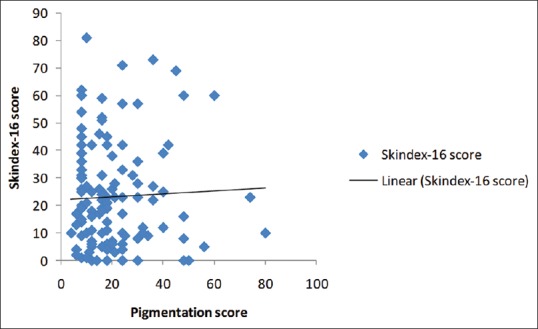
The total number of cases studied was 238 of which 186 (78.2%) were females and 52 (21.8%) were males. The most common diagnosis was melasma seen in 73% of cases. Other conditions noted were phototanning (5.8%), post-inflammatory hyperpigmentation (5.8%), Lichen planus pigmentosus (4.2%), freckles (3.7%), and Nevus of Ota (1.6%). Skindex-16 score against different grades of pigmentation showed that the mean Skindex-16 score was higher in severe cases but there was no statistically significant difference between the groups.
The extent and severity of facial pigmentation and the decrease in the QoL are not proportional.
面部色素沉着会降低生活质量(QoL)。黄褐斑是最常见的原因,但面部色素沉着还有多种其他病因。
研究面部色素沉着患者的临床特征以及这些患者的心理负担。
本医院横断面研究纳入了在一家三级医院门诊就诊、面部有斑片状或弥漫性色素沉着达1年的所有患者。
记录并列表所有患者色素沉着的类型、范围和分布情况。向所有患者解释Skindex - 16问卷,并要求他们完成该问卷。
采用学生t检验(双侧、独立样本)来确定两组间连续变量研究参数的显著性。采用卡方检验/费舍尔精确检验来确定两组或多组间分类变量研究参数的显著性。使用斯皮尔曼相关性分析进行相关性分析。
研究的病例总数为238例,其中女性186例(78.2%),男性52例(21.8%)。最常见的诊断是黄褐斑,占73%的病例。其他发现的情况有光晒黑(5.8%)、炎症后色素沉着(5.8%)、色素性扁平苔藓(4.2%)、雀斑(3.7%)和太田痣(1.6%)。针对不同色素沉着等级的Skindex - 16评分显示,严重病例的Skindex - 16平均评分较高,但两组间无统计学显著差异。
面部色素沉着的范围和严重程度与生活质量的降低不成正比。