La Roche-Posay Pharmaceutical Laboratories, Asnières, France.
Clin Cosmet Investig Dermatol. 2012;5:123-8. doi: 10.2147/CCID.S33172. Epub 2012 Sep 7.
Disfiguring dermatoses may have a significant impact on patients' quality of life, namely on their relationship with others, self image, and self esteem. Some previous studies have suggested that corrective foundation can improve the quality of life (QOL) of patients with facial dermatoses; in particular, in patients with acne vulgaris or pigmentary disorders.
The aim of this prospective study was to evaluate the impact of the skin conditions of patients with various skin diseases affecting their face (scars, acne, rosacea, melasma, vitiligo, hypo or hyperpigmentation, lentigines, etc) on their QOL and the improvement afforded by the use of corrective makeup for 1 month after being instructed on how to use it by a medical cosmetician during an initial medical consultation.
One hundred and twenty-nine patients with various skin diseases affecting the patients' face were investigated. The patients were instructed by a cosmetician on how to use corrective makeup (complexion, eyes, and lips) and applied it for 1 month. The safety of the makeup application was evaluated and the QOL was assessed via a questionnaire (DLQI) and using a 10-cm visual analog scale (VAS) completed before the first application and at the final visit. The amelioration of their appearance was documented by standardized photography.
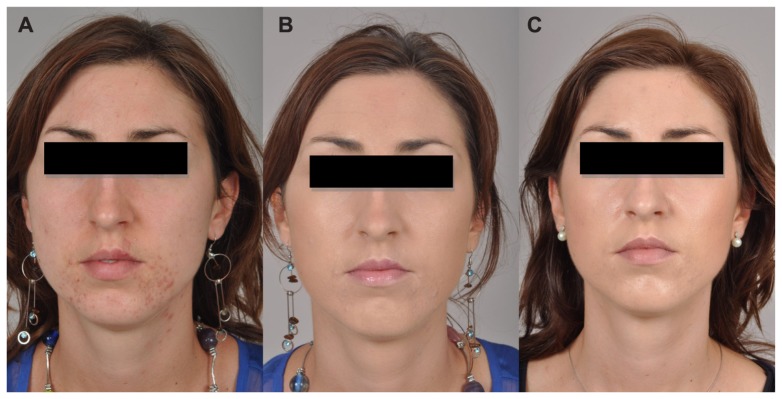
No side effects occurred during the course of the study. A comparison of the standardized photographs taken at each visit showed the patients' significant improvement in appearance due to the application of corrective makeup. The mean DLQI score dropped significantly from 9.90 ± 0.73 to 3.49 ± 0.40 (P < 0.0001).
Our results suggest that dermatologists should encourage patients with disfiguring dermatoses to utilize appropriate and safe makeup to improve their appearance and their QOL. Corrective makeup can also complement the treatment of face dermatological diseases in order to improve patient's adherence.
毁容性皮肤病会对患者的生活质量产生重大影响,尤其是对他们与他人的关系、自我形象和自尊心。一些先前的研究表明,矫正粉底可以改善面部皮肤病患者的生活质量(QOL);特别是在患有寻常痤疮或色素障碍的患者中。
本前瞻性研究旨在评估影响患有各种影响面部的皮肤病(疤痕、痤疮、酒渣鼻、黄褐斑、白癜风、色素减退或过度、雀斑等)的患者 QOL 的皮肤状况,并评估使用矫正化妆品在最初的医疗咨询中由医学美容师指导使用一个月后对患者的改善情况。
调查了 129 名患有各种影响面部的皮肤病的患者。美容师指导患者如何使用矫正化妆品(肤色、眼部和唇部),并使用一个月。评估了化妆品应用的安全性,并通过问卷调查(DLQI)和使用在第一次应用前和最后一次就诊时完成的 10 厘米视觉模拟量表(VAS)评估 QOL。通过标准化摄影记录他们外观的改善情况。
在研究过程中没有发生不良反应。每次就诊拍摄的标准化照片比较显示,患者因使用矫正化妆品而显著改善了外观。平均 DLQI 评分从 9.90 ± 0.73 显著降至 3.49 ± 0.40(P < 0.0001)。
我们的结果表明,皮肤科医生应鼓励毁容性皮肤病患者使用适当和安全的化妆品来改善他们的外表和他们的 QOL。矫正化妆也可以补充面部皮肤病的治疗,以提高患者的依从性。