Digital Health Section, Department of Health Technology, Technical University of Denmark, Kongens Lyngby, Denmark.
Copenhagen Center for Health Technology, Kongens Lyngby, Denmark.
JMIR Mhealth Uhealth. 2020 Jun 1;8(6):e17506. doi: 10.2196/17506.
Cognitive functioning plays a significant role in individuals' mental health, since fluctuations in memory, attention, and executive functions influence their daily task performance. Existing digital cognitive assessment tools cannot be administered in the wild and their test sets are not brief enough to capture frequent fluctuations throughout the day. The ubiquitous availability of mobile and wearable devices may allow their incorporation into a suitable platform for real-world cognitive assessment.
The aims of this study were threefold: (1) to evaluate a smartwatch-based tool for the assessment of cognitive performance, (2) to investigate the usability of this tool, and (3) to understand participants' perceptions regarding the application of a smartwatch in cognitive assessment.
We built the Ubiquitous Cognitive Assessment Tool (UbiCAT) on a smartwatch-based platform. UbiCAT implements three cognitive tests-an Arrow test, a Letter test, and a Color test-adapted from the two-choice reaction-time, N-back, and Stroop tests, respectively. These tests were designed together with domain experts. We evaluated the UbiCAT test measures against standard computer-based tests with 21 healthy adults by applying statistical analyses significant at the 95% level. Usability testing for each UbiCAT app was performed using the Mobile App Rating Scale (MARS) questionnaire. The NASA-TLX (Task Load Index) questionnaire was used to measure cognitive workload during the N-back test. Participants rated perceived discomfort of wearing a smartwatch during the tests using a 7-point Likert scale. Upon finishing the experiment, an interview was conducted with each participant. The interviews were transcribed and semantic analysis was performed to group the findings.
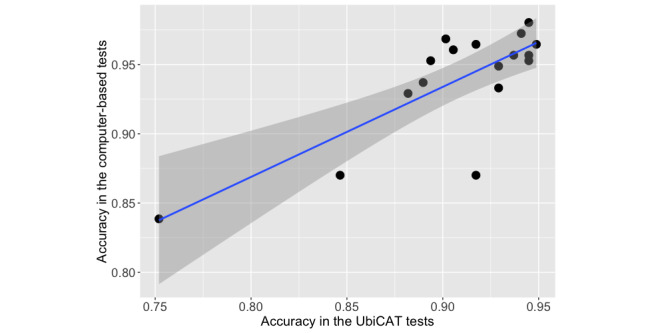
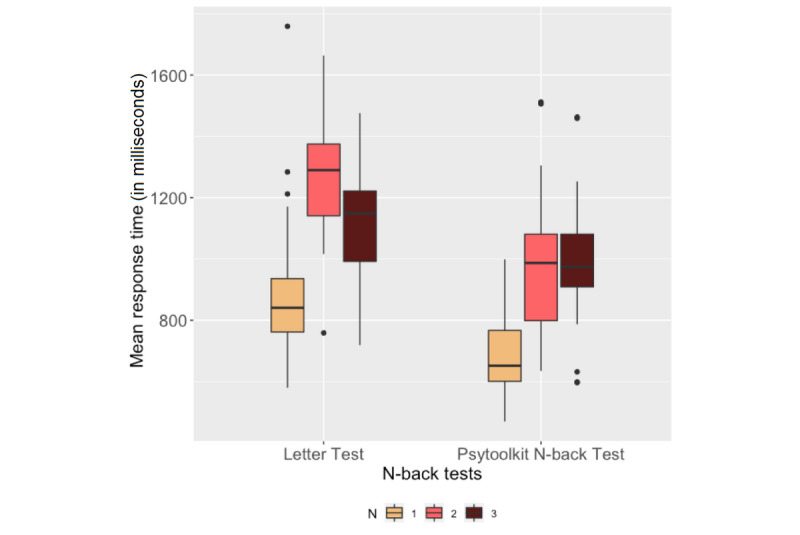
Pearson correlation analysis between the total correct responses obtained from the UbiCAT and the computer-based tests revealed a significant strong correlation (r=.78, P<.001). One-way analysis of variance (ANOVA) showed a significant effect of the N-back difficulty level on the participants' performance measures. The study also demonstrated usability ratings above 4 out of 5 in terms of aesthetics, functionality, and information. Low discomfort (<3 out of 7) was reported by our participants after using the UbiCAT. Seven themes were extracted from the transcripts of the interviews conducted with our participants.
UbiCAT is a smartwatch-based tool that assesses three key cognitive domains. Usability ratings showed that participants were engaged with the UbiCAT tests and did not feel any discomfort. The majority of the participants were interested in using the UbiCAT, although some preferred computer-based tests, which might be due to the widespread use of personal computers. The UbiCAT can be administered in the wild with mentally ill patients to assess their attention, working memory, and executive function.

认知功能在个体的心理健康中起着重要作用,因为记忆、注意力和执行功能的波动会影响他们的日常任务表现。现有的数字认知评估工具不能在野外使用,而且它们的测试集不够简短,无法捕捉一整天的频繁波动。移动和可穿戴设备的普遍可用性可能允许将其纳入适合现实世界认知评估的平台。
本研究旨在评估一种基于智能手表的认知性能评估工具,调查该工具的可用性,并了解参与者对智能手表在认知评估中应用的看法。
我们在基于智能手表的平台上构建了通用认知评估工具(UbiCAT)。UbiCAT 实现了三种认知测试-箭头测试、字母测试和颜色测试-分别改编自二择一反应时、N 回测试和斯特鲁普测试。这些测试是与领域专家一起设计的。我们通过应用统计学分析,将 UbiCAT 测试指标与 21 名健康成年人的标准计算机测试进行了对比,该分析在 95%的水平上具有显著意义。使用移动应用程序评级量表(MARS)问卷对每个 UbiCAT 应用程序进行了可用性测试。在 N 回测试期间,使用 NASA-TLX(任务负荷指数)问卷测量认知工作量。参与者使用 7 分制李克特量表对佩戴智能手表时的感知不适进行评分。完成实验后,对每位参与者进行了访谈。访谈记录并进行语义分析以分组发现。
UbiCAT 和基于计算机的测试的总正确反应之间的 Pearson 相关分析显示出显著的强相关性(r=.78,P<.001)。单因素方差分析(ANOVA)显示,N 回难度水平对参与者的表现有显著影响。研究还表明,在美学、功能和信息方面,用户对 UbiCAT 的评价均高于 4 分(满分 5 分)。我们的参与者报告使用 UbiCAT 后不适感较低(<3 分)。从对参与者进行的访谈记录中提取了 7 个主题。
UbiCAT 是一种基于智能手表的工具,可评估三个关键认知领域。可用性评分表明,参与者参与了 UbiCAT 测试,并且没有感到任何不适。大多数参与者对使用 UbiCAT 感兴趣,尽管一些参与者更喜欢基于计算机的测试,这可能是因为个人计算机的广泛使用。可以在野外对精神病患者使用 UbiCAT 来评估他们的注意力、工作记忆和执行功能。