• 文献检索
  • 文档翻译
  • 深度研究
  • 学术资讯
  • Suppr Zotero 插件Zotero 插件
  • 邀请有礼
  • 套餐&价格
  • 历史记录
应用&插件
Suppr Zotero 插件Zotero 插件浏览器插件Mac 客户端Windows 客户端微信小程序
定价
高级版会员购买积分包购买API积分包
服务
文献检索文档翻译深度研究API 文档MCP 服务
关于我们
关于 Suppr公司介绍联系我们用户协议隐私条款
关注我们

Suppr 超能文献

核心技术专利:CN118964589B侵权必究
粤ICP备2023148730 号-1Suppr @ 2026

文献检索

告别复杂PubMed语法,用中文像聊天一样搜索,搜遍4000万医学文献。AI智能推荐,让科研检索更轻松。

立即免费搜索

文件翻译

保留排版,准确专业,支持PDF/Word/PPT等文件格式,支持 12+语言互译。

免费翻译文档

深度研究

AI帮你快速写综述,25分钟生成高质量综述,智能提取关键信息,辅助科研写作。

立即免费体验

中国武汉癌症患者 COVID-19 疾病严重程度相关的临床特征和危险因素:一项多中心、回顾性、队列研究。

Clinical characteristics and risk factors associated with COVID-19 disease severity in patients with cancer in Wuhan, China: a multicentre, retrospective, cohort study.

机构信息

Department of Epidemiology and Biostatistics, Key Laboratory for Environment and Health, School of Public Health, Tongji Medical College, Huazhong University of Science and Technology, Wuhan, China.

Department of Oncology, Tongji Hospital, Tongji Medical College, Huazhong University of Science and Technology, Wuhan, China.

出版信息

Lancet Oncol. 2020 Jul;21(7):893-903. doi: 10.1016/S1470-2045(20)30309-0. Epub 2020 May 29.

DOI:10.1016/S1470-2045(20)30309-0
PMID:32479790
原文链接:https://pmc.ncbi.nlm.nih.gov/articles/PMC7259911/
Abstract

BACKGROUND

COVID-19 has spread globally. Epidemiological susceptibility to COVID-19 has been reported in patients with cancer. We aimed to systematically characterise clinical features and determine risk factors of COVID-19 disease severity for patients with cancer and COVID-19.

METHODS

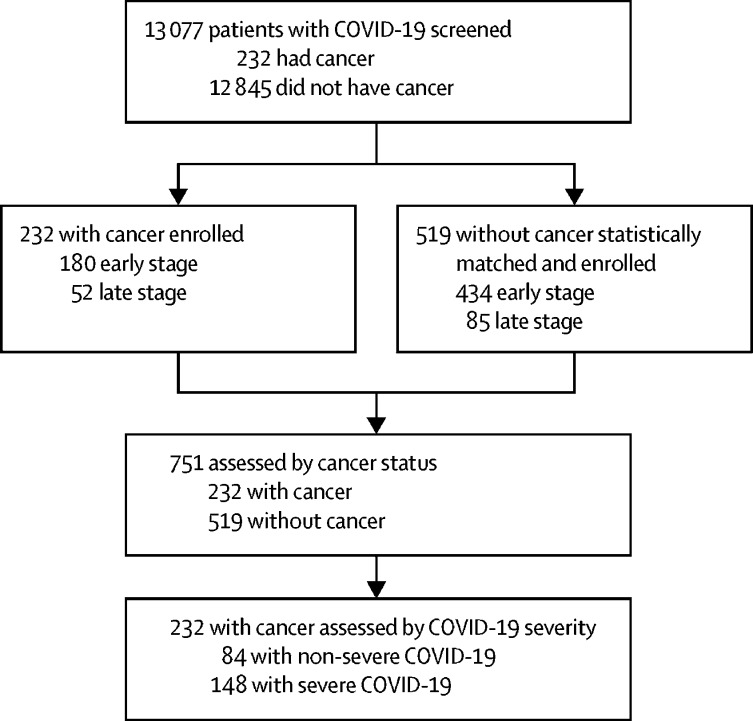
In this multicentre, retrospective, cohort study, we included all adult patients (aged ≥18 years) with any type of malignant solid tumours and haematological malignancy who were admitted to nine hospitals in Wuhan, China, with laboratory-confirmed COVID-19 between Jan 13 and March 18, 2020. Enrolled patients were statistically matched (2:1) with patients admitted with COVID-19 who did not have cancer with propensity score on the basis of age, sex, and comorbidities. Demographic characteristics, laboratory examinations, illness severity, and clinical interventions were compared between patients with COVID-19 with or without cancer as well as between patients with cancer with non-severe or severe COVID-19. COVID-19 disease severity was defined on admission on the basis of the WHO guidelines. Univariable and multivariable logistic regression, adjusted for age, sex, comorbidities, cancer type, tumour stage, and antitumour treatments, were used to explore risk factors associated with COVID-19 disease severity. This study was registered in the Chinese Clinical Trial Register, ChiCTR2000030807.

FINDINGS

Between Jan 13 and March 18, 2020, 13 077 patients with COVID-19 were admitted to the nine hospitals in Wuhan and 232 patients with cancer and 519 statistically matched patients without cancer were enrolled. Median follow-up was 29 days (IQR 22-38) in patients with cancer and 27 days (20-35) in patients without cancer. Patients with cancer were more likely to have severe COVID-19 than patients without cancer (148 [64%] of 232 vs 166 [32%] of 519; odds ratio [OR] 3·61 [95% CI 2·59-5·04]; p<0·0001). Risk factors previously reported in patients without cancer, such as older age; elevated interleukin 6, procalcitonin, and D-dimer; and reduced lymphocytes were validated in patients with cancer. We also identified advanced tumour stage (OR 2·60, 95% CI 1·05-6·43; p=0·039), elevated tumour necrosis factor α (1·22, 1·01-1·47; p=0·037), elevated N-terminal pro-B-type natriuretic peptide (1·65, 1·03-2·78; p=0·032), reduced CD4+ T cells (0·84, 0·71-0·98; p=0·031), and reduced albumin-globulin ratio (0·12, 0·02-0·77; p=0·024) as risk factors of COVID-19 severity in patients with cancer.

INTERPRETATION

Patients with cancer and COVID-19 were more likely to deteriorate into severe illness than those without cancer. The risk factors identified here could be helpful for early clinical surveillance of disease progression in patients with cancer who present with COVID-19.

FUNDING

China National Natural Science Foundation.

摘要

背景

COVID-19 已在全球范围内传播。有报道称,癌症患者对 COVID-19 具有易感性。我们旨在系统地描述 COVID-19 患者的临床特征,并确定 COVID-19 疾病严重程度的风险因素。

方法

在这项多中心、回顾性、队列研究中,我们纳入了 2020 年 1 月 13 日至 3 月 18 日期间在中国武汉的 9 家医院因实验室确诊 COVID-19 而住院的所有患有任何类型恶性实体瘤和血液恶性肿瘤的成年患者(年龄≥18 岁)。根据年龄、性别和合并症,使用倾向评分对入院的 COVID-19 患者与癌症患者进行了统计学匹配(2:1)。将 COVID-19 合并癌症患者与 COVID-19 无癌症患者的人口统计学特征、实验室检查、疾病严重程度和临床干预进行了比较,也比较了癌症患者中 COVID-19 非重症与重症患者的比较。根据世界卫生组织(WHO)指南,入院时确定 COVID-19 疾病严重程度。采用单变量和多变量逻辑回归分析,调整年龄、性别、合并症、癌症类型、肿瘤分期和抗肿瘤治疗,以探讨与 COVID-19 疾病严重程度相关的风险因素。本研究在中国临床试验注册中心注册,注册号 ChiCTR2000030807。

结果

2020 年 1 月 13 日至 3 月 18 日期间,武汉的 9 家医院共收治了 13077 例 COVID-19 患者,其中 232 例癌症患者和 519 例经统计学匹配无癌症患者纳入研究。癌症患者的中位随访时间为 29 天(22-38),无癌症患者的中位随访时间为 27 天(20-35)。与无癌症患者相比,癌症患者更有可能出现严重 COVID-19(232 例中的 148 例[64%]与 519 例中的 166 例[32%];比值比[OR]3.61[95%CI 2.59-5.04];p<0.0001)。先前在无癌症患者中报道的风险因素,如年龄较大;白细胞介素 6、降钙素原和 D-二聚体升高;以及淋巴细胞减少,在癌症患者中也得到了验证。我们还发现晚期肿瘤分期(OR 2.60,95%CI 1.05-6.43;p=0.039)、肿瘤坏死因子-α(1.22,1.01-1.47;p=0.037)、N 末端 B 型利钠肽前体(1.65,1.03-2.78;p=0.032)、CD4+T 细胞(0.84,0.71-0.98;p=0.031)和白蛋白-球蛋白比值(0.12,0.02-0.77;p=0.024)降低是癌症患者 COVID-19 严重程度的风险因素。

解释

与无癌症患者相比,癌症合并 COVID-19 的患者更有可能恶化至重症。这里确定的风险因素可能有助于对患有 COVID-19 的癌症患者进行疾病进展的早期临床监测。

资助

中国国家自然科学基金。

https://cdn.ncbi.nlm.nih.gov/pmc/blobs/199a/7259911/3489b6f971b2/gr1_lrg.jpg

相似文献

1
Clinical characteristics and risk factors associated with COVID-19 disease severity in patients with cancer in Wuhan, China: a multicentre, retrospective, cohort study.中国武汉癌症患者 COVID-19 疾病严重程度相关的临床特征和危险因素:一项多中心、回顾性、队列研究。
Lancet Oncol. 2020 Jul;21(7):893-903. doi: 10.1016/S1470-2045(20)30309-0. Epub 2020 May 29.
2
Clinical characteristics, outcomes, and risk factors for mortality in patients with cancer and COVID-19 in Hubei, China: a multicentre, retrospective, cohort study.中国湖北省癌症合并 COVID-19 患者的临床特征、结局和死亡危险因素:一项多中心、回顾性队列研究。
Lancet Oncol. 2020 Jul;21(7):904-913. doi: 10.1016/S1470-2045(20)30310-7. Epub 2020 May 29.
3
Clinical course and risk factors for mortality of adult inpatients with COVID-19 in Wuhan, China: a retrospective cohort study.中国武汉成人 COVID-19 住院患者的临床病程和死亡危险因素:一项回顾性队列研究。
Lancet. 2020 Mar 28;395(10229):1054-1062. doi: 10.1016/S0140-6736(20)30566-3. Epub 2020 Mar 11.
4
Haematological characteristics and risk factors in the classification and prognosis evaluation of COVID-19: a retrospective cohort study.新冠病毒肺炎分类及预后评估中的血液学特征与危险因素:一项回顾性队列研究
Lancet Haematol. 2020 Sep;7(9):e671-e678. doi: 10.1016/S2352-3026(20)30217-9. Epub 2020 Jul 10.
5
COVID-19 in patients with thoracic malignancies (TERAVOLT): first results of an international, registry-based, cohort study.胸恶性肿瘤患者的 COVID-19(TERAVOLT):一项国际、基于登记的队列研究的初步结果。
Lancet Oncol. 2020 Jul;21(7):914-922. doi: 10.1016/S1470-2045(20)30314-4. Epub 2020 Jun 12.
6
Clinical characteristics of 116 hospitalized patients with COVID-19 in Wuhan, China: a single-centered, retrospective, observational study.中国武汉 116 例 COVID-19 住院患者的临床特征:一项以医院为中心、回顾性、观察性研究。
BMC Infect Dis. 2020 Oct 22;20(1):787. doi: 10.1186/s12879-020-05452-2.
7
Clinical characteristics and risk factors for severity of COVID-19 outside Wuhan: a double-center retrospective cohort study of 213 cases in Hunan, China.中国湖南两中心回顾性队列研究 213 例病例:武汉以外地区 COVID-19 严重程度的临床特征和危险因素。
Ther Adv Respir Dis. 2020 Jan-Dec;14:1753466620963035. doi: 10.1177/1753466620963035.
8
Clinical characteristics and co-infections of 354 hospitalized patients with COVID-19 in Wuhan, China: a retrospective cohort study.中国武汉 354 例 COVID-19 住院患者的临床特征和合并感染:一项回顾性队列研究。
Microbes Infect. 2020 May-Jun;22(4-5):195-199. doi: 10.1016/j.micinf.2020.05.007. Epub 2020 May 18.
9
Clinical Characteristics of Patients with Severe Pneumonia Caused by the SARS-CoV-2 in Wuhan, China.中国武汉严重肺炎患者的临床特征。
Respiration. 2020;99(8):649-657. doi: 10.1159/000507940. Epub 2020 Aug 25.
10
Clinical characteristics of different subtypes and risk factors for the severity of illness in patients with COVID-19 in Zhejiang, China.中国浙江 COVID-19 患者不同亚型的临床特征及疾病严重程度的危险因素。
Infect Dis Poverty. 2020 Jul 8;9(1):85. doi: 10.1186/s40249-020-00710-6.

引用本文的文献

1
Safety of immune checkpoint inhibitors in cancer patients with COVID-19: A review.免疫检查点抑制剂在新冠肺炎癌症患者中的安全性:综述
Medicine (Baltimore). 2025 Aug 8;104(32):e43579. doi: 10.1097/MD.0000000000043579.
2
The impact of the COVID-19 pandemic on the small cell lung cancer epidemiology.2019年冠状病毒病大流行对小细胞肺癌流行病学的影响。
Discov Oncol. 2025 Jun 9;16(1):1037. doi: 10.1007/s12672-025-02816-5.
3
Evaluating the impact of COVID-19 on cancer care: a comprehensive analysis of treatment modifications, risk factors, and patient outcomes.

本文引用的文献

1
The Epidemiological Characteristics of an Outbreak of 2019 Novel Coronavirus Diseases (COVID-19) - China, 2020.2019新型冠状病毒病(COVID-19)疫情的流行病学特征 - 中国,2020年
China CDC Wkly. 2020 Feb 21;2(8):113-122.
2
Compassionate Use of Remdesivir for Patients with Severe Covid-19.瑞德西韦在治疗重症 COVID-19 患者中的同情使用。
N Engl J Med. 2020 Jun 11;382(24):2327-2336. doi: 10.1056/NEJMoa2007016. Epub 2020 Apr 10.
3
Association of Public Health Interventions With the Epidemiology of the COVID-19 Outbreak in Wuhan, China.
评估2019冠状病毒病对癌症护理的影响:对治疗调整、风险因素和患者结局的综合分析。
BMC Infect Dis. 2025 Jun 2;25(1):779. doi: 10.1186/s12879-025-11172-2.
4
Sociodemographic, medical, health behavior, and psychosocial factors associated with COVID-19 diagnoses in the New Jersey cancer survivor cohort.新泽西州癌症幸存者队列中与新冠病毒疾病(COVID-19)诊断相关的社会人口学、医学、健康行为和心理社会因素。
Cancer Causes Control. 2025 Apr 25. doi: 10.1007/s10552-025-01997-2.
5
Deep insight into cytokine storm: from pathogenesis to treatment.深入洞察细胞因子风暴:从发病机制到治疗。
Signal Transduct Target Ther. 2025 Apr 16;10(1):112. doi: 10.1038/s41392-025-02178-y.
6
Wearing a surgical mask during chemotherapy session is safe.在化疗期间佩戴外科口罩是安全的。
Sci Rep. 2025 Mar 27;15(1):10557. doi: 10.1038/s41598-025-94940-z.
7
When to resume antitumor therapy in COVID-19-infected tumor patients: a retrospective, real-world study.新冠病毒感染的肿瘤患者何时恢复抗肿瘤治疗:一项回顾性真实世界研究
Support Care Cancer. 2025 Mar 11;33(4):268. doi: 10.1007/s00520-025-09333-9.
8
Efficacy of Ayurvedic treatment given to cancer patients in the prevention of COVID-19 - A Retrospective Cohort Study at Integrated Cancer Treatment and Research Centre, Wagholi.阿育吠陀疗法对癌症患者预防COVID-19的疗效——瓦戈利综合癌症治疗与研究中心的一项回顾性队列研究
J Ayurveda Integr Med. 2025 Mar 5;16(2):101045. doi: 10.1016/j.jaim.2024.101045.
9
Assessing the impact of comorbidities on disease severity in COVID-19 patients requires consideration of age.评估合并症对新冠肺炎患者疾病严重程度的影响需要考虑年龄因素。
Medicine (Baltimore). 2025 Jan 31;104(5):e41360. doi: 10.1097/MD.0000000000041360.
10
Bidirectional approach of Punica granatum natural compounds: reduction in lung cancer and SARS-CoV-2 propagation.石榴天然化合物的双向作用:减少肺癌和新冠病毒传播。
BMC Complement Med Ther. 2025 Jan 30;25(1):32. doi: 10.1186/s12906-024-04738-1.
公共卫生干预措施与中国武汉 COVID-19 疫情流行病学的关联。
JAMA. 2020 May 19;323(19):1915-1923. doi: 10.1001/jama.2020.6130.
4
Clinical and immunological features of severe and moderate coronavirus disease 2019.新型冠状病毒病 2019 重症和中度患者的临床和免疫学特征。
J Clin Invest. 2020 May 1;130(5):2620-2629. doi: 10.1172/JCI137244.
5
Temporal Changes of CT Findings in 90 Patients with COVID-19 Pneumonia: A Longitudinal Study.90 例 COVID-19 肺炎患者 CT 表现的时间变化:一项纵向研究。
Radiology. 2020 Aug;296(2):E55-E64. doi: 10.1148/radiol.2020200843. Epub 2020 Mar 19.
6
Clinical course and risk factors for mortality of adult inpatients with COVID-19 in Wuhan, China: a retrospective cohort study.中国武汉成人 COVID-19 住院患者的临床病程和死亡危险因素:一项回顾性队列研究。
Lancet. 2020 Mar 28;395(10229):1054-1062. doi: 10.1016/S0140-6736(20)30566-3. Epub 2020 Mar 11.
7
Implications of COVID-19 for patients with pre-existing digestive diseases.2019冠状病毒病对患有既往消化系统疾病患者的影响。
Lancet Gastroenterol Hepatol. 2020 May;5(5):425-427. doi: 10.1016/S2468-1253(20)30076-5. Epub 2020 Mar 11.
8
Risk Factors Associated With Acute Respiratory Distress Syndrome and Death in Patients With Coronavirus Disease 2019 Pneumonia in Wuhan, China.中国武汉 2019 年冠状病毒病肺炎患者急性呼吸窘迫综合征和死亡的相关危险因素。
JAMA Intern Med. 2020 Jul 1;180(7):934-943. doi: 10.1001/jamainternmed.2020.0994.
9
Dysregulation of Immune Response in Patients With Coronavirus 2019 (COVID-19) in Wuhan, China.中国武汉 2019 年冠状病毒病(COVID-19)患者免疫反应失调。
Clin Infect Dis. 2020 Jul 28;71(15):762-768. doi: 10.1093/cid/ciaa248.
10
COVID-19 and the cardiovascular system.新型冠状病毒肺炎与心血管系统。
Nat Rev Cardiol. 2020 May;17(5):259-260. doi: 10.1038/s41569-020-0360-5.