
基于胶原蛋白的组织工程构建体的可调生物活性和力学性能:EDC-NHS、京尼平与转谷氨酰胺酶2交联剂的比较
Tunable bioactivity and mechanics of collagen-based tissue engineering constructs: A comparison of EDC-NHS, genipin and TG2 crosslinkers.
作者信息
Nair Malavika, Johal Ramneek K, Hamaia Samir W, Best Serena M, Cameron Ruth E
机构信息
Cambridge Centre for Medical Materials, Department of Materials Science and Metallurgy, University of Cambridge, 27 Charles Babbage Road, Cambridge, CB3 0FS, United Kingdom.
Department of Biochemistry, University of Cambridge, 8 Tennis Court Road, Cambridge, CB2 1QW, United Kingdom.
出版信息
Biomaterials. 2020 Sep;254:120109. doi: 10.1016/j.biomaterials.2020.120109. Epub 2020 May 22.
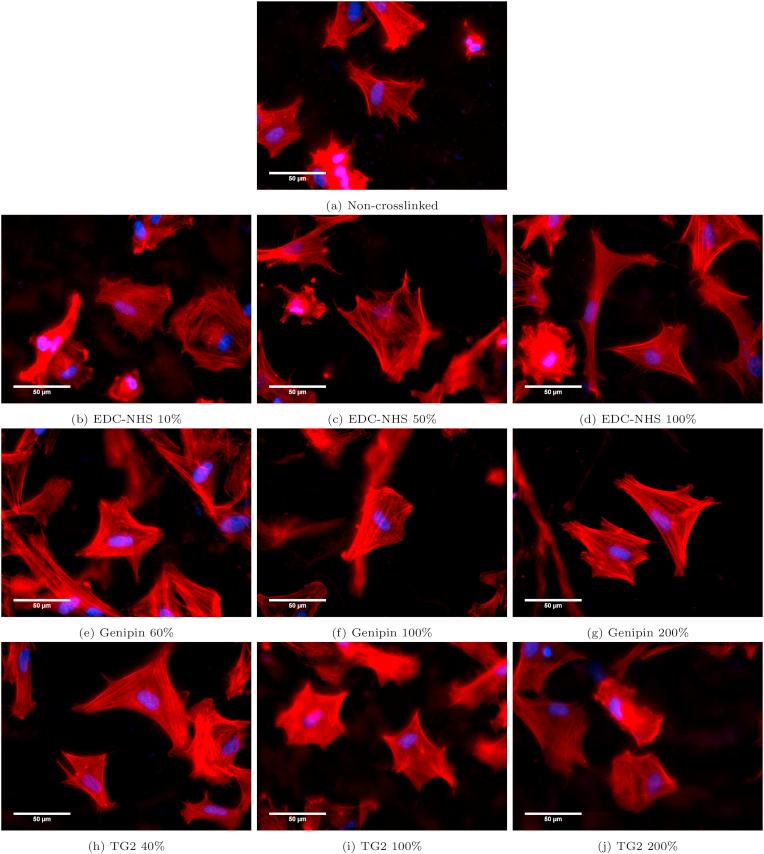
Due to its ubiquity and versatility in the human body, collagen is an ideal base material for tissue-engineering constructs. Chemical crosslinking treatments allow precise control of the biochemical and mechanical properties through macromolecular modifications to the structure of collagen. In this work, three key facets regarding the collagen crosslinking process are explored. Firstly, a comparison is drawn between the carbodiimide-succinimide (EDC-NHS) system and two emerging crosslinkers utilising alternate chemistries: genipin and tissue transglutaminase (TG2). By characterising the chemical changes upon treatment, the effect of EDC-NHS, genipin and TG2 crosslinking mechanisms on the chemical structure of collagen, and thus the mechanical properties conferred to the substrate is explored. Secondly, the relative importance of mechanical and biochemical cues on cellular phenomena are investigated, including cell viability, integrin-specific attachment, spreading and proliferation. Here, we observe that for human dermal fibroblasts, long-term, stable proliferation is preconditioned by the availability of suitable binding sites, irrespective of the substrate modulus post-crosslinking. Finally, as seen in the graphical abstract we show that by choosing the appropriate crosslinker chemistries, a materials selection map can be drawn for collagen films, encompassing both a range of tensile modulus and fibroblast proliferation which can be modified independently. Thus, in addition to a range of parameters that can be modified in collagen constructs, we demonstrate a route to obtaining tunable bioactivity and mechanics in collagen constructs is uncovered, that is exclusively driven by the crosslinking process.
由于胶原蛋白在人体中无处不在且具有多种功能,它是组织工程构建体的理想基础材料。化学交联处理通过对胶原蛋白结构进行大分子修饰,能够精确控制其生化和机械性能。在这项工作中,我们探索了胶原蛋白交联过程的三个关键方面。首先,对碳二亚胺-琥珀酰亚胺(EDC-NHS)体系与两种采用不同化学方法的新型交联剂:京尼平和组织转谷氨酰胺酶(TG2)进行了比较。通过表征处理后的化学变化,探究了EDC-NHS、京尼平和TG2交联机制对胶原蛋白化学结构的影响,进而研究了赋予底物的机械性能。其次,研究了机械和生化信号对细胞现象的相对重要性,包括细胞活力、整合素特异性附着、铺展和增殖。在这里,我们观察到对于人皮肤成纤维细胞,长期稳定增殖的前提是有合适的结合位点,而与交联后底物的模量无关。最后,如图形摘要所示,我们表明通过选择合适的交联剂化学方法,可以绘制出胶原蛋白膜的材料选择图,涵盖一系列可独立调节的拉伸模量和成纤维细胞增殖范围。因此,除了胶原蛋白构建体中可改变的一系列参数外,我们还展示了一条在胶原蛋白构建体中获得可调节生物活性和力学性能的途径,这完全由交联过程驱动。


 Zotero 插件