Renjun Gu, Ziyun Li, Xiwu Yan, Wei Wei, Yihuang Gu, Chunbing Zhang, Zhiguang Sun
The First School of Clinical Medicine.
The Third School of Clinical Medicine.
Medicine (Baltimore). 2020 May 22;99(21):e20335. doi: 10.1097/MD.0000000000020335.
COVID-19 is novel coronavirus infection in 2019. Many reports suggested that psychological intervention is playing a positive role in COVID-19 treatment, but there is no high-quality evidence to prove its effects. This paper reports the protocol of a systematic review and meta-analysis to clarify effectiveness of psychological intervention during the treatment of COVID-19.
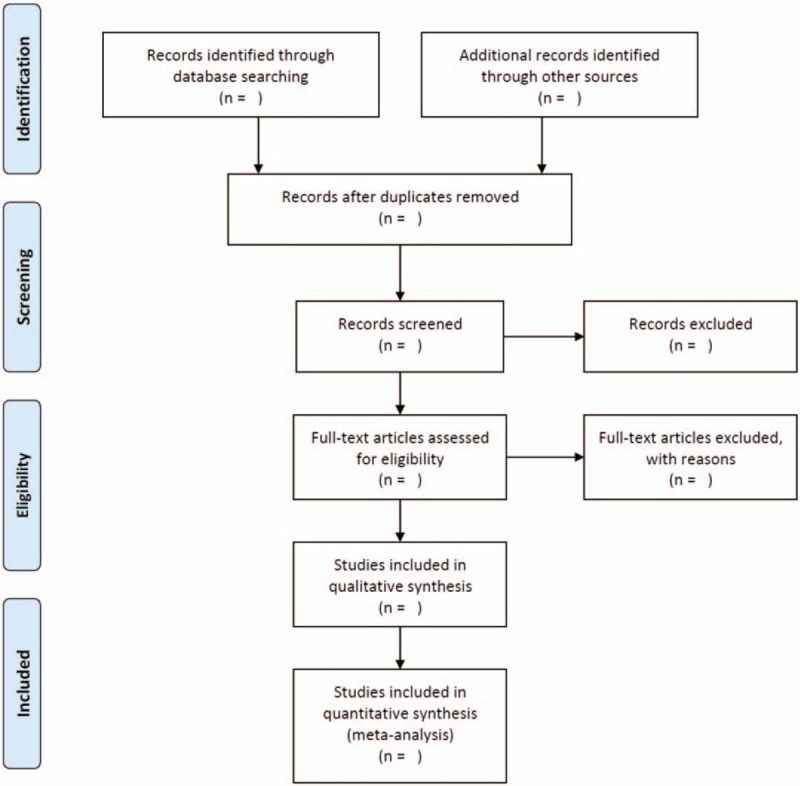
The following electronic databases will be used by 2 independent reviewers: Web of Science, Embase, Cochrane Library, PubMed, Chinese Biomedical Literature Database, Chinese National Knowledge Infrastructure, Chinese Scientific Journal Database, Wan fang Database, ClinicalTrials, WHO Trials, and Chinese Clinical Trial Registry. The randomised controlled trials of psychological intervention on COVID-19 will be searched in the databases by 2 researchers independently. Clinical recovery time and effective rate will be assessed as the primary outcomes. Changes of patients physical condition (1. Time until COVID-19 RT-PCR negative in upper respiratory tract specimen; 2. Time until cough reported as mild or absent; 3. Time until dyspnea reported as mild or absent; 4. Frequency of requiring supplemental oxygen or non-invasive ventilation; 5. Frequency of requiring respiratory; 6. Incidence of severe cases; 7. Proportion of re-hospitalization or admission to ICU; 8. All-cause mortality; 9. Frequency of seriously adverse events) and changes of psychological condition (such as: SRQ-20, PHQ-9, GAD-7, Hamilton Depression Scale, Hamilton Anxiety Scale) will be assessed as the secondary outcomes. For dichotomous outcomes, such as effective rate, data will be expressed as risk ratio (RR) with 95% confidence intervals (CIs). For continuous outcomes, weighted mean differences (WMD) or standardized mean differences (SMD) will be calculated. Fixed effect model will be used for evaluating efficiency. Considering clinical heterogeneity, random effect model will be used for continuous outcomes.
Relevant studies will be used to evaluate whether psychological intervention is effective for COVID-19.
This study will provide reliable evidence for psychological intervention on COVID-19.
CRD42020178699.
2019冠状病毒病(COVID-19)是2019年新型冠状病毒感染。许多报告表明心理干预在COVID-19治疗中发挥着积极作用,但尚无高质量证据证明其效果。本文报告一项系统评价和荟萃分析方案,以阐明心理干预在COVID-19治疗期间的有效性。
两名独立评审员将使用以下电子数据库:科学网、Embase、考克兰图书馆、PubMed、中国生物医学文献数据库、中国知网、维普数据库、万方数据库、ClinicalTrials、世界卫生组织试验注册库和中国临床试验注册中心。两名研究人员将独立在数据库中检索心理干预对COVID-19的随机对照试验。临床恢复时间和有效率将作为主要结局进行评估。患者身体状况的变化(1. 上呼吸道标本中COVID-19逆转录聚合酶链反应(RT-PCR)转阴时间;2. 咳嗽减轻或消失时间;3. 呼吸困难减轻或消失时间;4. 需要补充氧气或无创通气的频率;5. 需要呼吸支持的频率;6. 重症病例发生率;7. 再次住院或入住重症监护病房(ICU)的比例;8. 全因死亡率;9. 严重不良事件的频率)和心理状况的变化(如:20项症状自评量表(SRQ-20)、患者健康问卷-9(PHQ-9)、广泛性焦虑障碍量表(GAD-7)、汉密尔顿抑郁量表、汉密尔顿焦虑量表)将作为次要结局进行评估。对于二分结局,如有效率,数据将表示为风险比(RR)及95%置信区间(CI)。对于连续性结局,将计算加权均数差(WMD)或标准化均数差(SMD)。将使用固定效应模型评估疗效。考虑到临床异质性,对于连续性结局将使用随机效应模型。
将使用相关研究评估心理干预对COVID-19是否有效。
本研究将为COVID-19的心理干预提供可靠证据。
国际前瞻性注册系统(PROSPERO)注册号:CRD42020178699。