Administration of Pharmaceutical Care, Al-Ahsa Health Cluster, Ministry of Health, Al-Ahsa, Saudi Arabia.
Research Center, Almoosa Specialist Hospital, Dhahran Street, Al-Ahsa, 31982, Saudi Arabia.
Antimicrob Resist Infect Control. 2021 Jun 3;10(1):86. doi: 10.1186/s13756-021-00957-0.
Knowledge of infection prevention and control (IPC) procedures among healthcare workers (HCWs) is crucial for effective IPC. Compliance with IPC measures has critical implications for HCWs safety, patient protection and the care environment.
To discuss the body of available literature regarding HCWs' knowledge of IPC and highlight potential factors that may influence compliance to IPC precautions.
A systematic review. A protocol was developed based on the Preferred Reporting Items for Systematic reviews and Meta-Analysis [PRISMA] statement.
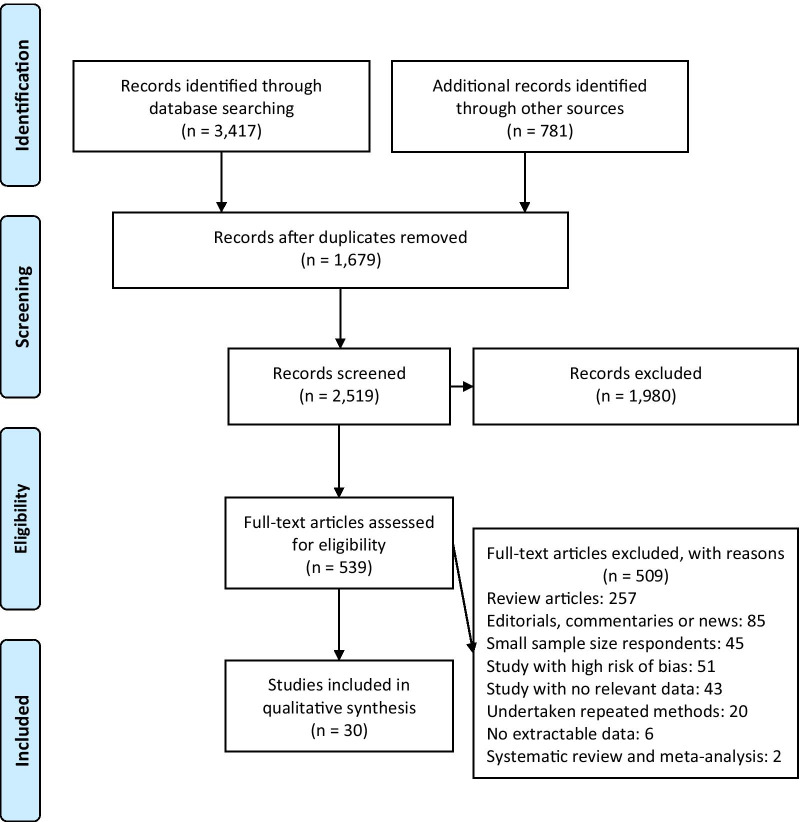
Electronic databases (PubMed, CINAHL, Embase, Proquest, Wiley online library, Medline, and Nature) were searched from 1 January 2006 to 31 January 2021 in the English language using the following keywords alone or in combination: knowledge, awareness, healthcare workers, infection, compliance, comply, control, prevention, factors. 3417 papers were identified and 30 papers were included in the review.
Overall, the level of HCW knowledge of IPC appears to be adequate, good, and/or high concerning standard precautions, hand hygiene, and care pertaining to urinary catheters. Acceptable levels of knowledge were also detected in regards to IPC measures for specific diseases including TB, MRSA, MERS-CoV, COVID-19 and Ebola. However, gaps were identified in several HCWs' knowledge concerning occupational vaccinations, the modes of transmission of infectious diseases, and the risk of infection from needle stick and sharps injuries. Several factors for noncompliance surrounding IPC guidelines are discussed, as are recommendations for improving adherence to those guidelines.
Embracing a multifaceted approach towards improving IPC-intervention strategies is highly suggested. The goal being to improve compliance among HCWs with IPC measures is necessary.
医护人员(HCWs)对感染预防和控制(IPC)程序的了解对于有效的 IPC 至关重要。遵守 IPC 措施对 HCWs 的安全、患者保护和护理环境具有重要意义。
讨论关于 HCWs 对 IPC 知识的现有文献,并强调可能影响遵守 IPC 预防措施的潜在因素。
系统评价。根据系统评价和荟萃分析的首选报告项目 [PRISMA] 声明制定了方案。
从 2006 年 1 月 1 日至 2021 年 1 月 31 日,使用以下关键词单独或组合在电子数据库(PubMed、CINAHL、Embase、Proquest、Wiley online library、Medline 和 Nature)中进行了搜索:知识、意识、医护人员、感染、合规、遵守、控制、预防、因素。共确定了 3417 篇论文,并对其中 30 篇论文进行了综述。
总体而言,HCW 对 IPC 的了解水平似乎在标准预防措施、手卫生以及与导尿管相关的护理方面是充分的、良好的和/或高的。在针对结核病、耐甲氧西林金黄色葡萄球菌、中东呼吸综合征冠状病毒、COVID-19 和埃博拉等特定疾病的 IPC 措施方面,也检测到了可接受的知识水平。然而,HCWs 在职业疫苗接种、传染病传播模式以及针和锐器伤害感染风险等方面的知识存在差距。讨论了围绕 IPC 指南的非遵守因素,并提出了改善对这些指南的遵守建议。
强烈建议采取多方面的方法来改进 IPC 干预策略。提高 HCWs 对 IPC 措施的依从性是必要的。