Research Centre, Institut universitaire de Cardiologie et de Pneumologie de Québec, Université Laval, 2725 Chemin Sainte-Foy, Québec, G1V 4G5, Canada.
Department of Medicine, Queen's University and Kingston Health Sciences Centre, Kingston, ON, Canada.
Ther Adv Respir Dis. 2020 Jan-Dec;14:1753466620926858. doi: 10.1177/1753466620926858.
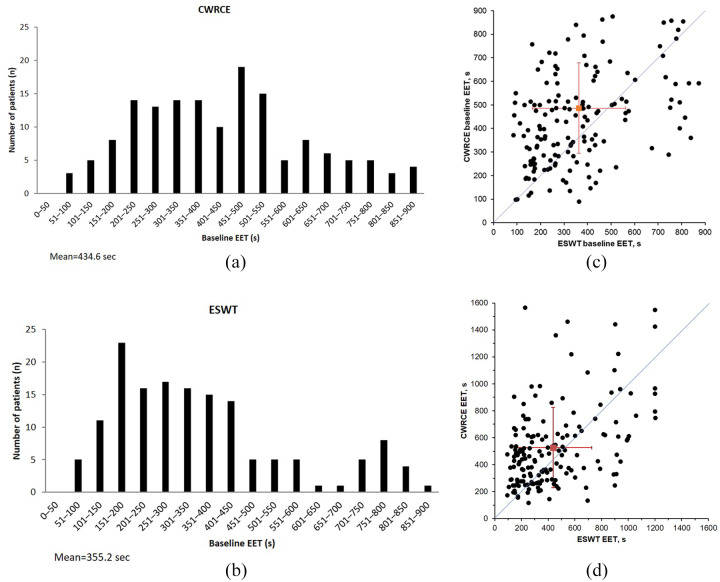
Exercise tolerance is an important endpoint in chronic obstructive pulmonary disease (COPD) clinical trials. Little is known about the comparative measurement properties of constant work rate cycle ergometry (CWRCE) and the endurance shuttle walking test (ESWT). The objective of this sub-analysis of the TORRACTO study was to directly compare the endurance measurement properties of CWRCE and ESWT in patients with COPD in a multicentre, multinational setting. We predicted that both tests would be similarly reliable, but that the ESWT would be more responsive to bronchodilation than CWRCE.
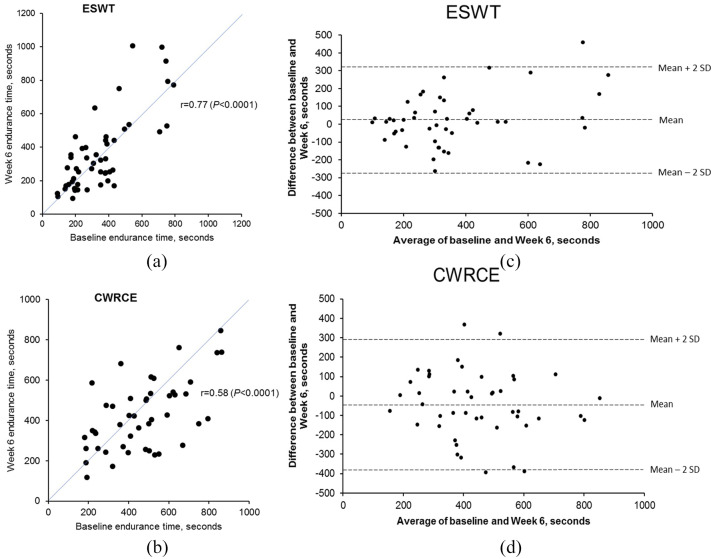
This analysis included 151 patients who performed CWRCE and ESWT at baseline and week 6 after receiving once-daily placebo, tiotropium/olodaterol (T/O) 2.5/5 μg or T/O 5/5 μg. Reproducibility was assessed by comparing their respective performance at baseline and week 6 in the placebo group. Responsiveness to bronchodilation was assessed by comparing endurance time at week 6 with T/O with baseline values and placebo. The locus of symptom limitation and end-exercise Borg scales for breathing and leg discomfort for both tests were also analysed.
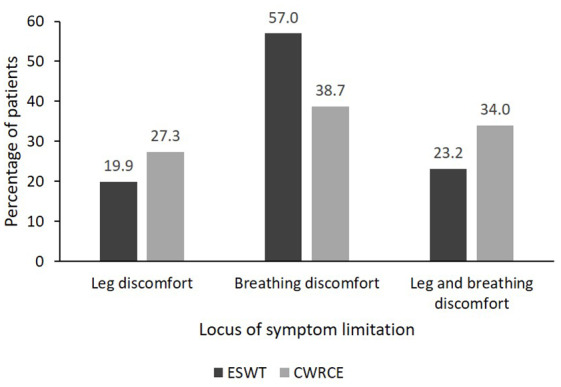
The intraclass correlation coefficients for CWRCE and ESWT were 0.56 [95% confidence interval (CI) 0.37-0.71] and 0.75 (95% CI 0.63-0.84). More patients were limited by breathing discomfort during the ESWT than during CWRCE, whereas more patients were limited by leg discomfort or breathing/leg discomfort during CWRCE than the ESWT ( <0.0001). Both tests were responsive to bronchodilator treatment: there was a 19% increase in endurance time from baseline at week 6 ( = 0.0006) assessed with CWRCE, and a 20% increase in endurance time assessed with ESWT ( = 0.0013).
Both exercise tests performed well in a multicentre clinical trial. Although the locus of symptom limitation differed between the two tests, both were reliable and responsive to bronchodilation. For future clinical trials, the choice of test should depend on the study requirements.
CLINICALTRIALS.GOV IDENTIFIER: NCT01525615.
运动耐量是慢性阻塞性肺疾病(COPD)临床试验中的一个重要终点。对于恒功率踏车运动试验(CWRCE)和耐力穿梭步行试验(ESWT)的比较测量特性,人们知之甚少。本项 TORRACTO 研究的子分析旨在直接比较 COPD 患者在多中心、多国环境中 CWRCE 和 ESWT 的耐力测量特性。我们预测两种测试的可靠性相似,但 ESWT 对支气管扩张的反应将优于 CWRCE。
本分析纳入了 151 例患者,他们在接受每日一次安慰剂、噻托溴铵/奥达特罗(T/O)2.5/5μg 或 T/O 5/5μg 治疗前基线和第 6 周时进行了 CWRCE 和 ESWT。通过比较安慰剂组在基线和第 6 周的各自表现来评估重复性。通过比较第 6 周 T/O 与基线和安慰剂的耐力时间来评估对支气管扩张的反应性。还分析了两种测试的症状限制和运动终点时呼吸和腿部不适的 Borg 量表位置。
CWRCE 和 ESWT 的组内相关系数分别为 0.56(95%置信区间 [CI] 0.37-0.71)和 0.75(95%CI 0.63-0.84)。在 ESWT 中,更多患者因呼吸不适而受限,而在 CWRCE 中,更多患者因腿部不适或呼吸/腿部不适而受限(<0.0001)。两种测试均对支气管扩张剂治疗有反应:与基线相比,CWRCE 的耐力时间增加了 19%(第 6 周时 = 0.0006),而 ESWT 的耐力时间增加了 20%(第 6 周时 = 0.0013)。
两种运动试验在多中心临床试验中表现良好。尽管两种测试的症状限制部位不同,但它们都可靠且对支气管扩张剂有反应。对于未来的临床试验,测试的选择应取决于研究要求。
临床试验.gov 标识符:NCT01525615。