Department of Environmental Health, Harvard T.H. Chan School of Public Health, Boston, MA, USA.
Department of Environmental and Occupational Health, Milken Institute School of Public Health, The George Washington University, Washington, DC, USA.
J Expo Sci Environ Epidemiol. 2022 Jul;32(4):571-582. doi: 10.1038/s41370-021-00403-8. Epub 2022 Jan 4.
Foreign-born Black and Latina women on average have higher birthweight infants than their US-born counterparts, despite generally worse socioeconomic indicators and prenatal care access, i.e., "immigrant birthweight paradox" (IBP). Residence in immigrant enclaves and associated social-cultural and economic benefits may be drivers of IBP. Yet, enclaves have been found to have higher air pollution, a risk factor for lower birthweight.
We investigated the association of immigrant enclaves and children's birthweight accounting for prenatal ambient air pollution exposure.
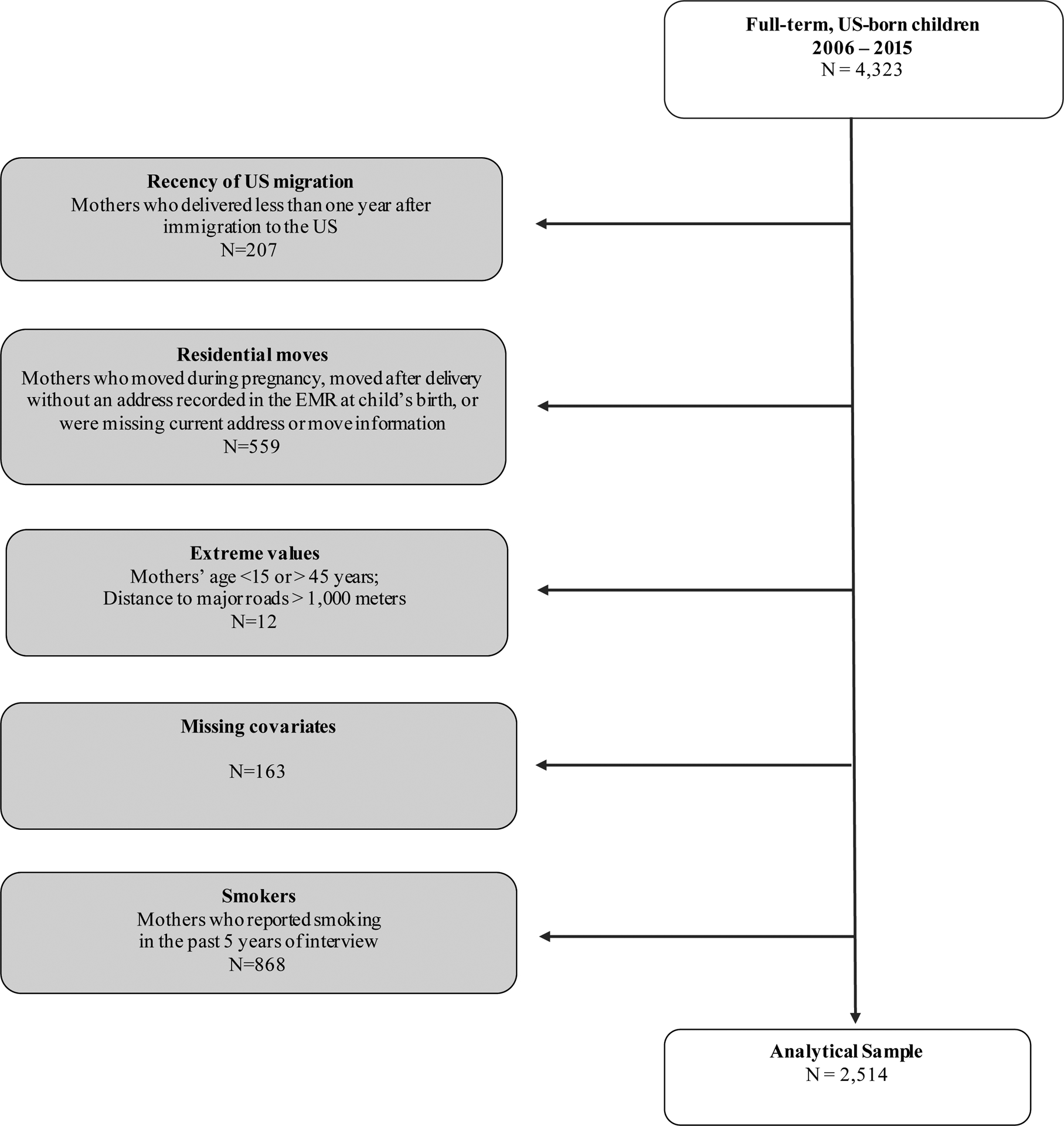
In the Boston-based Children's HealthWatch cohort of mother-child dyads, we obtained birthweight-for-gestational-age z-scores (BWGAZ) for US-born births, 2006-2015. We developed an immigrant enclave score based on census-tract percentages of foreign-born, non-citizen, and linguistically-isolated households statewide. We estimated trimester-specific PM concentrations and proximity to major roads based residential address at birth. We fit multivariable linear regressions of BWGAZ and examined effect modification by maternal nativity. Analyses were restricted to nonsmoking women and term births.
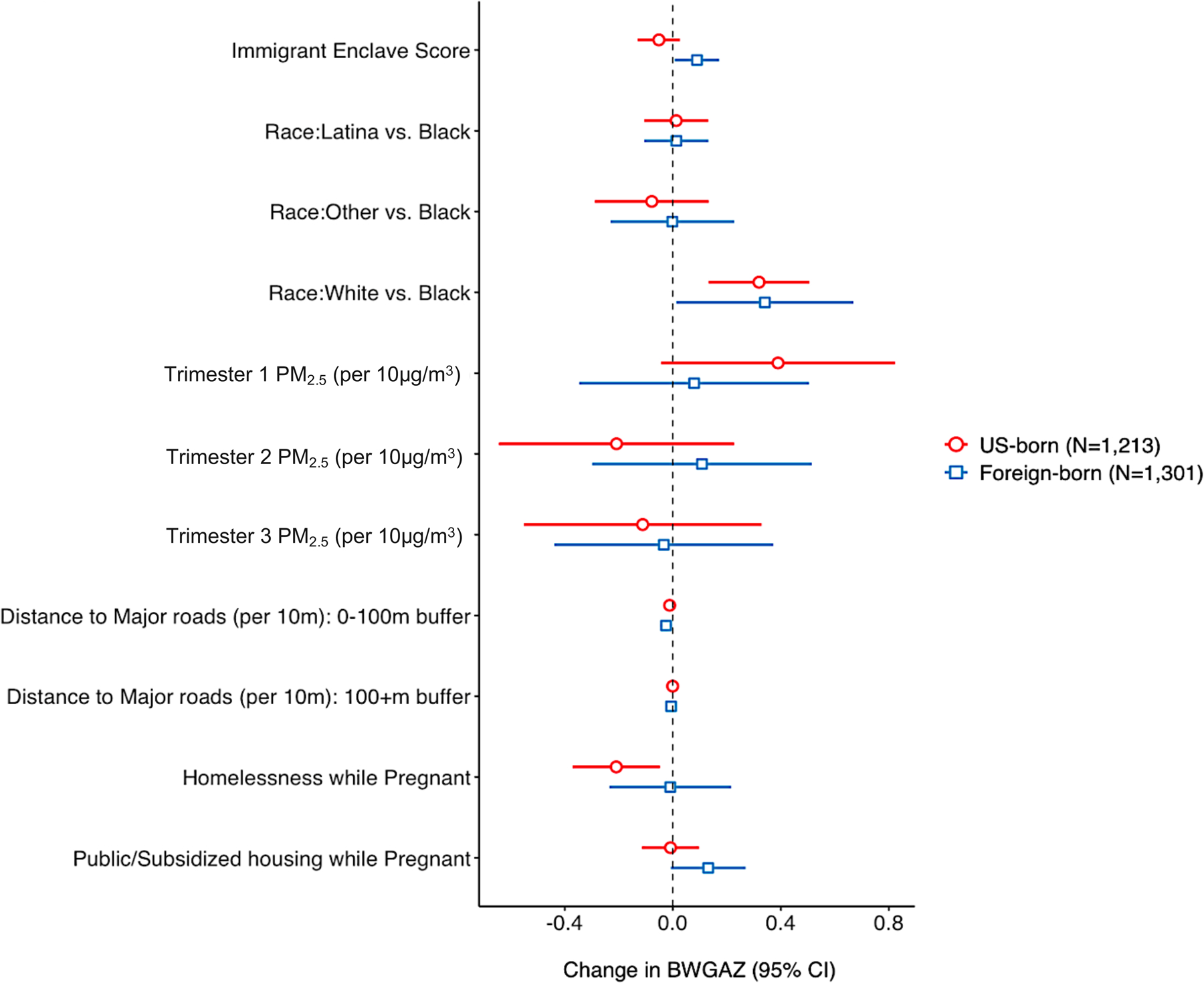
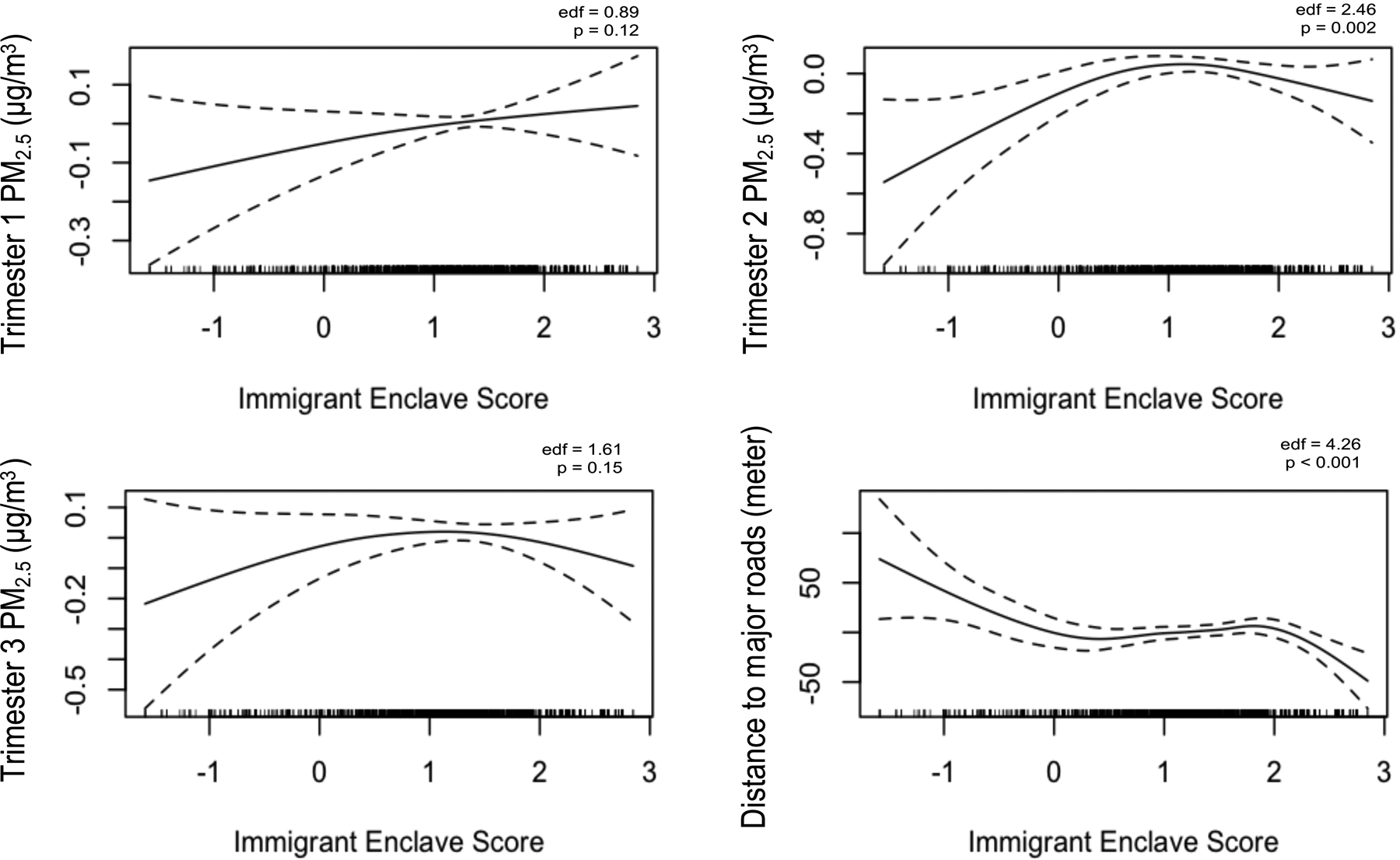
Foreign-born women had children with 0.176 (95% CI: 0.092, 0.261) higher BWGAZ than US-born women, demonstrating the IBP in our cohort. Immigrant enclave score was not associated with BWGAZ, even after adjusting for air pollution exposures. However, this association was significantly modified by maternal nativity (p = 0.014), in which immigrant enclave score was positively associated with BWGAZ for only foreign-born women (0.090, 95% CI: 0.007, 0.172). Proximity to major roads was negatively associated with BWGAZ (-0.018 per 10 m, 95% CI: -0.032, -0.003) and positively correlated with immigrant enclave scores. Trimester-specific PM concentrations were not associated with BWGAZ.
Residence in immigrant enclaves was associated with higher birthweight children for foreign-born women, supporting the role of immigrant enclaves in the IBP. Future research of the IBP should account for immigrant enclaves and assess their spatial correlation with potential environmental risk factors and protective resources.
与美国本土出生的同龄人相比,出生在国外的黑人和拉丁裔女性的婴儿平均体重更高,尽管她们的社会经济指标和产前保健的获取情况通常较差,即“移民出生体重悖论”(IBP)。居住在移民飞地以及相关的社会文化和经济利益可能是 IBP 的驱动因素。然而,已经发现飞地的空气污染更高,而空气污染是导致低出生体重的一个风险因素。
我们调查了在考虑产前环境空气污染暴露的情况下,移民飞地与儿童出生体重的关系。
在波士顿的儿童健康观察队列中,我们获得了 2006 年至 2015 年美国本土出生的母婴对子的出生体重-胎龄 z 评分(BWGAZ)。我们根据全州范围内的外国出生、非公民和语言隔离家庭的比例,制定了一个移民飞地得分。我们根据出生时的住址估计了特定于妊娠阶段的 PM 浓度和接近主要道路的程度。我们使用多变量线性回归分析了 BWGAZ,并检查了母亲出生地对其的影响。分析仅限于不吸烟的女性和足月出生的婴儿。
与美国本土出生的女性相比,外国出生的女性的孩子 BWGAZ 高出 0.176(95%CI:0.092,0.261),这表明了我们队列中的 IBP。即使调整了空气污染暴露因素,移民飞地得分与 BWGAZ 也没有关联。然而,这种关联在母亲出生地方面有显著的变化(p=0.014),在这个关联中,移民飞地得分仅与外国出生的女性的 BWGAZ 呈正相关(0.090,95%CI:0.007,0.172)。接近主要道路与 BWGAZ 呈负相关(每增加 10 米,BWGAZ 降低 0.018,95%CI:0.032,-0.003),与移民飞地得分呈正相关。妊娠阶段特异性的 PM 浓度与 BWGAZ 无关。
居住在移民飞地与外国出生的女性的高体重婴儿有关,这支持了移民飞地在 IBP 中的作用。未来对 IBP 的研究应考虑到移民飞地,并评估其与潜在环境风险因素和保护资源的空间相关性。