Akram Umair, Gardani Maria, Irvine Kamila, Allen Sarah, Ypsilanti Antonia, Lazuras Lambros, Drabble Jennifer, Stevenson Jodie C, Akram Asha
Centre for Behavioural Science and Applied Psychology, Sheffield Hallam University, Sheffield, UK.
Nuffield Department of Clinical Neurosciences, University of Oxford, Oxford, UK.
NPJ Schizophr. 2020 Jun 1;6(1):15. doi: 10.1038/s41537-020-0103-y.
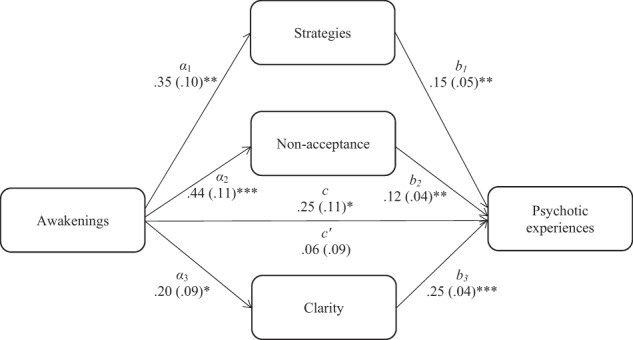
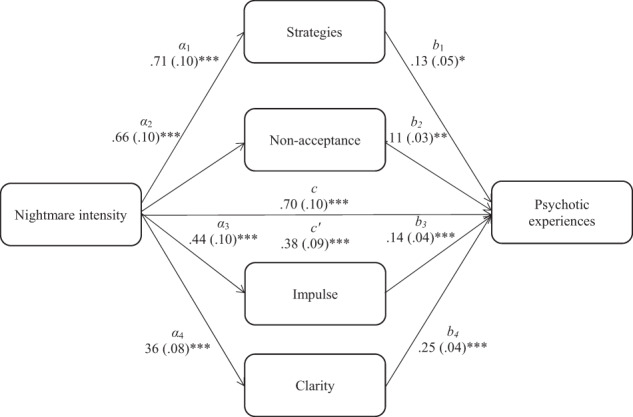
Sleep disruption is commonly associated with psychotic experiences. While sparse, the literature to date highlights nightmares and related distress as prominent risk factors for psychosis in students. We aimed to further explore the relationship between specific nightmare symptoms and psychotic experiences in university students while examining the mediating role of emotion dysregulation. A sample (N = 1273) of student respondents from UK universities completed measures of psychotic experiences, nightmare disorder symptomology and emotion dysregulation. Psychotic experiences were significantly more prevalent in students reporting nightmares (n = 757) relative to those who did not (n = 516). Hierarchical linear regression analysis showed that psychotic experiences were significantly associated (Adjusted R = 32.4%) with perceived nightmare intensity, consequences and resulting awakenings, and with emotion regulation difficulties. Furthermore, multiple mediation analysis showed that the association between psychotic experiences and nightmare factors was mediated by emotion regulation difficulties. Adaptive regulation of dream content during rapid eye-movement sleep has previously been demonstrated to attenuate surges in affective arousal by controlling the intensity and variability of emotional content. Difficulties in emotion regulation may partially explain the experience of more intense and disruptive nightmares among individuals with psychotic experiences. Emotion regulation may represent an important control mechanism that safeguards dream content and sleep quality.
睡眠中断通常与精神病性体验相关。尽管相关文献稀少,但迄今为止的研究强调噩梦及相关困扰是学生患精神病的突出风险因素。我们旨在进一步探究大学生特定噩梦症状与精神病性体验之间的关系,同时考察情绪调节障碍的中介作用。来自英国大学的1273名学生受访者完成了精神病性体验、噩梦障碍症状学及情绪调节障碍的测量。报告有噩梦的学生(n = 757)中,精神病性体验的发生率显著高于未报告噩梦的学生(n = 516)。分层线性回归分析表明,精神病性体验与感知到的噩梦强度、后果及由此导致的觉醒以及情绪调节困难显著相关(调整后R = 32.4%)。此外,多重中介分析表明,情绪调节困难在精神病性体验与噩梦因素之间的关联中起中介作用。先前已证明,在快速眼动睡眠期间对梦境内容进行适应性调节可通过控制情绪内容的强度和变异性来减轻情感唤醒的激增。情绪调节困难可能部分解释了有精神病性体验的个体中更强烈、更具干扰性的噩梦体验。情绪调节可能是一种重要的控制机制,可保护梦境内容和睡眠质量。