• 文献检索
  • 文档翻译
  • 深度研究
  • 学术资讯
  • Suppr Zotero 插件Zotero 插件
  • 邀请有礼
  • 套餐&价格
  • 历史记录
应用&插件
Suppr Zotero 插件Zotero 插件浏览器插件Mac 客户端Windows 客户端微信小程序
定价
高级版会员购买积分包购买API积分包
服务
文献检索文档翻译深度研究API 文档MCP 服务
关于我们
关于 Suppr公司介绍联系我们用户协议隐私条款
关注我们

Suppr 超能文献

核心技术专利:CN118964589B侵权必究
粤ICP备2023148730 号-1Suppr @ 2026

文献检索

告别复杂PubMed语法,用中文像聊天一样搜索,搜遍4000万医学文献。AI智能推荐,让科研检索更轻松。

立即免费搜索

文件翻译

保留排版,准确专业,支持PDF/Word/PPT等文件格式,支持 12+语言互译。

免费翻译文档

深度研究

AI帮你快速写综述,25分钟生成高质量综述,智能提取关键信息,辅助科研写作。

立即免费体验

11 个中低收入国家现代避孕方法使用的社会人口经济学不平等:PMA2020 调查分析。

Socio-demographic and economic inequalities in modern contraception in 11 low- and middle-income countries: an analysis of the PMA2020 surveys.

机构信息

International Center for Equity in Health (ICEH), Federal University of Pelotas, Rua Marechal Deodoro 1160, 3o piso, Pelotas, RS, 96020-220, Brazil.

Postgraduate Program in Epidemiology, Federal University of Pelotas, Pelotas, RS, Brazil.

出版信息

Reprod Health. 2020 Jun 1;17(1):82. doi: 10.1186/s12978-020-00931-w.

DOI:10.1186/s12978-020-00931-w
PMID:32487182
原文链接:https://pmc.ncbi.nlm.nih.gov/articles/PMC7268403/
Abstract

BACKGROUND

Contraception is a key component of sustainable development, empowering women, reducing the risk of maternal and child mortality and promoting economic growth. It is part of the Sustainable Development Goals agenda, where the aim is to achieve universal access to sexual and reproductive health. Our objective was to evaluate trends and inequalities in modern contraceptive prevalence, and according to the type of modern contraceptive, in 11 low- and middle-income countries that are partners of the Family Planning 2020 initiative.

METHODS

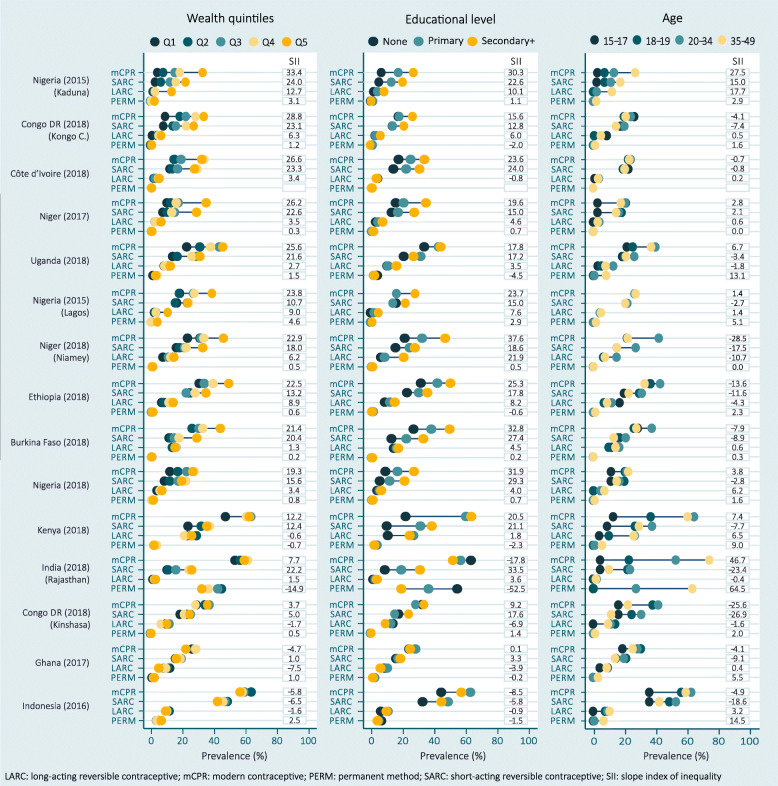
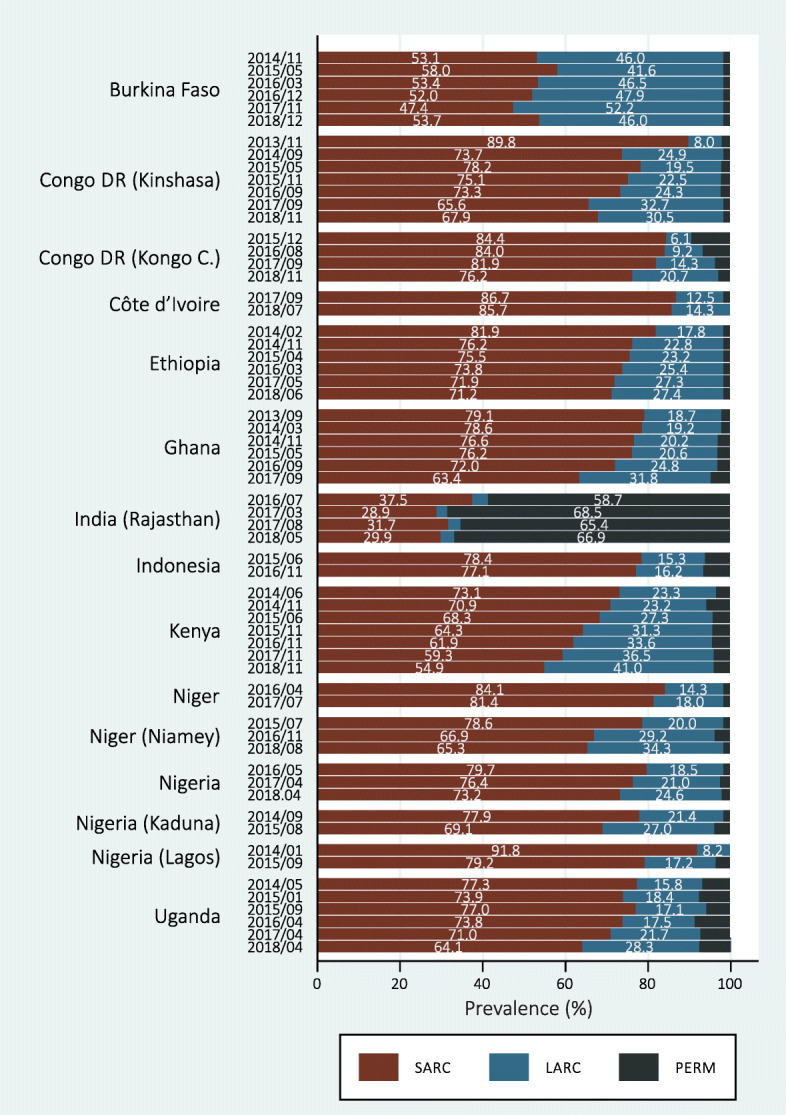
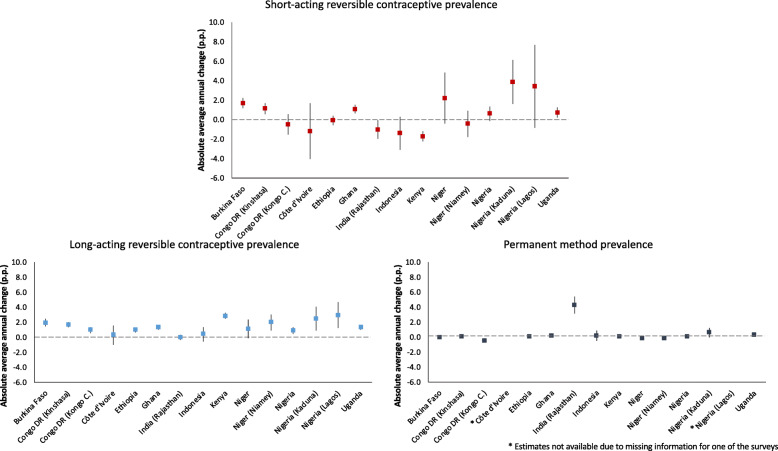
Analyses were performed using 62 Performance Monitoring and Accountability 2020 (PMA2020) surveys from 11 countries. Forty surveys were nationally representative, while 22 had regional coverage. Regional surveys were analyzed separately, totalizing 15 geographies from 11 countries. We described trends on modern contraceptive prevalence, and its subtypes (short- and long-acting reversible contraceptives, and permanent methods), by calculating absolute average annual changes. Absolute inequalities on the prevalence of modern contraceptives were assessed for the most recent survey of each geography using the slope index of inequality, and according to wealth, education and age.

RESULTS

The overall prevalence of modern contraception increased in most geographies analyzed, reaching a 7.2 percentage points increase per year in Lagos, Nigeria. This increase was mostly influenced by the long-acting reversible contraceptives, which increased in 73% of the geographies. Although the largest share of modern contraception is represented by short-acting reversible contraceptives, these are reducing and giving space for the long-acting methods. The exception was Rajasthan, India, where the permanent methods accounted for 70% of the modern contraception share, and their prevalence was almost 40%. Inequalities were identified in favor of richer, older and better educated women.

CONCLUSIONS

Out of the 15 geographies analyzed, 11 demonstrated an increase in overall modern contraceptive use - mainly driven by the uptake of long-acting reversible contraception. However, even in the groups with the highest prevalence, modern contraceptive use was at most 60% in most geographies. So, we are far from reaching the desired universal coverage proposed by the Sustainable Development Goals.

摘要

背景

避孕是可持续发展的关键组成部分,它赋予了妇女权力,降低了母婴死亡率,并促进了经济增长。它是可持续发展目标议程的一部分,目标是实现所有人都能获得性健康和生殖健康。我们的目标是评估 11 个计划生育 2020 倡议合作伙伴的低收入和中等收入国家中现代避孕方法的流行率趋势和不平等现象,并按现代避孕方法的类型进行评估。

方法

使用来自 11 个国家的 62 项绩效监测和问责制 2020 年(PMA2020)调查进行分析。其中 40 项调查具有全国代表性,而 22 项调查具有区域覆盖范围。分别对区域调查进行了分析,总计来自 11 个国家的 15 个地区。我们通过计算绝对年均变化来描述现代避孕方法流行率及其亚类(短效和长效可逆避孕方法以及永久性方法)的趋势。我们使用不平等斜率指数并根据财富、教育和年龄评估了每个地区最近一次调查中现代避孕方法流行率的绝对不平等情况。

结果

在大多数分析的地区,现代避孕方法的总体流行率有所增加,在尼日利亚拉各斯每年增加 7.2 个百分点。这种增加主要受到长效可逆避孕方法的影响,在 73%的地区增加了。尽管短期可逆避孕方法在现代避孕方法中占最大份额,但它们正在减少,为长效方法留出了空间。印度拉贾斯坦邦是个例外,那里永久性方法占现代避孕方法的 70%,其流行率几乎为 40%。调查发现,富有、年长和受教育程度较高的妇女享有更多的不平等。

结论

在所分析的 15 个地区中,有 11 个地区的整体现代避孕方法使用率有所增加 - 主要是由于长效可逆避孕方法的采用。然而,即使在流行率最高的群体中,在大多数地区,现代避孕方法的使用率最多也只有 60%。因此,我们远未达到可持续发展目标所提议的理想普遍覆盖目标。
https://cdn.ncbi.nlm.nih.gov/pmc/blobs/5c85/7268403/78de9fe7ec9c/12978_2020_931_Fig3_HTML.jpg
https://cdn.ncbi.nlm.nih.gov/pmc/blobs/5c85/7268403/a090450875f6/12978_2020_931_Fig1_HTML.jpg
https://cdn.ncbi.nlm.nih.gov/pmc/blobs/5c85/7268403/2aeba227c076/12978_2020_931_Fig2_HTML.jpg
https://cdn.ncbi.nlm.nih.gov/pmc/blobs/5c85/7268403/78de9fe7ec9c/12978_2020_931_Fig3_HTML.jpg
https://cdn.ncbi.nlm.nih.gov/pmc/blobs/5c85/7268403/a090450875f6/12978_2020_931_Fig1_HTML.jpg
https://cdn.ncbi.nlm.nih.gov/pmc/blobs/5c85/7268403/2aeba227c076/12978_2020_931_Fig2_HTML.jpg
https://cdn.ncbi.nlm.nih.gov/pmc/blobs/5c85/7268403/78de9fe7ec9c/12978_2020_931_Fig3_HTML.jpg

相似文献

1
Socio-demographic and economic inequalities in modern contraception in 11 low- and middle-income countries: an analysis of the PMA2020 surveys.11 个中低收入国家现代避孕方法使用的社会人口经济学不平等:PMA2020 调查分析。
Reprod Health. 2020 Jun 1;17(1):82. doi: 10.1186/s12978-020-00931-w.
2
Contraceptive use in Latin America and the Caribbean with a focus on long-acting reversible contraceptives: prevalence and inequalities in 23 countries.拉丁美洲和加勒比地区的避孕措施使用情况,重点关注长效可逆避孕方法:23 个国家的流行情况和不平等现象。
Lancet Glob Health. 2019 Feb;7(2):e227-e235. doi: 10.1016/S2214-109X(18)30481-9.
3
Modern contraceptive use among women in need of family planning in India: an analysis of the inequalities related to the mix of methods used.印度有计划生育需求的女性中现代避孕方法的使用情况:对与使用方法组合相关的不平等现象的分析。
Reprod Health. 2021 Aug 21;18(1):173. doi: 10.1186/s12978-021-01220-w.
4
Inequality gaps in modern contraceptive use and associated factors among women of reproductive age in Nigeria between 2003 and 2018.2003 年至 2018 年尼日利亚育龄妇女现代避孕方法使用和相关因素的不平等差距。
BMC Womens Health. 2024 Jun 1;24(1):317. doi: 10.1186/s12905-024-03167-z.
5
Demand satisfied by modern contraceptive among married women of reproductive age in Kenya.肯尼亚育龄已婚妇女现代避孕方法的需求满足情况。
PLoS One. 2021 Apr 9;16(4):e0248393. doi: 10.1371/journal.pone.0248393. eCollection 2021.
6
Trends in contraceptive prevalence rates in sub-Saharan Africa since the 2012 London Summit on Family Planning: results from repeated cross-sectional surveys.撒哈拉以南非洲地区自 2012 年计划生育问题伦敦峰会以来的避孕普及率趋势:来自重复横断面调查的结果。
Lancet Glob Health. 2019 Jul;7(7):e904-e911. doi: 10.1016/S2214-109X(19)30200-1. Epub 2019 May 17.
7
Reasons for nonuse of contraceptive methods by women with demand for contraception not satisfied: an assessment of low and middle-income countries using demographic and health surveys.未使用避孕方法的有避孕需求的妇女的原因:利用人口与健康调查对中低收入国家的评估。
Reprod Health. 2019 Oct 11;16(1):148. doi: 10.1186/s12978-019-0805-7.
8
Contraceptive Use in Adolescent Girls and Adult Women in Low- and Middle-Income Countries.中低收入国家青少年和成年女性避孕措施使用情况。
JAMA Netw Open. 2020 Feb 5;3(2):e1921437. doi: 10.1001/jamanetworkopen.2019.21437.
9
Modern contraceptive use, unmet need, and demand satisfied among women of reproductive age who are married or in a union in the focus countries of the Family Planning 2020 initiative: a systematic analysis using the Family Planning Estimation Tool.计划生育 2020 倡议重点国家中已婚或处于伴侣关系的育龄妇女的现代避孕措施使用、未满足的避孕需求和需求得到满足情况:利用计划生育估计工具进行的系统分析。
Lancet. 2018 Mar 3;391(10123):870-882. doi: 10.1016/S0140-6736(17)33104-5. Epub 2017 Dec 5.
10
Socio-economic inequalities in non-use of modern contraceptives among young and non-young married women in India.印度年轻和非年轻已婚妇女中现代避孕药具未使用率的社会经济不平等。
BMC Public Health. 2023 May 1;23(1):797. doi: 10.1186/s12889-023-15669-w.

引用本文的文献

1
Factors influencing contraceptive use among teenage girls in Ghana: analysis of the Ghana living standard survey 7.影响加纳少女避孕措施使用情况的因素:对加纳生活水平调查7的分析
Contracept Reprod Med. 2025 Aug 11;10(1):47. doi: 10.1186/s40834-025-00387-y.
2
Prevalence and determinants of modern contraception use among persons with disabilities in low- and middle-income countries: A systematic review and meta-analysis.低收入和中等收入国家残疾人使用现代避孕方法的患病率及影响因素:一项系统评价和荟萃分析。
Trop Med Int Health. 2025 Jul;30(7):588-597. doi: 10.1111/tmi.14130. Epub 2025 May 19.
3
Women's reproductive mental health: currently available evidence and future directions for research, clinical practice and health policy.

本文引用的文献

1
A study of the status of provision of sterilisation services in India.印度绝育服务提供状况的一项研究。
J Family Med Prim Care. 2019 Oct 31;8(10):3297-3302. doi: 10.4103/jfmpc.jfmpc_627_19. eCollection 2019 Oct.
2
Reasons for nonuse of contraceptive methods by women with demand for contraception not satisfied: an assessment of low and middle-income countries using demographic and health surveys.未使用避孕方法的有避孕需求的妇女的原因:利用人口与健康调查对中低收入国家的评估。
Reprod Health. 2019 Oct 11;16(1):148. doi: 10.1186/s12978-019-0805-7.
3
Getting to intent: Are social norms influencing intentions to use modern contraception in the DRC?
女性生殖心理健康:当前可得证据以及研究、临床实践和卫生政策的未来方向
World Psychiatry. 2025 Jun;24(2):196-215. doi: 10.1002/wps.21305.
4
Demand for family planning satisfied by modern methods in Ghana: trends and inequalities (2013-2022).加纳通过现代方法满足的计划生育需求:趋势与不平等(2013 - 2022年)
BMC Public Health. 2025 May 1;25(1):1620. doi: 10.1186/s12889-025-22022-w.
5
Progress in reducing socioeconomic inequalities in the use of modern contraceptives in 48 focus countries as part of the FP2030 initiative between 1990 and 2020: a population-based analysis.1990年至2020年期间,作为“2030年计划生育倡议”的一部分,48个重点国家在减少现代避孕方法使用方面的社会经济不平等方面取得的进展:一项基于人群的分析。
Lancet Glob Health. 2025 Jan;13(1):e38-e49. doi: 10.1016/S2214-109X(24)00424-8.
6
Modern contraceptive use among currently married non-pregnant women (aged 15-49 years) in West Bengal, India: a reflection from NFHS-5.印度西孟加拉邦目前已婚未孕女性(年龄在15至49岁之间)的现代避孕措施使用情况:来自第五次全国家庭健康调查的反映
Contracept Reprod Med. 2024 Nov 29;9(1):63. doi: 10.1186/s40834-024-00322-7.
7
Mapping inequalities in health service coverage in Africa: a scoping review.绘制非洲卫生服务覆盖不平等地图:范围综述。
BMJ Open. 2024 Nov 24;14(11):e082918. doi: 10.1136/bmjopen-2023-082918.
8
Trends and inequalities in modern contraceptive use among women in Sierra Leone, 2008-2019.2008-2019 年塞拉利昂妇女现代避孕方法使用的趋势和不平等。
Reprod Health. 2024 Nov 19;21(1):167. doi: 10.1186/s12978-024-01900-3.
9
Wealth-related inequalities in the utilisation of modern contraceptives in Papua New Guinea: evidence from the 2016-2018 Demographic and Health Survey data.巴布亚新几内亚现代避孕药具利用方面的财富相关不平等:来自 2016-2018 年人口与健康调查数据的证据。
BMJ Open. 2024 Oct 17;14(10):e085990. doi: 10.1136/bmjopen-2024-085990.
10
Unravelling factors influencing demand for modern contraception and evaluating coverage progress since 2015 in Ethiopia, Kenya, and Nigeria: insights from multilevel and geostatistical modelling.揭示影响现代避孕需求的因素,并评估 2015 年以来埃塞俄比亚、肯尼亚和尼日利亚的现代避孕覆盖率进展:多水平和地质统计学建模的见解。
BMC Public Health. 2024 Jul 11;24(1):1855. doi: 10.1186/s12889-024-19387-9.
了解意图:社会规范是否影响刚果民主共和国使用现代避孕方法的意愿?
PLoS One. 2019 Jul 16;14(7):e0219617. doi: 10.1371/journal.pone.0219617. eCollection 2019.
4
Trends in contraceptive prevalence rates in sub-Saharan Africa since the 2012 London Summit on Family Planning: results from repeated cross-sectional surveys.撒哈拉以南非洲地区自 2012 年计划生育问题伦敦峰会以来的避孕普及率趋势:来自重复横断面调查的结果。
Lancet Glob Health. 2019 Jul;7(7):e904-e911. doi: 10.1016/S2214-109X(19)30200-1. Epub 2019 May 17.
5
Self care interventions for sexual and reproductive health and rights: costs, benefits, and financing.自我保健干预措施在促进性健康与生殖健康及权利方面的成本、效益和筹资。
BMJ. 2019 Apr 1;365:l1228. doi: 10.1136/bmj.l1228.
6
Contraception in adolescence: the influence of parity and marital status on contraceptive use in 73 low-and middle-income countries.青少年避孕:在 73 个中低收入国家中,生育状况和婚姻状况对避孕措施使用的影响。
Reprod Health. 2019 Feb 21;16(1):21. doi: 10.1186/s12978-019-0686-9.
7
Contraceptive use in Latin America and the Caribbean with a focus on long-acting reversible contraceptives: prevalence and inequalities in 23 countries.拉丁美洲和加勒比地区的避孕措施使用情况,重点关注长效可逆避孕方法:23 个国家的流行情况和不平等现象。
Lancet Glob Health. 2019 Feb;7(2):e227-e235. doi: 10.1016/S2214-109X(18)30481-9.
8
Population and fertility by age and sex for 195 countries and territories, 1950-2017: a systematic analysis for the Global Burden of Disease Study 2017.1950-2017 年 195 个国家和地区按年龄和性别划分的人口和生育率:2017 年全球疾病负担研究的系统分析。
Lancet. 2018 Nov 10;392(10159):1995-2051. doi: 10.1016/S0140-6736(18)32278-5. Epub 2018 Nov 8.
9
Demand for family planning satisfied with modern methods among sexually active women in low- and middle-income countries: who is lagging behind?在中低收入国家,有性生活的女性对现代计划生育方法的需求得到满足:哪些人落后了?
Reprod Health. 2018 Mar 6;15(1):42. doi: 10.1186/s12978-018-0483-x.
10
Contraceptive utilization and associated factors among women of reproductive age group in Southern Nations Nationalities and Peoples' Region, Ethiopia: cross-sectional survey, mixed-methods.埃塞俄比亚南方各族州育龄妇女的避孕措施使用情况及相关因素:横断面调查,混合方法研究
Contracept Reprod Med. 2017 Feb 2;2:10. doi: 10.1186/s40834-016-0036-z. eCollection 2017.