INRAE Toxalim UMR 1331 (Research Center in Food Toxicology), Team Endocrinology and Toxicology of the Intestinal Barrier, INRAE, Toulouse University, ENVT, INP-Purpan, UPS, 180 Chemin de Tournefeuille, 31027, Toulouse cedex 3, France.
Part Fibre Toxicol. 2020 Jun 1;17(1):19. doi: 10.1186/s12989-020-00349-z.
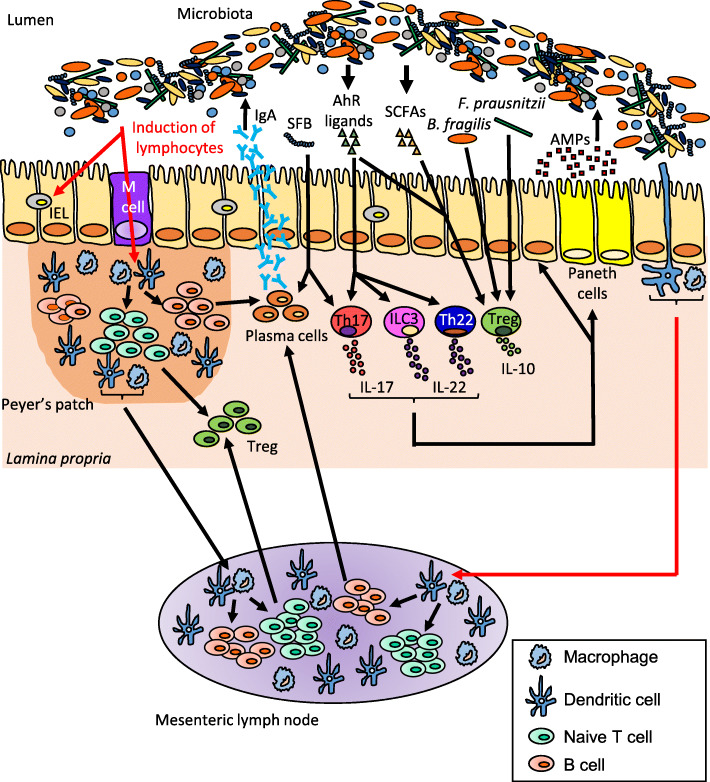
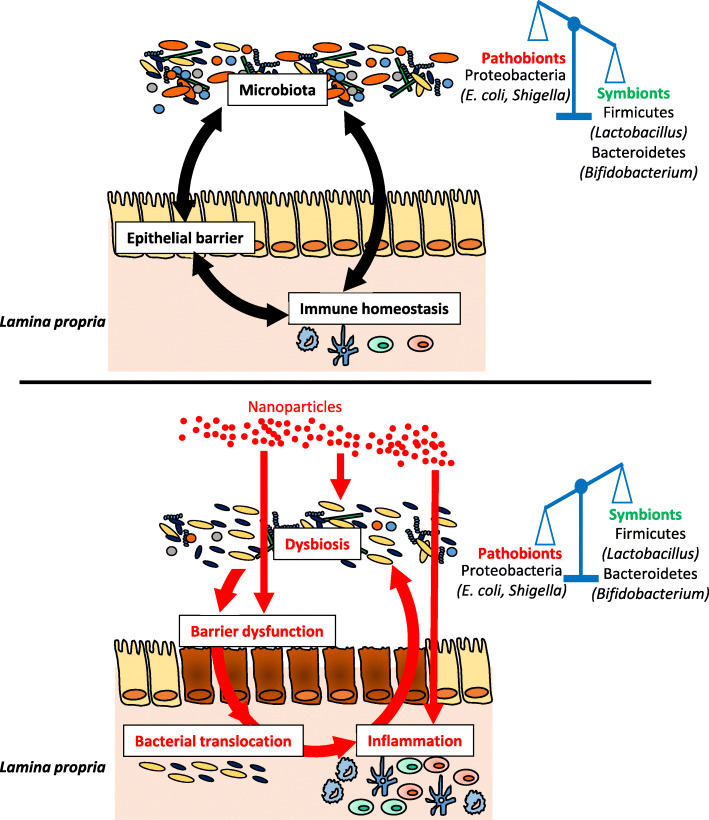
In food toxicology, there is growing interest in studying the impacts of foodborne nanoparticles (NPs, originating from food additives, food supplements or food packaging) on the intestinal microbiome due to the important and complex physiological roles of these microbial communities in host health. Biocidal activities, as described over recent years for most inorganic and metal NPs, could favour chronic changes in the composition and/or metabolic activities of commensal bacteria (namely, intestinal dysbiosis) with consequences on immune functions. Reciprocally, direct interactions of NPs with the immune system (e.g., inflammatory responses, adjuvant or immunosuppressive properties) may in turn have effects on the gut microbiota. Many chronic diseases in humans are associated with alterations along the microbiota-immune system axis, such as inflammatory bowel diseases (IBD) (Crohn's disease and ulcerative colitis), metabolic disorders (e.g., obesity) or colorectal cancer (CRC). This raises the question of whether chronic dietary exposure to inorganic NPs may be viewed as a risk factor facilitating disease onset and/or progression. Deciphering the variety of effects along the microbiota-immune axis may aid the understanding of how daily exposure to inorganic NPs through various foodstuffs may potentially disturb the intricate dialogue between gut commensals and immunity, hence increasing the vulnerability of the host. In animal studies, dose levels and durations of oral treatment are key factors for mimicking exposure conditions to which humans are or may be exposed through the diet on a daily basis, and are needed for hazard identification and risk assessment of foodborne NPs. This review summarizes relevant studies to support the development of predictive toxicological models that account for the gut microbiota-immune axis.
The literature indicates that, in addition to evoking immune dysfunctions in the gut, inorganic NPs exhibit a moderate to extensive impact on intestinal microbiota composition and activity, highlighting a recurrent signature that favours colonization of the intestine by pathobionts at the expense of beneficial bacterial strains, as observed in IBD, CRC and obesity. Considering the long-term exposure via food, the effects of NPs on the gut microbiome should be considered in human health risk assessment, especially when a nanomaterial exhibits antimicrobial properties.
在食品毒理学中,由于这些微生物群落对宿主健康具有重要而复杂的生理作用,因此越来越关注研究食源纳米颗粒(NPs,源自食品添加剂、食品补充剂或食品包装)对肠道微生物组的影响。近年来,正如大多数无机和金属 NPs 所描述的那样,杀菌活性可能有利于共生菌(即肠道菌群失调)组成和/或代谢活性的慢性变化,从而对免疫功能产生影响。反过来,NPs 与免疫系统的直接相互作用(例如炎症反应、佐剂或免疫抑制特性)也可能对肠道微生物群产生影响。人类的许多慢性疾病都与微生物群-免疫系统轴的改变有关,例如炎症性肠病(IBD)(克罗恩病和溃疡性结肠炎)、代谢紊乱(如肥胖)或结直肠癌(CRC)。这就提出了一个问题,即慢性饮食摄入无机 NPs 是否可以被视为促进疾病发生和/或进展的危险因素。沿着微生物群-免疫系统轴解析各种影响可能有助于理解通过各种食品每日暴露于无机 NPs 如何可能破坏肠道共生体和免疫之间的复杂对话,从而增加宿主的脆弱性。在动物研究中,口服治疗的剂量水平和持续时间是模拟人类通过饮食每日暴露于食源纳米颗粒的暴露条件的关键因素,对于识别食源纳米颗粒的危害和进行风险评估是必要的。本综述总结了相关研究,以支持开发考虑肠道微生物群-免疫系统轴的预测毒理学模型。
文献表明,除了在肠道中引发免疫功能障碍外,无机 NPs 对肠道微生物组的组成和活性也具有中度到广泛的影响,突出了一种反复出现的特征,即有利于病原菌在肠道中定植,而牺牲有益的细菌菌株,如在 IBD、CRC 和肥胖中观察到的那样。考虑到通过食物进行长期暴露,应该在人类健康风险评估中考虑 NPs 对肠道微生物组的影响,特别是当纳米材料具有抗菌特性时。