Hardy Anthony, Benford Diane, Halldorsson Thorhallur, Jeger Michael John, Knutsen Helle Katrine, More Simon, Naegeli Hanspeter, Noteborn Hubert, Ockleford Colin, Ricci Antonia, Rychen Guido, Schlatter Josef R, Silano Vittorio, Solecki Roland, Turck Dominique, Younes Maged, Chaudhry Qasim, Cubadda Francesco, Gott David, Oomen Agnes, Weigel Stefan, Karamitrou Melpo, Schoonjans Reinhilde, Mortensen Alicja
EFSA J. 2018 Jul 4;16(7):e05327. doi: 10.2903/j.efsa.2018.5327. eCollection 2018 Jul.
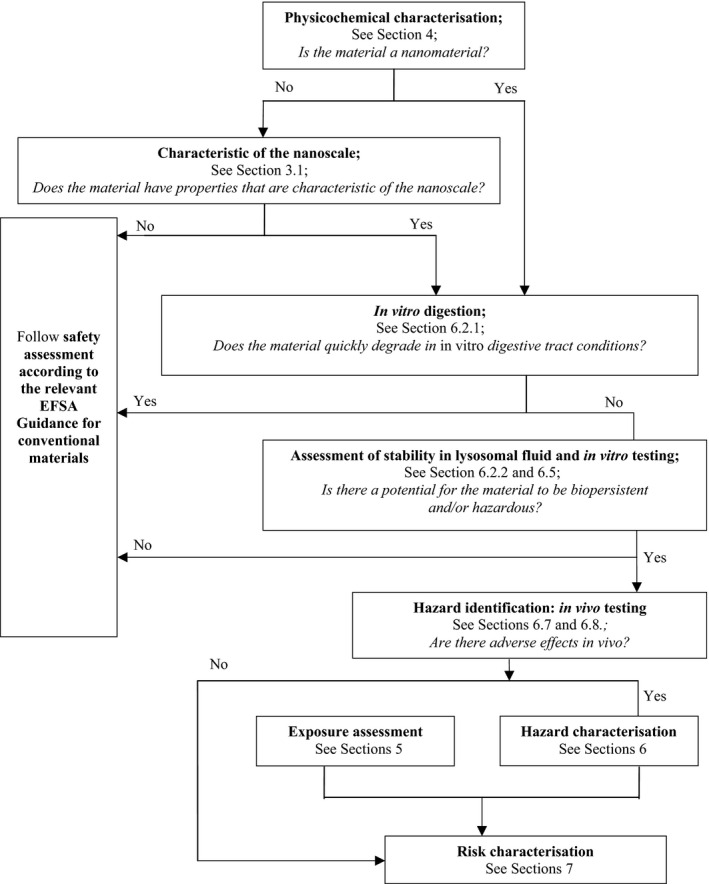
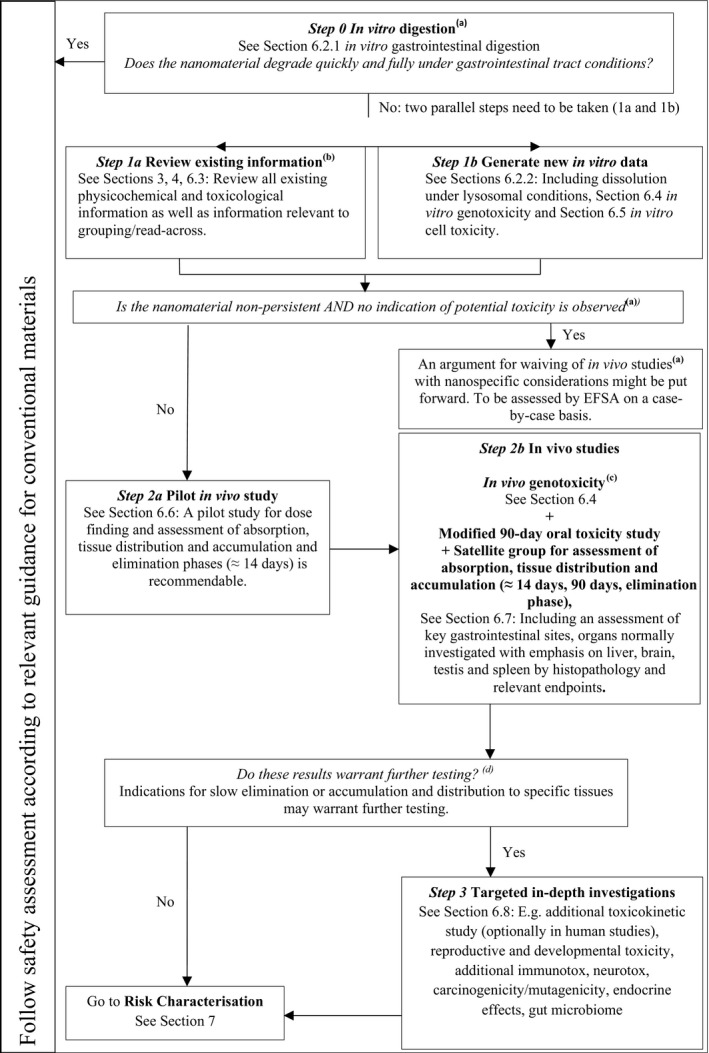
The European Food Safety Authority has produced this Guidance on human and animal health aspects (Part 1) of the risk assessment of nanoscience and nanotechnology applications in the food and feed chain. It covers the application areas within EFSA's remit, e.g. novel foods, food contact materials, food/feed additives and pesticides. The Guidance takes account of the new developments that have taken place since publication of the previous Guidance in 2011. Potential future developments are suggested in the scientific literature for nanoencapsulated delivery systems and nanocomposites in applications such as novel foods, food/feed additives, biocides, pesticides and food contact materials. Therefore, the Guidance has taken account of relevant new scientific studies that provide more insights to physicochemical properties, exposure assessment and hazard characterisation of nanomaterials. It specifically elaborates on physicochemical characterisation of nanomaterials in terms of how to establish whether a material is a nanomaterial, the key parameters that should be measured, the methods and techniques that can be used for characterisation of nanomaterials and their determination in complex matrices. It also details the aspects relating to exposure assessment and hazard identification and characterisation. In particular, nanospecific considerations relating to / toxicological studies are discussed and a tiered framework for toxicological testing is outlined. It describes degradation, toxicokinetics, genotoxicity as well as general issues relating to testing of nanomaterials. Depending on the initial tier results, studies may be needed to investigate reproductive and developmental toxicity, immunotoxicity, allergenicity, neurotoxicity, effects on gut microbiome and endocrine activity. The possible use of read-across to fill data gaps as well as the potential use of integrated testing strategies and the knowledge of modes/mechanisms of action are also discussed. The Guidance proposes approaches to risk characterisation and uncertainty analysis, and provides recommendations for further research in this area.
欧洲食品安全局制定了本关于食品和饲料链中纳米科学与纳米技术应用的人类和动物健康方面(第1部分)的指南。它涵盖了欧洲食品安全局职责范围内的应用领域,例如新型食品、食品接触材料、食品/饲料添加剂和农药。本指南考虑了自2011年上一版指南发布以来发生的新进展。科学文献中针对新型食品、食品/饲料添加剂、杀生物剂、农药和食品接触材料等应用中的纳米封装递送系统和纳米复合材料提出了潜在的未来发展方向。因此,本指南考虑了相关的新科学研究,这些研究为纳米材料的物理化学性质、暴露评估和危害特征提供了更多见解。它具体阐述了纳米材料的物理化学表征,包括如何确定一种材料是否为纳米材料、应测量的关键参数、可用于纳米材料表征及其在复杂基质中测定的方法和技术。它还详细介绍了与暴露评估以及危害识别和特征相关的方面。特别是,讨论了与毒理学研究相关的纳米特异性考虑因素,并概述了毒理学测试的分层框架。它描述了纳米材料的降解、毒代动力学、遗传毒性以及一般测试问题。根据初始分层结果,可能需要进行研究以调查生殖和发育毒性、免疫毒性、致敏性、神经毒性、对肠道微生物群的影响以及内分泌活性。还讨论了利用类推填补数据空白的可能性以及综合测试策略的潜在用途和作用模式/机制的知识。本指南提出了风险特征描述和不确定性分析的方法,并为该领域的进一步研究提供了建议。