Department of Breast Surgery, The First Affiliated Hospital, College of Medicine, Zhejiang University, Hangzhou, China.
Department of Oncology, The Second Affiliated Hospital of Xi'an Jiaotong University, Xi'an, China.
Aging (Albany NY). 2020 Jun 2;12(11):10772-10794. doi: 10.18632/aging.103292.
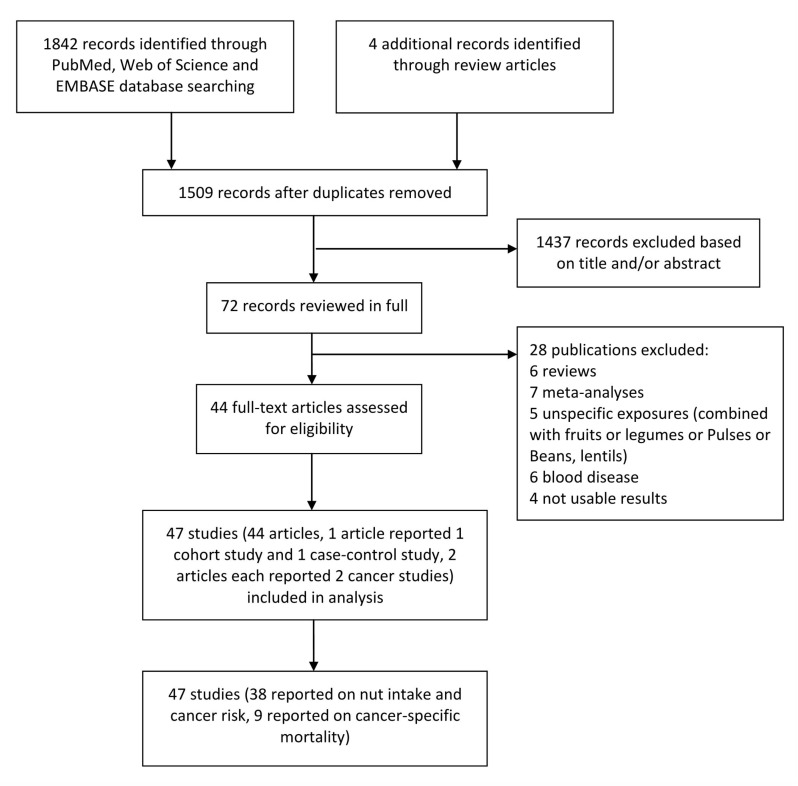
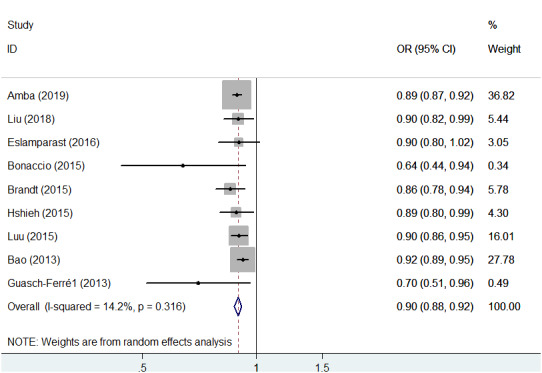
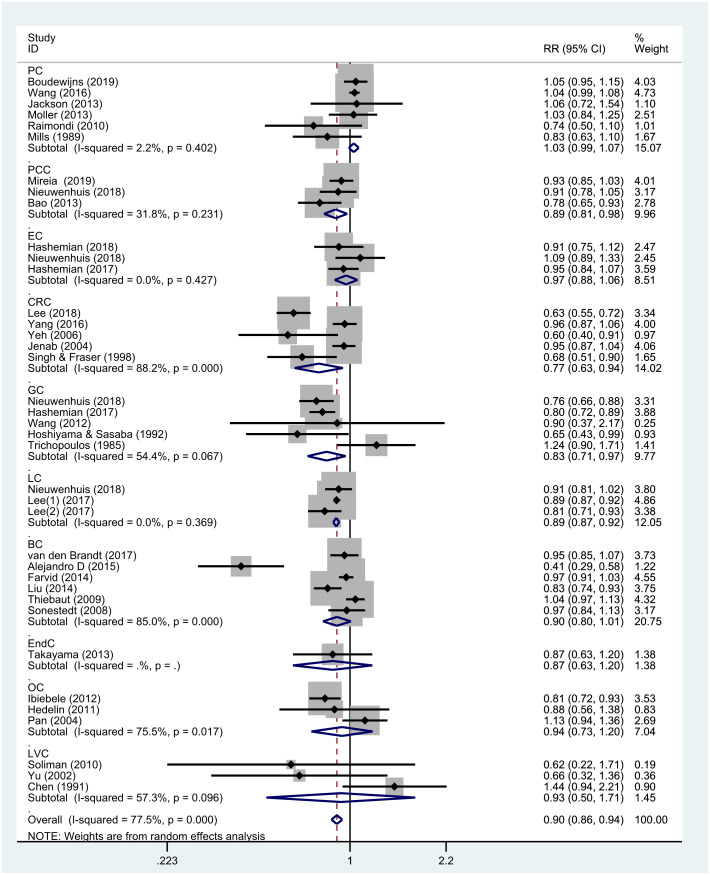
Previous studies have indicated a correlation between nut intake and cancer risk in humans. This meta-analysis aimed to determine the relationship between nut consumption and the risks of cancer incidence and mortality. The PubMed, Embase, and Web of Science databases were searched up to August 2019. Relative risks and 95% confidence intervals were calculated using random-effects and fixed-effects models. We included 38 studies on nut consumption and cancer risk and 9 studies on cancer-specific mortality. Compared with no nut intake, nut intake was associated with a lower cancer risk (Relative Risk=0.90; 95% confidence interval, 0.86-0.94). Inverse associations were observed with colorectal cancer, gastric cancer, pancreatic cancer, and lung cancer in subgroup analyses. Tree nut consumption was found to reduce cancer risk (Relative Risk=0.88; 95% confidence interval, 0.79-0.99). Dose-response curves suggested that protective benefits against cancer increased with increased nut intake (P=0.005, P-nonlinearity=0.0414). An inverse correlation with cancer-specific mortality (Odd Ratio=0.90; 95% confidence interval, 0.88-0.92) was observed. In conclusion, nut consumption is inversely associated with the risks of cancer incidence and mortality; a higher intake is significantly associated with a lower cancer risk.
先前的研究表明坚果摄入与人类癌症风险之间存在相关性。本荟萃分析旨在确定坚果消费与癌症发病率和死亡率风险之间的关系。我们检索了 PubMed、Embase 和 Web of Science 数据库,截至 2019 年 8 月。使用随机效应和固定效应模型计算相对风险和 95%置信区间。我们纳入了 38 项关于坚果消费与癌症风险的研究和 9 项关于癌症特异性死亡率的研究。与不摄入坚果相比,摄入坚果与较低的癌症风险相关(相对风险=0.90;95%置信区间,0.86-0.94)。亚组分析显示,与结直肠癌、胃癌、胰腺癌和肺癌呈负相关。树坚果的摄入被发现可降低癌症风险(相对风险=0.88;95%置信区间,0.79-0.99)。剂量-反应曲线表明,随着坚果摄入量的增加,对癌症的保护作用增加(P=0.005,P-非线性=0.0414)。还观察到与癌症特异性死亡率呈负相关(比值比=0.90;95%置信区间,0.88-0.92)。总之,坚果的摄入与癌症发病率和死亡率的风险呈负相关;较高的摄入量与较低的癌症风险显著相关。