Medicine Design, Pfizer Inc, 1 Portland Street, Cambridge, Massachusetts, 02139, United States.
Medicine Design, Pfizer Inc, Eastern Point Road, Groton, Connecticut, 06340, United States.
Sci Rep. 2020 Jun 2;10(1):8974. doi: 10.1038/s41598-020-65762-y.
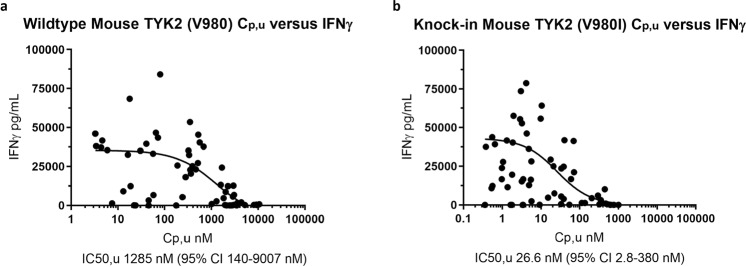
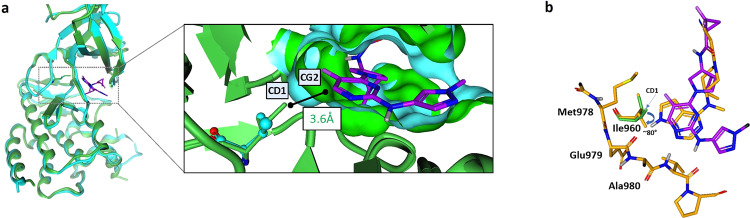
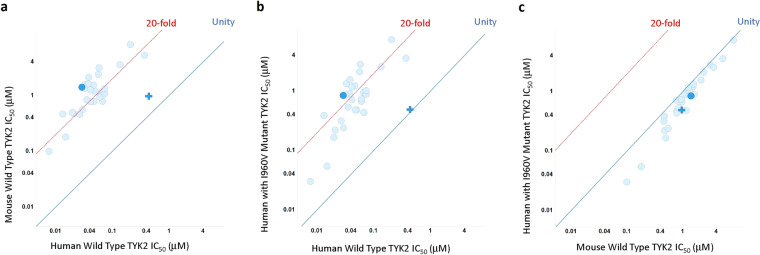
Translation of modulation of drug target activity to therapeutic effect is a critical aspect for all drug discovery programs. In this work we describe the profiling of a non-receptor tyrosine-protein kinase (TYK2) inhibitor which shows a functionally relevant potency shift between human and preclinical species (e.g. murine, dog, macaque) in both biochemical and cellular assays. Comparison of the structure and sequence homology of TYK2 between human and preclinical species within the ATP binding site highlights a single amino acid (I960 → V) responsible for the potency shift. Through TYK2 kinase domain mutants and a TYK2 980I knock-in mouse model, we demonstrate that this single amino acid change drives a functionally relevant potency difference that exists between human and all evaluated preclinical species, for a series of TYK2 inhibitors which target the ATP binding site.
药物靶标活性调节与治疗效果之间的关系是所有药物发现项目的一个关键方面。在这项工作中,我们描述了一种非受体酪氨酸蛋白激酶(TYK2)抑制剂的分析,该抑制剂在生化和细胞测定中显示出在人类和临床前物种(例如鼠、犬、猕猴)之间具有功能相关的效力转变。在 ATP 结合位点内比较 TYK2 人类和临床前物种的结构和序列同源性,突出了一个单一的氨基酸(I960→V)负责效力转变。通过 TYK2 激酶结构域突变体和 TYK2 980I 敲入小鼠模型,我们证明这种单一氨基酸变化导致了在人类和所有评估的临床前物种之间存在的功能相关的效力差异,对于一系列靶向 ATP 结合位点的 TYK2 抑制剂而言。