Department of Psychiatry and Biobehavioral Sciences, University of California Los Angeles, Los Angeles, USA.
Autism & Neurodevelopmental Disorders Institute, The George Washington University School of Medicine and Health Sciences, Washington D.C., USA.
Transl Psychiatry. 2020 Jun 2;10(1):178. doi: 10.1038/s41398-020-0824-8.
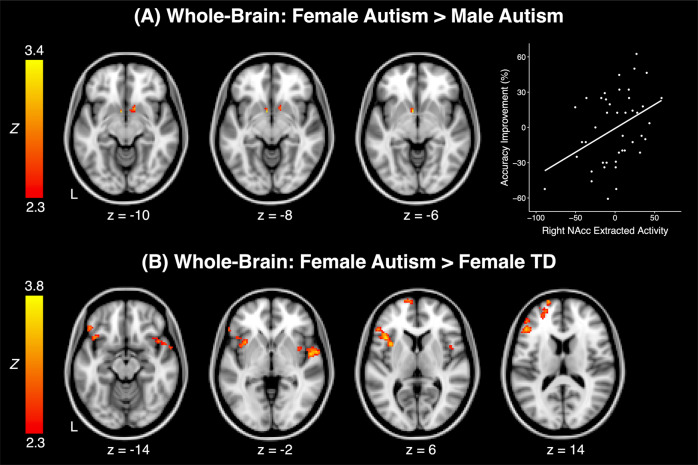
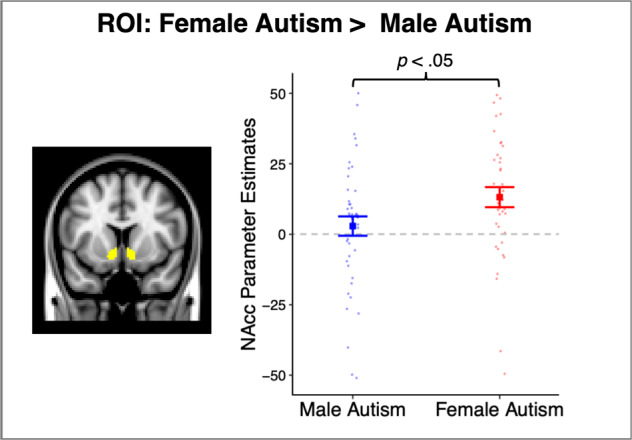
Autism is hypothesized to be in part driven by a reduced sensitivity to the inherently rewarding nature of social stimuli. Previous neuroimaging studies have indicated that autistic males do indeed display reduced neural activity to social rewards, but it is unknown whether this finding extends to autistic females, particularly as behavioral evidence suggests that affected females may not exhibit the same reduction in social motivation as their male peers. We therefore used functional magnetic resonance imaging to examine social reward processing during an instrumental implicit learning task in 154 children and adolescents (ages 8-17): 39 autistic girls, 43 autistic boys, 33 typically developing girls, and 39 typically developing boys. We found that autistic girls displayed increased activity to socially rewarding stimuli, including greater activity in the nucleus accumbens relative to autistic boys, as well as greater activity in lateral frontal cortices and the anterior insula compared with typically developing girls. These results demonstrate for the first time that autistic girls do not exhibit the same reduction in activity within social reward systems as autistic boys. Instead, autistic girls display increased neural activation to such stimuli in areas related to reward processing and salience detection. Our findings indicate that a reduced sensitivity to social rewards, as assessed with a rewarded instrumental implicit learning task, does not generalize to affected female youth and highlight the importance of studying potential sex differences in autism to improve our understanding of the condition and its heterogeneity.
自闭症被假设部分是由于对社会刺激固有的奖励性质的敏感性降低所致。先前的神经影像学研究表明,自闭症男性确实表现出对社会奖励的神经活动减少,但尚不清楚这一发现是否适用于自闭症女性,特别是因为行为证据表明,受影响的女性可能不会像男性同龄人那样表现出相同的社交动机降低。因此,我们使用功能磁共振成像技术,在 154 名儿童和青少年(8-17 岁)中检查了社会奖励处理:39 名自闭症女孩、43 名自闭症男孩、33 名典型发育女孩和 39 名典型发育男孩。我们发现,自闭症女孩对社会奖励刺激的反应更加活跃,包括与自闭症男孩相比,伏隔核的活动增加,以及与典型发育女孩相比,外侧额叶皮质和前岛叶的活动增加。这些结果首次表明,自闭症女孩的社交奖励系统中的活动减少与自闭症男孩不同。相反,自闭症女孩在与奖励处理和突显检测相关的区域对这些刺激显示出更高的神经激活。我们的发现表明,用奖励性工具性隐性学习任务评估的对社会奖励的敏感性降低并不适用于受影响的女性青少年,这突显了研究自闭症中的潜在性别差异的重要性,以提高我们对该疾病及其异质性的理解。