Epigenetic Health Solutions, Unit of Nephrology, Ankara, Turkey.
Division of Paediatric Rheumatology, Victoria Children's Hospital, University of Western Ontario, London, ON, Canada.
Sci Rep. 2020 Jun 2;10(1):9018. doi: 10.1038/s41598-020-65528-6.
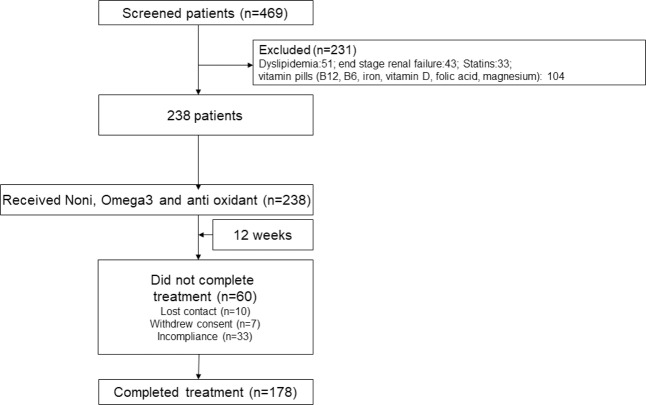
While the pathophysiology of chronic disorders varies there are three basic mechanisms - inflammation, oxidative stress and endothelial dysfunction - that are common in many chronic diseases. However, the failure of these mechanisms to work synchronously can lead to morbidity complicating the course of many chronic diseases. We analyzed data of 178 patients from cohorts with selected chronic diseases in this quasi-experimental study. Endothelial dysfunction was determined by flow-mediated dilatation (FMD) and asymmetric dimethylarginine (ADMA) levels. Serum ADMA, high sensitive C-reactive protein (hs-CRP), serum PTX3, malondialdehyde (MDA), Cu/Zn-superoxide dismutase (Cu/Zn-SOD), glutathione peroxidase (GSH-Px) levels and FMD were studied in baseline and after 12 weeks of Morinda citrifolia (anti-atherosclerotic liquid- AAL), omega-3 (anti-inflammatory capsules- AIC) and extract with Alaskan blueberry (anti-oxidant liquid- AOL). Stepwise multivariate regression analysis was used to evaluate the association of FMD with clinical and serologic parameters. Serum ADMA, MDA, PTX3, hsCRP and albumin levels, and proteinuria were significantly decreased while CuZn-SOD, GSH-Px and FMD levels were significantly increased following AAL, AIC and AOL therapies. The FMD was negatively correlated with serum ADMA, MDA, PTX3, and hsCRP levels and positively correlated with CuZn-SOD and eGFR levels. ADMA and PTX3 levels were independently related to FMD both before and after AAL, AIC and AOL therapies. Our study shows that serum ADMA, MDA, PTX3 levels are associated with endothelial dysfunction in patients with selected chronic diseases. In addition, short-term AAL, AIC and AOL therapies significantly improves a number of parameters in our cohort and can normalize ADMA, PTX3, hsCRP and MDA levels.
虽然慢性疾病的病理生理学有所不同,但有三种基本机制——炎症、氧化应激和内皮功能障碍——在许多慢性疾病中都很常见。然而,如果这些机制不能协同工作,就会导致发病率增加,使许多慢性疾病的病程复杂化。在这项准实验研究中,我们分析了来自具有选定慢性疾病队列的 178 名患者的数据。内皮功能障碍通过血流介导的扩张(FMD)和不对称二甲基精氨酸(ADMA)水平来确定。在基线和 Morinda citrifolia(抗动脉粥样硬化液-AAL)、omega-3(抗炎胶囊-AIC)和阿拉斯加蓝莓提取物(抗氧化液-AOL)治疗 12 周后,研究了血清 ADMA、高敏 C 反应蛋白(hs-CRP)、血清 PTX3、丙二醛(MDA)、Cu/Zn-超氧化物歧化酶(Cu/Zn-SOD)、谷胱甘肽过氧化物酶(GSH-Px)水平和 FMD。逐步多元回归分析用于评估 FMD 与临床和血清学参数的相关性。AAL、AIC 和 AOL 治疗后,血清 ADMA、MDA、PTX3、hsCRP 和白蛋白水平显著降低,CuZn-SOD、GSH-Px 和 FMD 水平显著升高。FMD 与血清 ADMA、MDA、PTX3 和 hsCRP 水平呈负相关,与 CuZn-SOD 和 eGFR 水平呈正相关。ADMA 和 PTX3 水平在 AAL、AIC 和 AOL 治疗前后与 FMD 独立相关。我们的研究表明,血清 ADMA、MDA、PTX3 水平与选定慢性疾病患者的内皮功能障碍有关。此外,短期 AAL、AIC 和 AOL 治疗显著改善了我们队列中的许多参数,并能使 ADMA、PTX3、hsCRP 和 MDA 水平正常化。