Ji Wenting, Zhang Qianyi, Shi Hanfen, Dong Ruijuan, Ge Dongyu, Du Xin, Ren Beida, Wang Xueqian, Wang Qingguo
Beijing University of Chinese Medicine, Beijing, 100029 China.
Chin Med. 2020 May 24;15:53. doi: 10.1186/s13020-020-00334-w. eCollection 2020.
Asthma, a common respiratory disease, is harmful biological effect to our health. As a traditional Chinese medicine for asthma, Majie cataplasm could alleviate the symptoms of asthma and its compositions have immunomodulatory effects. Previous experiments showed that Majie cataplasm was an effective approach to mitigate asthma airway remodeling and had the potential to regulate Th2 cytokines of IL-5 and IL-13. Therefore, our further research focuses on the explanation about the regulatory effect of Majie cataplasm on reshaping Th1/Th2 through their related transcription factors.
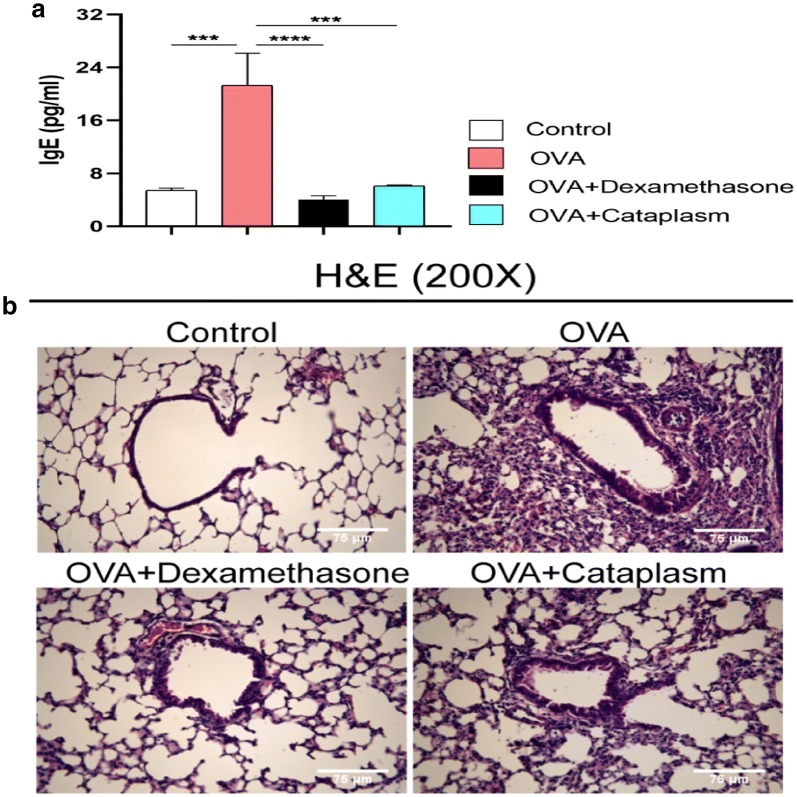
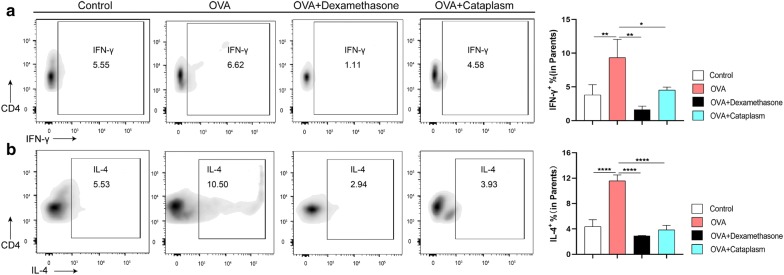
In this experiment, the launch of asthma model was made by inducing with Ovalbumin (OVA) in C57 mice (n = 40), including 4 groups: the untreated control group (n = 10), the asthma model group (n = 10), the dexamethasone group (n = 10) and the Majie cataplasm group (n = 10). After the intervention, all groups of animals got detected for serum IgE levels, and HE staining of lung tissues was to observe and examine pathological changes. Meanwhile, we analyzed the secretion of IL-4 T cells and IFN-γ T cells in spleen by flow cytometry. The expressions of transcription factor STAT6 mRNA, GATA-3 mRNA and T-bet mRNA in lung tissues was tested by PCR, and western blot had been used to detect levels of JAK2 and STAT3.
We found that Majie cataplasm eased the content of serum IgE and lung inflammation. It could lower the increased number of IL-4 T cells and IFN-γ T cells (< 0.0001, < 0.01) in asthmatic mice and curb the expression of STAT6 mRNA and GATA-3 (< 0.0001< 0.01) mRNA as well as the protein levels of JAK2 (< 0.001) and the ratio of pSTAT3/STAT3 (< 0.05). Besides, Majie cataplasm made its mark on T-bet mRNA by improving it (< 0.0001).
These data suggest that Majie cataplasm exert an anti-inflammatory effect of Th2 by rebalancing Th1/Th2 through corresponding transcription factor STAT6, GATA-3, STAT3, and T-bet, which providing a strong cornerstone for asthma control.
哮喘是一种常见的呼吸系统疾病,对我们的健康具有有害的生物学效应。作为治疗哮喘的传统中药,麻杏石甘贴膏可缓解哮喘症状,其成分具有免疫调节作用。先前的实验表明,麻杏石甘贴膏是减轻哮喘气道重塑的有效方法,并且具有调节白细胞介素-5(IL-5)和白细胞介素-13(IL-13)等Th2细胞因子的潜力。因此,我们进一步的研究重点是通过相关转录因子来解释麻杏石甘贴膏对Th1/Th2重塑的调节作用。
在本实验中,通过用卵清蛋白(OVA)诱导C57小鼠(n = 40)建立哮喘模型,包括4组:未处理的对照组(n = 10)、哮喘模型组(n = 10)、地塞米松组(n = 10)和麻杏石甘贴膏组(n = 10)。干预后,检测所有组动物的血清IgE水平,并对肺组织进行苏木精-伊红(HE)染色以观察和检查病理变化。同时,通过流式细胞术分析脾脏中IL-4 T细胞和干扰素-γ(IFN-γ)T细胞的分泌情况。通过聚合酶链反应(PCR)检测肺组织中转录因子信号转导子和转录激活子6(STAT6)mRNA、GATA结合蛋白3(GATA-3)mRNA和T-框蛋白(T-bet)mRNA的表达,并使用蛋白质免疫印迹法检测Janus激酶2(JAK2)和信号转导子和转录激活子3(STAT3)的水平。
我们发现麻杏石甘贴膏可降低血清IgE含量和减轻肺部炎症。它可以降低哮喘小鼠中IL-4 T细胞和IFN-γ T细胞数量的增加(<0.0001,<0.01),抑制STAT6 mRNA和GATA-3 mRNA的表达(<0.0001,<0.01)以及JAK2的蛋白水平(<0.001)和磷酸化STAT3与STAT3的比值(<0.05)。此外,麻杏石甘贴膏通过提高T-bet mRNA水平(<0.0001)而产生显著效果。
这些数据表明,麻杏石甘贴膏通过相应的转录因子STAT6、GATA-3、STAT3和T-bet重新平衡Th1/Th2,从而发挥Th2抗炎作用,这为哮喘控制提供了有力的基石。