Jiao Long, Liu Yongzhuo, Zhang Xiaoye, Hong Gaobo, Zheng Jing, Cui Jingnan, Peng Xiaojun, Song Fengling
State Key Laboratory of Fine Chemicals, Dalian University of Technology, No. 2 Linggong Road, High-tech District, Dalian 116024, P. R. China.
Shandong Collaborative Innovation Center of Eco-Chemical Engineering, College of Chemical Engineering, Qingdao University of Science and Technology, No. 53 Zhengzhou Road, Shibei District, Qingdao 266042, P. R. China.
ACS Cent Sci. 2020 May 27;6(5):747-759. doi: 10.1021/acscentsci.0c00071. Epub 2020 Apr 22.
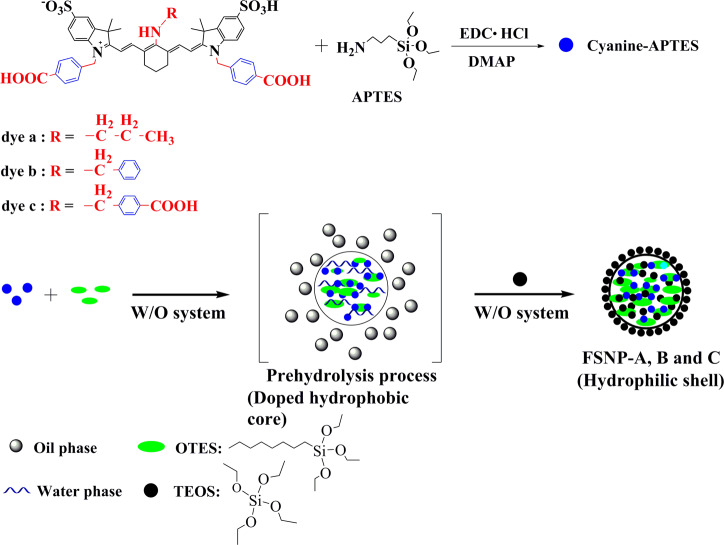
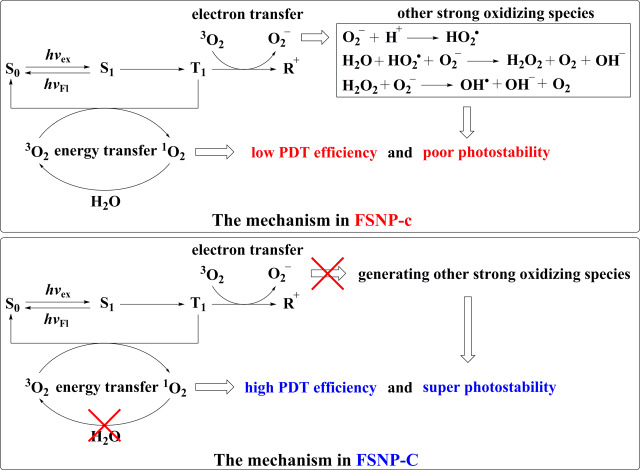
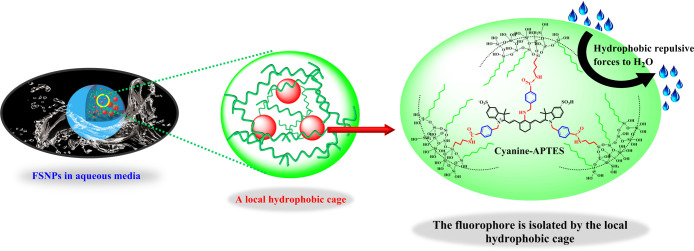
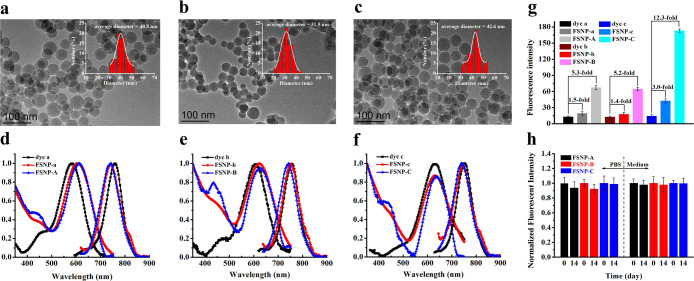
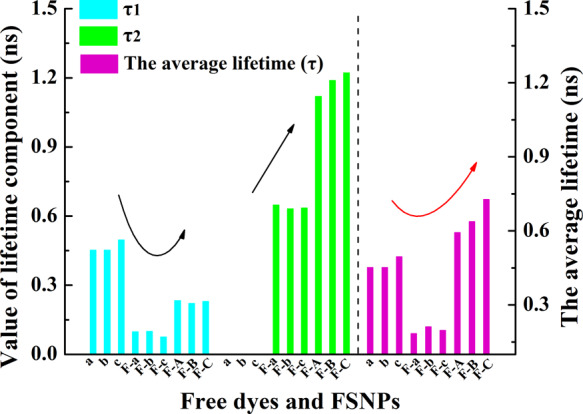
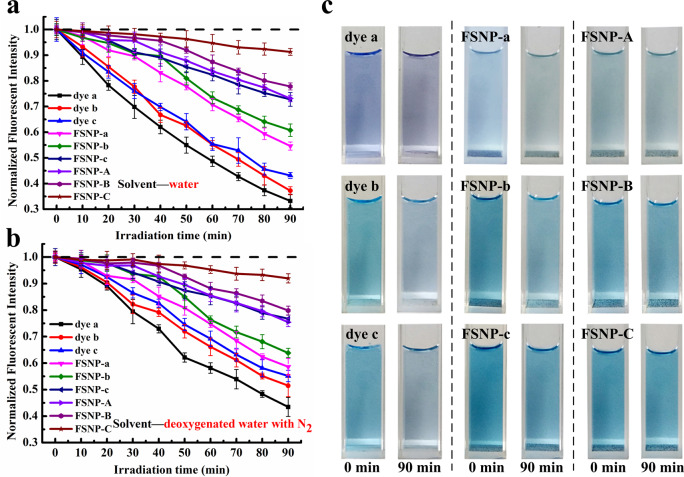
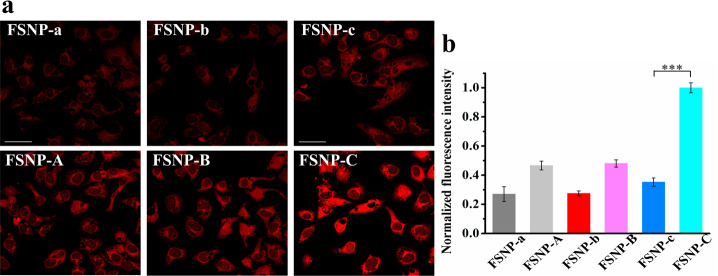
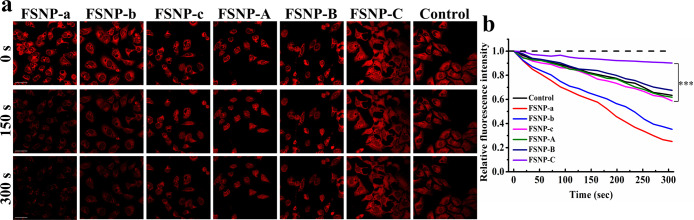
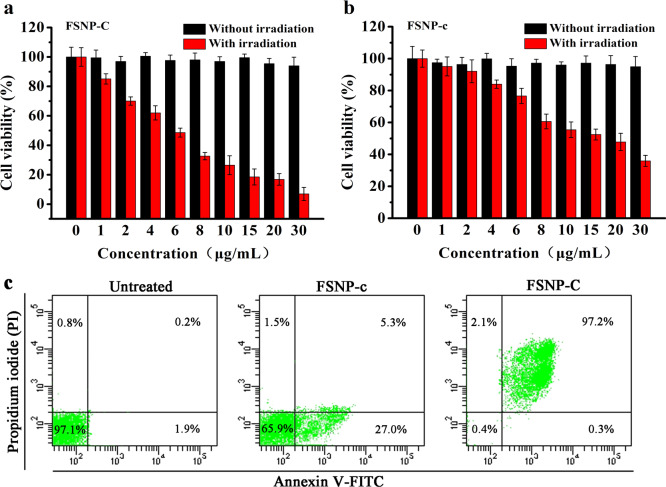
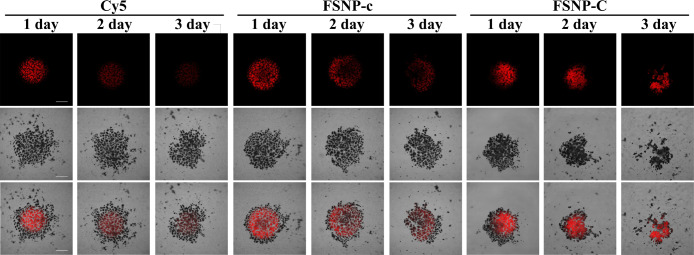
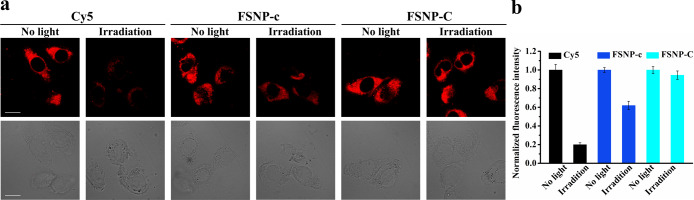
Aggregation-caused quenching (ACQ) and poor photostability in aqueous media are two common problems for organic fluorescence dyes which cause a dramatic loss of fluorescence imaging quality and photodynamic therapy (PDT) failure. Herein, a local hydrophobic cage is built up inside near-infrared (NIR) cyanine-anchored fluorescent silica nanoparticles (FSNPs) in which a hydrophobic silane coupling agent (-octyltriethoxysilane, OTES) is doped into FSNPs for the first time to significantly inhibit the ACQ effect and inward diffusion of water molecules. Therefore, the obtained optimal FSNP-C with OTES-modification can provide hydrophobic repulsive forces to effectively inhibit the π-π stacking interaction of cyanine dyes and simultaneously reduce the formation of strong oxidizing species (•OH and HO) in reaction with HO, resulting in the best photostability (fluorescent intensity remained at 90.1% of the initial value after 300 s of laser scanning) and a high PDT efficiency on two- and three-dimensional (spheroids) HeLa cell culture models. Moreover, through molecular engineering (including increasing covalent anchoring sites and steric hindrance groups of cyanine dyes), FSNP-C exhibits the highest fluorescent intensity both in water solution (12.3-fold improvement compared to free dye) and living cells due to the limitation of molecular motion. Thus, this study provides an effectively strategy by combining a local hydrophobic cage and molecular engineering for NIR FSNPs in long-term bright fluorescence imaging and a stable PDT process.
聚集诱导猝灭(ACQ)以及在水性介质中较差的光稳定性是有机荧光染料的两个常见问题,这会导致荧光成像质量急剧下降以及光动力疗法(PDT)失败。在此,在近红外(NIR)花菁锚定的荧光二氧化硅纳米颗粒(FSNPs)内部构建了一个局部疏水笼,其中首次将疏水硅烷偶联剂(-辛基三乙氧基硅烷,OTES)掺杂到FSNPs中,以显著抑制ACQ效应和水分子的向内扩散。因此,所获得的经OTES修饰的最佳FSNP-C能够提供疏水排斥力,有效抑制花菁染料的π-π堆积相互作用,同时减少与HO反应时强氧化物种(•OH和HO)的形成,从而实现最佳的光稳定性(激光扫描300秒后荧光强度保持在初始值的90.1%)以及在二维和三维(球体)HeLa细胞培养模型上具有高PDT效率。此外,通过分子工程(包括增加花菁染料的共价锚定位点和空间位阻基团),由于分子运动受限,FSNP-C在水溶液(与游离染料相比提高了12.3倍)和活细胞中均表现出最高的荧光强度。因此,本研究通过将局部疏水笼和分子工程相结合,为近红外FSNPs在长期明亮荧光成像和稳定的PDT过程中提供了一种有效的策略。