Xu Qian, Xiao Fangbin, Xu Hengyi
State Key Laboratory of Food Science and Technology, Nanchang University, Nanchang, 330047, PR China.
Trends Analyt Chem. 2023 Apr;161:116999. doi: 10.1016/j.trac.2023.116999. Epub 2023 Feb 23.
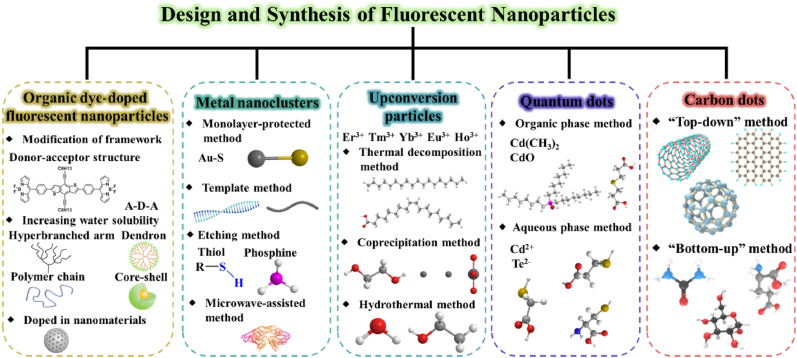
The spread of COVID-19 has caused huge economic losses and irreversible social impact. Therefore, to successfully prevent the spread of the virus and solve public health problems, it is urgent to develop detection methods with high sensitivity and accuracy. However, existing detection methods are time-consuming, rely on instruments, and require skilled operators, making rapid detection challenging to implement. Biosensors based on fluorescent nanoparticles have attracted interest in the field of detection because of their advantages, such as high sensitivity, low detection limit, and simple result readout. In this review, we systematically describe the synthesis, intrinsic advantages, and applications of organic dye-doped fluorescent nanoparticles, metal nanoclusters, up-conversion particles, quantum dots, carbon dots, and others for virus detection. Furthermore, future research initiatives are highlighted, including green production of fluorescent nanoparticles with high quantum yield, speedy signal reading by integrating with intelligent information, and error reduction by coupling with numerous fluorescent nanoparticles.
新型冠状病毒肺炎(COVID-19)的传播已造成巨大的经济损失和不可逆转的社会影响。因此,为成功预防病毒传播并解决公共卫生问题,迫切需要开发具有高灵敏度和准确性的检测方法。然而,现有的检测方法耗时、依赖仪器且需要熟练的操作人员,使得快速检测难以实施。基于荧光纳米颗粒的生物传感器因其高灵敏度、低检测限和结果读取简单等优点而在检测领域引起了关注。在这篇综述中,我们系统地描述了有机染料掺杂荧光纳米颗粒、金属纳米团簇、上转换颗粒、量子点、碳点等用于病毒检测的合成方法、固有优势及应用。此外,还强调了未来的研究方向,包括高量子产率荧光纳米颗粒的绿色生产、与智能信息集成的快速信号读取以及与多种荧光纳米颗粒耦合以减少误差。