Lee Sunyoung, Kim Seung-Seob, Chang Dong Ryul, Kim Hyerim, Kim Myeong-Jin
Department of Radiology and Research Institute of Radiological Science, Severance Hospital, Yonsei University College of Medicine, Seoul, Korea.
Biostatistics Collaboration Unit, Department of Biomedical Systems Informatics, Yonsei University College of Medicine, Seoul, Korea.
Clin Mol Hepatol. 2020 Jul;26(3):340-351. doi: 10.3350/cmh.2020.0004. Epub 2020 Jun 4.
BACKGROUND/AIMS: This study aimed to compare the diagnostic performances of Liver Imaging Reporting and Data System (LI-RADS) 2018 and Korean Liver Cancer Association-National Cancer Center (KLCA-NCC) 2018 criteria on magnetic resonance imaging (MRI) for the noninvasive diagnosis of hepatocellular carcinoma (HCC) in high-risk patients.
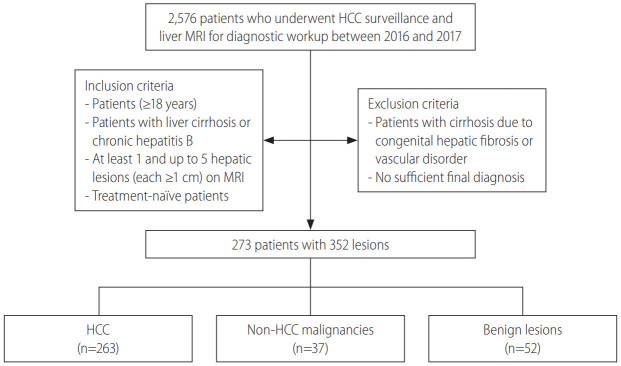
This retrospective study included 273 treatment-naïve patients (71 patients with extracellular contrast agent [ECA]-MRI and 202 patients with hepatobiliary agent [HBA]-MRI; 352 lesions including 263 HCCs) with high risk of HCC who underwent contrast-enhanced MRI between 2016 and 2017. Two readers evaluated all lesions according to the criteria of LI-RADS 2018 and KLCA-NCC 2018. The per-lesion diagnostic performances were compared using the generalized estimating equation method.
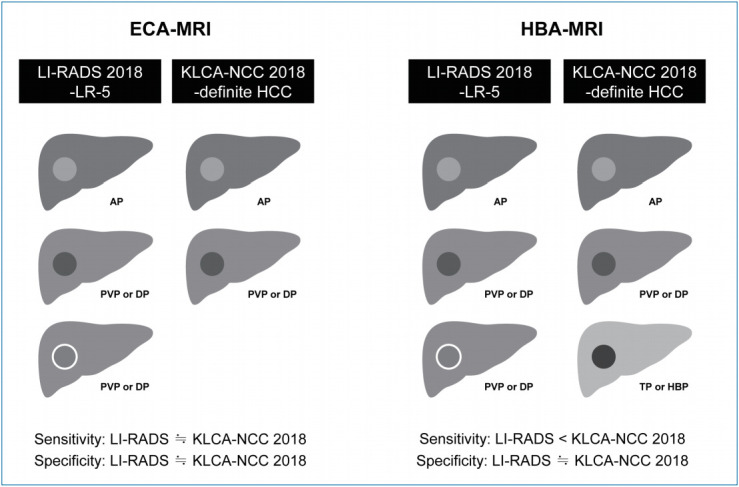
On ECA-MRI, the sensitivity and specificity of LI-RADS 2018 and KLCA-NCC 2018 were not significantly different (LR-5 vs. definite HCC: 75.8% vs. 69.4%, P=0.095 and 95.8% vs. 95.8%, P>0.999; LR-5/4 vs. definite/probable HCC: 87.1% vs.83.9%, P=0.313 and 87.5% vs. 91.7%, P=0.307). On HBA-MRI, definite HCC of KLCA-NCC 2018 showed significantly higher sensitivity (79.1% vs. 68.2%, P<0.001) than LR-5 of LI-RADS 2018 without a significant difference in specificity (93.9% vs. 95.4%, P=0.314). Definite/probable HCC of KLCA-NCC 2018 had higher specificity (92.3% vs. 80.0%, P=0.003) than LR-5/4 of LI-RADS 2018. The sensitivity was lower for definite/probable HCC than for LR-5/4 without statistical significance (85.6% vs. 88.1%, P=0.057).
On ECA-MRI, LI-RADS 2018 and KLCA-NCC 2018 showed comparable diagnostic performances. On HBA-MRI, definite HCC of KLCA-NCC 2018 provided better sensitivity than LR-5 category of LI-RADS 2018 without compromising the specificity, while definite/probable HCC of KLCA-NCC 2018 revealed higher specificity than LR-5/4 of LI-RADS 2018 for diagnosing HCC.
背景/目的:本研究旨在比较2018年肝脏影像报告和数据系统(LI-RADS)与2018年韩国肝癌协会-国立癌症中心(KLCA-NCC)标准在磁共振成像(MRI)上对高危患者肝细胞癌(HCC)的无创诊断性能。
这项回顾性研究纳入了2016年至2017年间接受对比增强MRI检查的273例未经治疗的HCC高危患者(71例接受细胞外对比剂[ECA]-MRI检查,202例接受肝胆对比剂[HBA]-MRI检查;352个病灶,包括263个HCC)。两名阅片者根据2018年LI-RADS和2018年KLCA-NCC标准对所有病灶进行评估。使用广义估计方程法比较每个病灶的诊断性能。
在ECA-MRI上,2018年LI-RADS和2018年KLCA-NCC的敏感性和特异性无显著差异(LR-5与确诊HCC:75.8%对69.4%,P=0.095;95.8%对95.8%,P>0.999;LR-5/4与确诊/可能HCC:87.1%对83.9%,P=0.313;87.5%对91.7%,P=0.307)。在HBA-MRI上,2018年KLCA-NCC的确诊HCC显示出比2018年LI-RADS的LR-5更高的敏感性(79.1%对68.2%,P<0.001),而特异性无显著差异(93.9%对95.4%,P=0.314)。2018年KLCA-NCC的确诊/可能HCC比2018年LI-RADS的LR-5/4具有更高的特异性(92.3%对80.0%,P=0.003)。确诊/可能HCC的敏感性低于LR-5/4,但无统计学意义(85.6%对88.1%,P=0.057)。
在ECA-MRI上,2018年LI-RADS和2018年KLCA-NCC显示出可比的诊断性能。在HBA-MRI上,2018年KLCA-NCC的确诊HCC在不影响特异性的情况下比2018年LI-RADS的LR-5类别具有更好的敏感性,而2018年KLCA-NCC的确诊/可能HCC在诊断HCC时比2018年LI-RADS的LR-5/4具有更高的特异性。