Mondal Dibakar, Zaharia Andrei, Mequanint Kibret, Rizkalla Amin S
Department of Chemical and Biochemical Engineering, The University of Western Ontario, London, ON N6A 5B9, Canada.
Bone and Joint Institute, The University of Western Ontario, London, ON N6A 5B9, Canada.
J Funct Biomater. 2020 Jun 1;11(2):35. doi: 10.3390/jfb11020035.
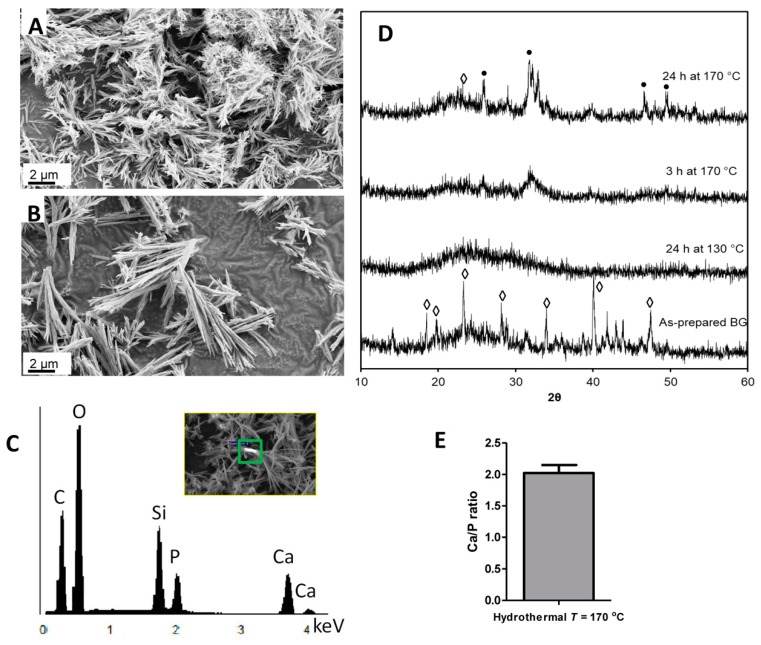
Bioactive glass (BG) nanoparticles have wide applications in bone repair due to their bone-bonding and biodegradable nature. In this work, nanometric rod-shaped ternary SiO-CaO-PO bioactive glass particles were prepared through sol-gel chemistry followed by a base-induced hydrothermal process at 130 °C and 170 °C for various times up to 36 h. This facile, low-temperature and surfactant-free hydrothermal process has shown to be capable of producing uniform nanorods and nanowires. One-dimensional growth of nanorods and the characteristics of siloxane bridging networks were dependent on the hydrothermal temperature and time. Hardened bioactive composites were prepared from BG nanorods and cryo-milled poly(vinylpyrrolidone-co-triethoxyvinylsilane) in the presence of ammonium phosphate as potential bone graft biomaterials. Covalent crosslinking has been observed between the organic and inorganic components within these composites. The ultimate compressive strength and modulus values increased with increasing co-polymer content, reaching 27 MPa and 500 MPa respectively with 30% co-polymer incorporation. The materials degraded in a controlled non-linear manner when incubated in phosphate-buffered saline from 6 h to 14 days. Fibroblast cell attachment and spreading on the composite were not as good as the positive control surfaces and suggested that they may require protein coating in order to promote favorable cell interactions.
生物活性玻璃(BG)纳米颗粒因其具有骨结合和可生物降解的特性,在骨修复领域有着广泛的应用。在本研究中,通过溶胶 - 凝胶化学法制备了纳米级棒状三元SiO-CaO-PO生物活性玻璃颗粒,随后在130℃和170℃下进行碱诱导水热过程,反应时间长达36小时。这种简便、低温且无表面活性剂的水热过程已证明能够制备出均匀的纳米棒和纳米线。纳米棒的一维生长以及硅氧烷桥连网络的特性取决于水热温度和时间。以BG纳米棒和冷冻研磨的聚(乙烯基吡咯烷酮 - 共 - 三乙氧基乙烯基硅烷)为原料,在磷酸铵存在下制备了硬化生物活性复合材料,作为潜在的骨移植生物材料。在这些复合材料中,已观察到有机和无机成分之间发生了共价交联。随着共聚物含量的增加,极限抗压强度和模量值也随之增加,当共聚物掺入量为30%时,分别达到27MPa和500MPa。当在磷酸盐缓冲盐水中孵育6小时至14天时,材料以可控的非线性方式降解。成纤维细胞在复合材料上的附着和铺展不如阳性对照表面,这表明它们可能需要蛋白质涂层以促进良好的细胞相互作用。