Department of Medical Laser, Medical Laser Research Center, Yara Institute, ACECR, Tehran, Iran.
Research Center for Molecular Medicine, School of Medicine, Hamadan University of Medical Sciences, Hamadan, Iran.
J Adv Res. 2021 Jun 26;37:235-253. doi: 10.1016/j.jare.2021.06.019. eCollection 2022 Mar.
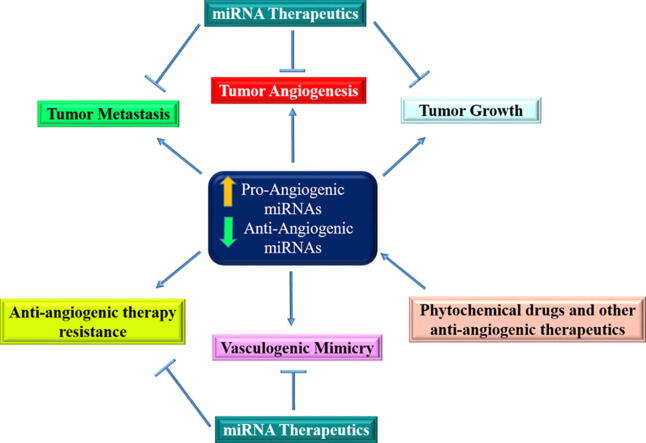
Cancer-associated angiogenesis is a fundamental process in tumor growth and metastasis. A variety of signaling regulators and pathways contribute to establish neovascularization, among them as small endogenous non-coding RNAs, microRNAs (miRNAs) play prominent dual regulatory function in breast cancer (BC) angiogenesis.
This review aims at describing the current state-of-the-art in BC angiogenesis-mediated by angioregulatory miRNAs, and an overview of miRNAs dysregulation association with the anti-angiogenic response in addition to potential clinical application of miRNAs-based therapeutics.
Angioregulatory miRNA-target gene interaction is not only involved in sprouting vessels of breast tumors but also, trans-differentiation of BC cells to endothelial cells (ECs) in a process termed vasculogenic mimicry. Using canonical and non-canonical angiogenesis pathways, the tumor cell employs the oncogenic characteristics such as miRNAs dysregulation to increase survival, proliferation, oxygen and nutrient supply, and treatment resistance. Angioregulatory miRNAs in BC cells and their microenvironment have therapeutic potential in cancer treatment. Although, miRNAs dysregulation can serve as tumor biomarker nevertheless, due to the association of miRNAs dysregulation with anti-angiogenic resistant phenotype, clinical benefits of anti-angiogenic therapy might be challenging in BC. Hence, unveiling the molecular mechanism underlying angioregulatory miRNAs sparked a booming interest in finding new treatment strategies such as miRNA-based therapies in BC.
癌症相关的血管生成是肿瘤生长和转移的一个基本过程。各种信号调节因子和途径有助于建立新血管生成,其中作为小的内源性非编码 RNA,microRNAs(miRNAs)在乳腺癌(BC)血管生成中发挥着突出的双重调节作用。
本综述旨在描述由血管生成调节 miRNA 介导的 BC 血管生成的最新研究进展,并概述 miRNA 失调与抗血管生成反应的相关性,以及 miRNA 治疗的潜在临床应用。
血管生成调节 miRNA-靶基因相互作用不仅涉及乳腺肿瘤的发芽血管,还涉及乳腺癌细胞向内皮细胞(ECs)的转分化过程,称为血管生成拟态。肿瘤细胞利用经典和非经典的血管生成途径,利用 miRNA 失调等致癌特征来增加存活、增殖、氧气和营养供应以及治疗耐药性。BC 细胞及其微环境中的血管生成调节 miRNAs 在癌症治疗中有治疗潜力。尽管 miRNA 失调可以作为肿瘤标志物,但由于 miRNA 失调与抗血管生成耐药表型相关,抗血管生成治疗在 BC 中的临床获益可能具有挑战性。因此,揭示血管生成调节 miRNAs 的分子机制引发了人们对寻找新的治疗策略(如 miRNA 治疗)的浓厚兴趣。