Marine Biotechnology Center for Pharmaceuticals and Foods, College of Medical and Life Sciences, Silla University, Busan 46958, Korea.
AMOREPACIFIC Research and Development Center, Yongin 17074, Korea.
Int J Mol Sci. 2020 Jun 1;21(11):3981. doi: 10.3390/ijms21113981.
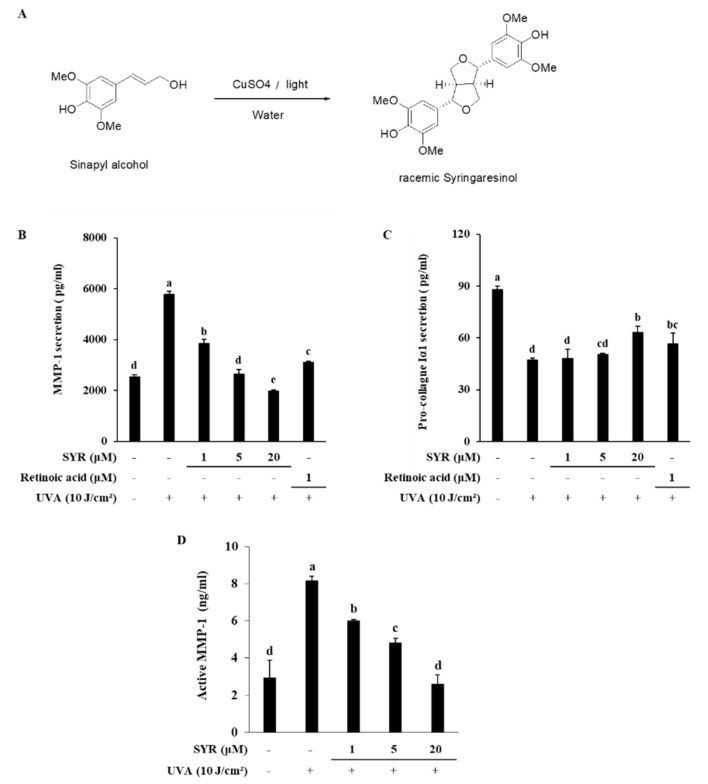
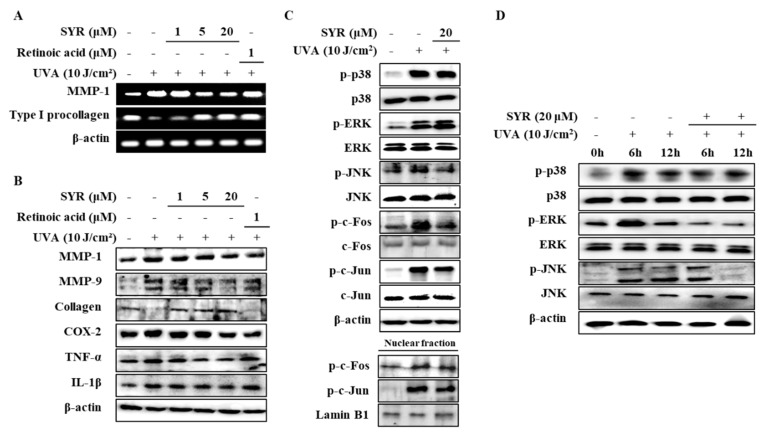
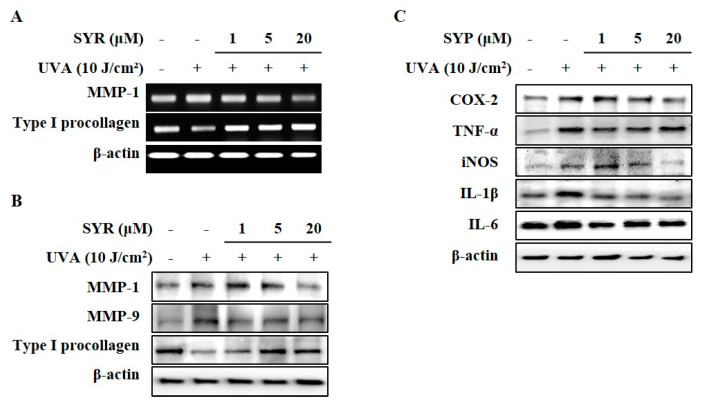
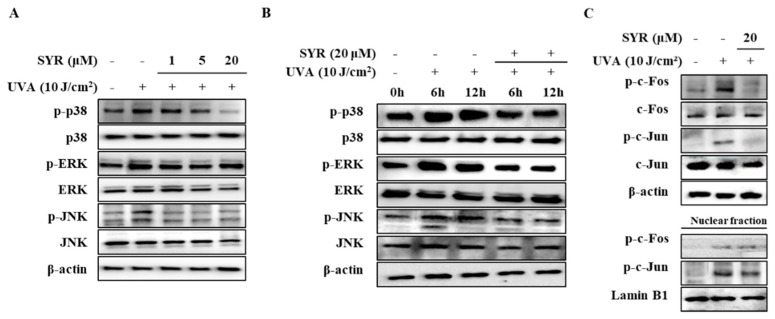
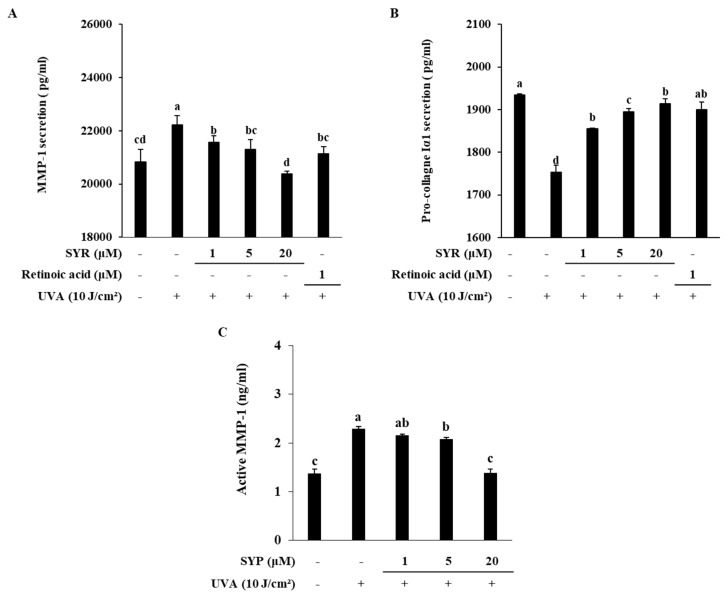
Ultraviolet (UV) irradiation induces detrimental changes in human skin which result in photoaging. UV-induced intracellular changes cause degradation of extracellular matrix (ECM). UV-stimulated cleavage of collagen in ECM occurs via matrix metalloproteinases (MMPs). (±)-syringaresinol (SYR), a phytochemical which belongs to the lignan group of polyphenols, was investigated for its ability to reverse the UVA-induced changes in human HaCaT keratinocytes and dermal fibroblasts (HDFs) in vitro. Effect of SYR on UVA-induced changes was investigated by production and activation of MMPs and its transcriptional upstream effectors; mitogen-activated protein kinases (MAPKs) and pro-inflammatory mediators. Levels of expression were determined using ELISA, RT-PCR and immunoblotting. UVA irradiation stimulated the production of MMP-1 and inhibited collagen production. SYR treatment suppressed MMP-1 and enhanced collagen production in UVA-irradiated HaCaT keratinocytes and HDFs. SYR repressed the UV-induced phosphorylation of p38, ERK and JNK MAPKs in HaCaT keratinocytes while only suppressing JNK phosphorylation in HDFs. In addition, SYR was able to inhibit UVA-induced production of inflammatory cytokines; TNF-α, COX-2, IL-1β and IL-6. Moreover, SYR suppressed the activator protein-1 (AP-1), a heterodimer of phosphorylated transcription factors c-Jun and c-Fos. SYR-treatment decreased nuclear levels of activated c-Fos and c-Jun as a mechanism to inhibit UVA-induced transcriptional activities leading to MMP-1 production. In conclusion, current results demonstrated that SYR could inhibit UVA-induced upregulation of MMP-1 by suppressing MAPK/AP-1 signaling in HaCaT keratinocytes and HDFs. Therefore, SYR was suggested as a potential compound with antiphotoaging properties against UVA-induced skin aging.
紫外线(UV)辐射会导致人体皮肤产生有害变化,从而导致光老化。UV 引起的细胞内变化导致细胞外基质(ECM)降解。UV 刺激 ECM 中胶原蛋白的裂解是通过基质金属蛋白酶(MMPs)发生的。(±)-丁香树脂酚(SYR)是一种植物化学物质,属于多酚类的木脂素,研究其在体外逆转 UVA 诱导的人 HaCaT 角质形成细胞和真皮成纤维细胞(HDFs)中的变化的能力。通过 MMPs 的产生和激活及其转录上游效应物;丝裂原活化蛋白激酶(MAPKs)和促炎介质,研究 SYR 对 UVA 诱导的变化的影响。使用 ELISA、RT-PCR 和免疫印迹测定表达水平。UVA 照射刺激 MMP-1 的产生并抑制胶原蛋白的产生。SYR 处理抑制 UVA 照射的 HaCaT 角质形成细胞和 HDFs 中 MMP-1 的产生并增强胶原蛋白的产生。SYR 抑制 UVA 诱导的 HaCaT 角质形成细胞中 p38、ERK 和 JNK MAPKs 的磷酸化,而仅抑制 HDFs 中 JNK 的磷酸化。此外,SYR 能够抑制 UVA 诱导的炎性细胞因子;TNF-α、COX-2、IL-1β和 IL-6 的产生。此外,SYR 抑制激活蛋白-1(AP-1),即磷酸化转录因子 c-Jun 和 c-Fos 的异二聚体。SYR 处理降低了核内激活的 c-Fos 和 c-Jun 的水平,作为抑制 UVA 诱导的转录活性导致 MMP-1 产生的机制。总之,目前的结果表明,SYR 可以通过抑制 MAPK/AP-1 信号通路抑制 HaCaT 角质形成细胞和 HDFs 中 UVA 诱导的 MMP-1 上调。因此,SYR 被认为是一种具有抗 UVA 诱导皮肤衰老作用的潜在化合物。