Wang Hsin-Yao, Chen Chun-Hsien, Shi Steve, Chung Chia-Ru, Wen Ying-Hao, Wu Min-Hsien, Lebowitz Michael S, Zhou Jiming, Lu Jang-Jih
Department of Laboratory Medicine, Chang Gung Memorial Hospital at Linkou, Taoyuan City 33305, Taiwan.
20/20 GeneSystems, Inc, Rockville, MD 20850, USA.
Cancers (Basel). 2020 Jun 1;12(6):1442. doi: 10.3390/cancers12061442.
Tumor markers are used to screen tens of millions of individuals worldwide at annual health check-ups, especially in East Asia. Machine learning (ML)-based algorithms that improve the diagnostic accuracy and clinical utility of these tests can have substantial impact leading to the early diagnosis of cancer.
ML-based algorithms, including a cancer screening algorithm and a secondary organ of origin algorithm, were developed and validated using a large real world dataset (RWD) from asymptomatic individuals undergoing routine cancer screening at a Taiwanese medical center between May 2001 and April 2015. External validation was performed using data from the same period from a separate medical center. The data set included tumor marker values, age, and gender from 27,938 individuals, including 342 subsequently confirmed cancer cases.
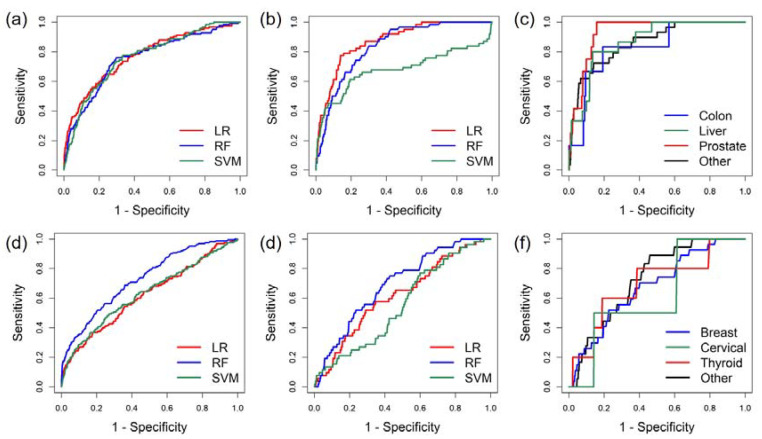
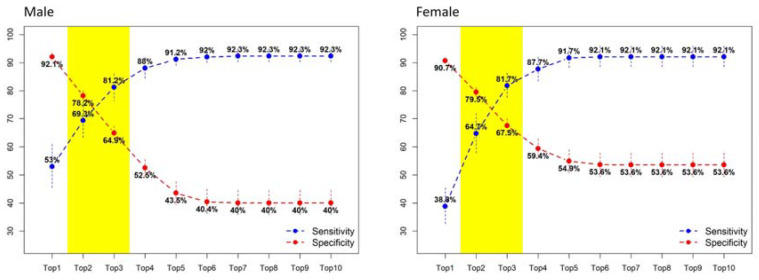
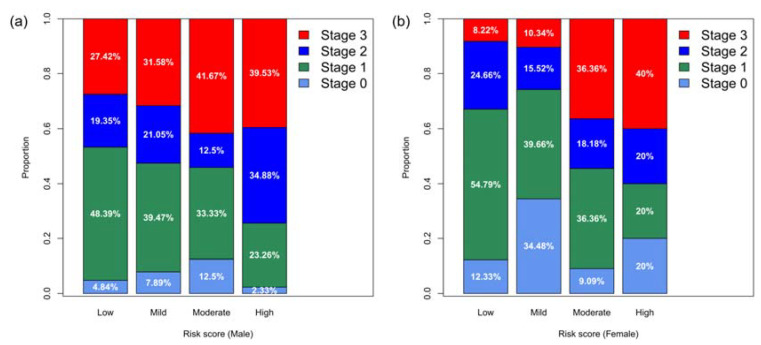
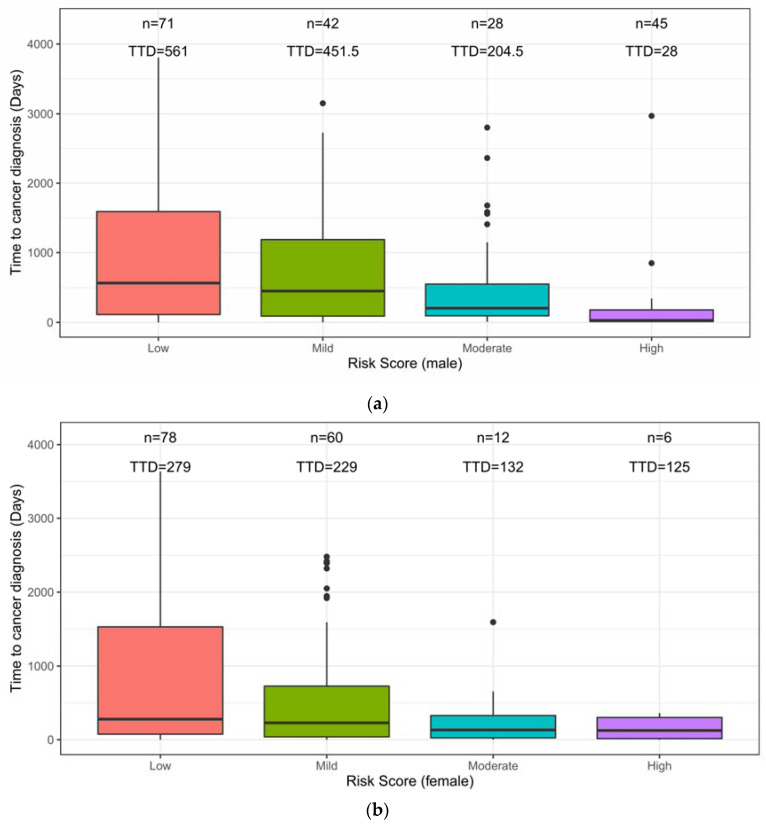
Separate gender-specific cancer screening algorithms were developed. For men, a logistic regression-based algorithm outperformed single-marker and other ML-based algorithms, with a mean area under the receiver operating characteristic curve (AUROC) of 0.7654 in internal and 0.8736 in external cross validation. For women, a random forest-based algorithm attained a mean AUROC of 0.6665 in internal and 0.6938 in external cross validation. The median time to cancer diagnosis (TTD) in men was 451.5, 204.5, and 28 days for the mild, moderate, and high-risk groups, respectively; for women, the median TTD was 229, 132, and 125 days for the mild, moderate, and high-risk groups. A second algorithm was developed to predict the most likely affected organ systems for at-risk individuals. The algorithm yielded 0.8120 sensitivity and 0.6490 specificity for men, and 0.8170 sensitivity and 0.6750 specificity for women.
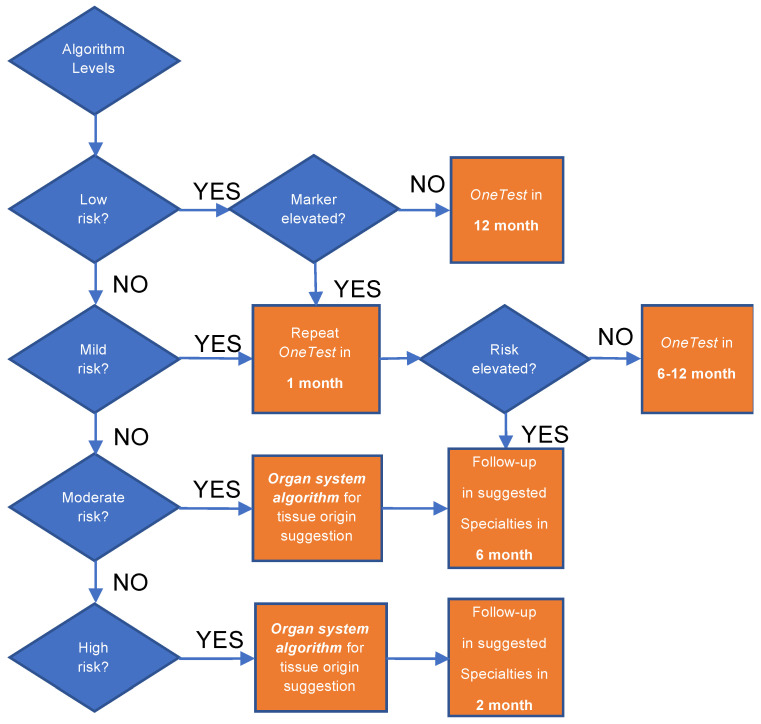
ML-derived algorithms, trained and validated by using a RWD, can significantly improve tumor marker-based screening for multiple types of early stage cancers, suggest the tissue of origin, and provide guidance for patient follow-up.
肿瘤标志物用于全球数千万人的年度健康检查,尤其是在东亚地区。基于机器学习(ML)的算法可提高这些检测的诊断准确性和临床实用性,对癌症的早期诊断具有重大影响。
使用2001年5月至2015年4月在台湾一家医疗中心接受常规癌症筛查的无症状个体的大型真实世界数据集(RWD),开发并验证了基于ML的算法,包括癌症筛查算法和继发器官起源算法。使用同期另一家医疗中心的数据进行外部验证。数据集包括27938名个体的肿瘤标志物值、年龄和性别,其中包括342例随后确诊的癌症病例。
开发了针对不同性别的癌症筛查算法。对于男性,基于逻辑回归的算法优于单标志物算法和其他基于ML的算法,在内部交叉验证中,受试者操作特征曲线下面积(AUROC)的平均值为0.7654,在外部交叉验证中为0.8736。对于女性,基于随机森林的算法在内部交叉验证中的平均AUROC为0.6665,在外部交叉验证中为0.6938。男性轻度、中度和高危组的癌症诊断中位时间(TTD)分别为451.5天、204.5天和28天;女性轻度、中度和高危组的中位TTD分别为229天、132天和125天。开发了第二种算法来预测高危个体最可能受影响的器官系统。该算法对男性的敏感性为0.8120,特异性为0.6490;对女性的敏感性为0.8170,特异性为0.6750。
通过使用RWD进行训练和验证的基于ML的算法,可显著改善基于肿瘤标志物的多种早期癌症筛查,提示起源组织,并为患者随访提供指导。