Program on Reproductive Health and the Environment, UCSF Department of Obstetrics, Gynecology & Reproductive Sciences, University of California, Mailstop 0132, 550 16th Street, 7th Floor, San Francisco, CA, 94143, USA.
Center for Reproductive Sciences and Department of Obstetrics, Gynecology & Reproductive Sciences, University of California, 513 Parnassus Avenue, San Francisco, CA, 94143, USA.
Environ Health. 2020 Jun 3;19(1):61. doi: 10.1186/s12940-020-00617-7.
Polybrominated diphenyl ether (PBDE) exposures have been associated with adverse pregnancy outcomes. A hypothesized mechanism is via alterations in placental development and function. However, we lack biomarkers that can be used as early indicators of maternal/fetal response to PBDE exposures and/or perturbations in placental development or function.
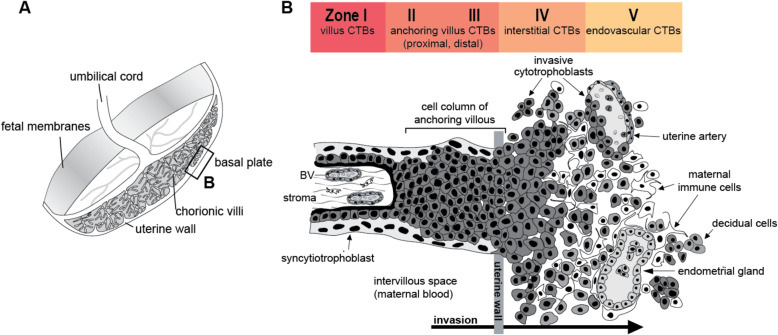
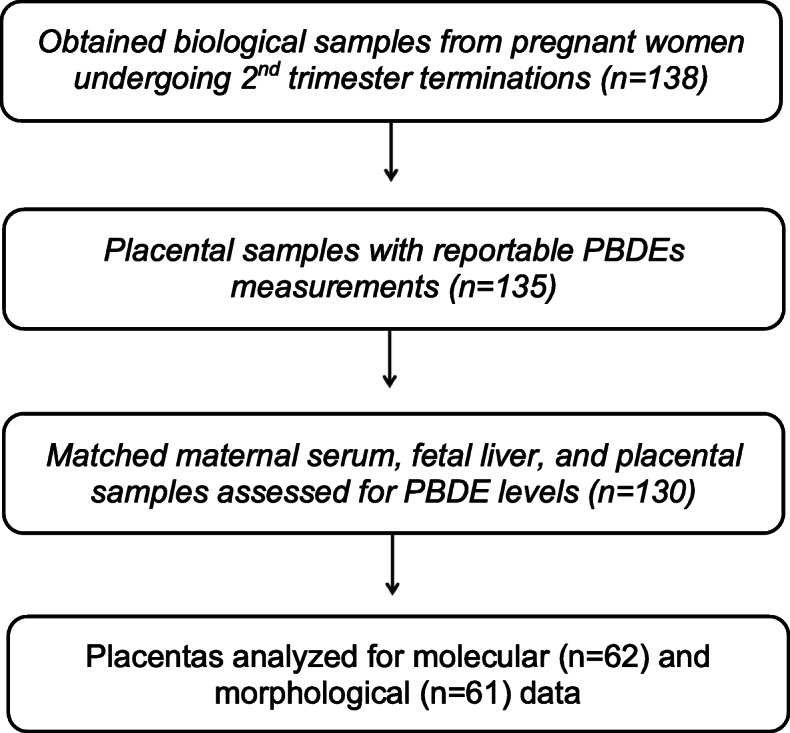
To evaluate the relationship between PBDE levels and placental biomarkers during mid-gestation of human pregnancy (n = 62), we immunolocalized three molecules that play key roles in cytotrophoblast (CTB) differentiation and interstitial/endovascular uterine invasion-integrin alpha-1 (ITGA1), vascular endothelial-cadherin (CDH5), and metalloproteinase-1 (MMP1)-and assessed three morphological parameters as potential indicators of pathological alterations using H&E-stained tissues-leukocyte infiltration, fibrinoid deposition, and CTB endovascular invasion. We evaluated associations between placental PBDE levels and of biomarkers of placental development and disease using censored Kendall's tau correlation and linear regression methods.
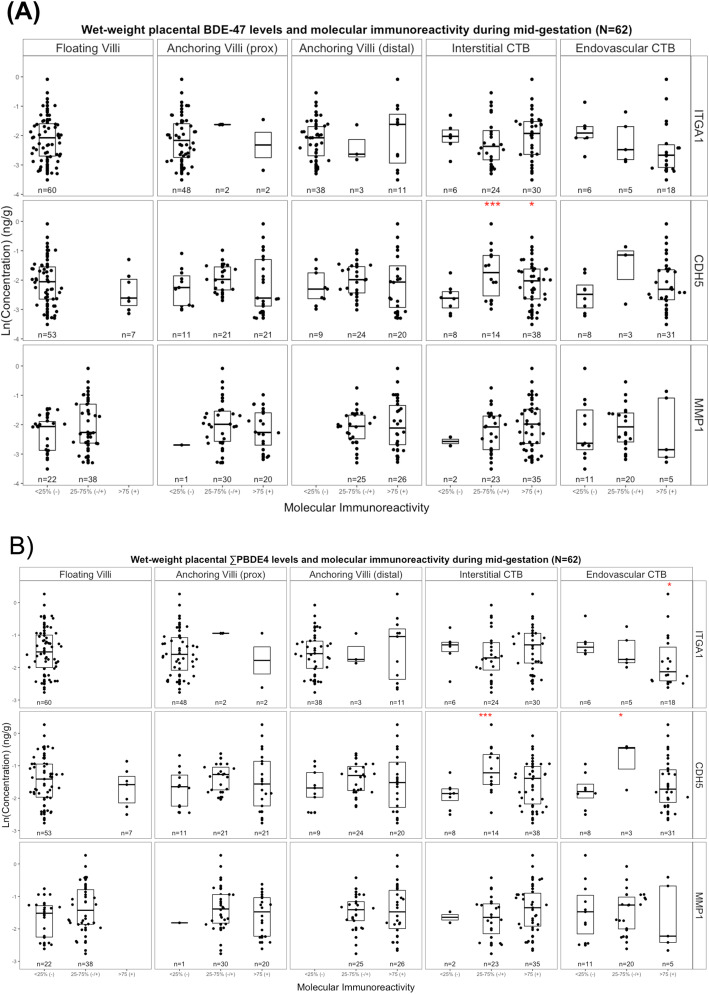
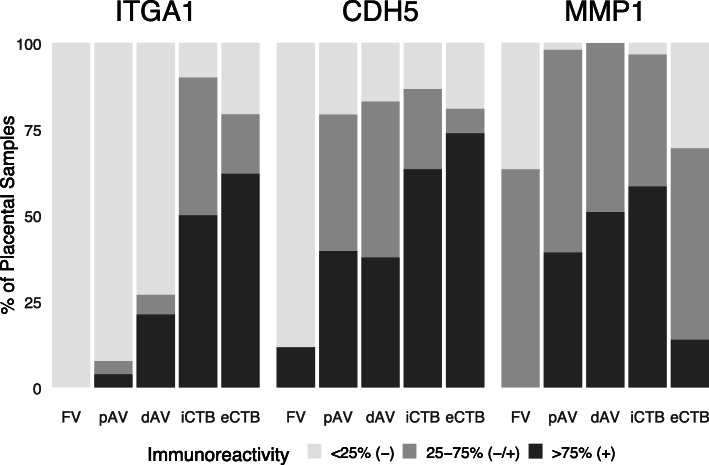
PBDEs were detected in all placental samples. We observed substantial variation in antigen expression and morphological endpoints across placental regions. We observed an association between PBDE concentrations and immunoreactivity of endovascular CTB staining with anti-ITGA1 (inverse) or interstitial CTBs staining with anti-CDH5 (positive).
We found several molecular markers that may be sensitive placental indicators of PBDE exposure. Further, this indicates that placental biomarkers of development and disease could be useful barometers of exposure to PBDEs, a paradigm that could be extended to other environmental chemicals and placental stage-specific antigens.
多溴二苯醚 (PBDE) 暴露与不良妊娠结局有关。一种假设的机制是通过改变胎盘发育和功能。然而,我们缺乏可作为母体/胎儿对 PBDE 暴露反应的早期指标以及胎盘发育或功能紊乱的生物标志物。
为了评估 PBDE 水平与人类妊娠中期胎盘生物标志物之间的关系(n=62),我们免疫定位了在滋养细胞分化和间质/血管内子宫侵袭中起关键作用的三种分子 - 整合素 alpha-1 (ITGA1)、血管内皮钙黏蛋白 (CDH5) 和基质金属蛋白酶-1 (MMP1) - 并用 H&E 染色组织评估了三种形态学参数作为病理性改变的潜在指标 - 白细胞浸润、纤维蛋白沉积和 CTB 血管内侵袭。我们使用带删失的 Kendall tau 相关和线性回归方法评估了胎盘 PBDE 水平与胎盘发育和疾病生物标志物之间的相关性。
所有胎盘样本中均检测到 PBDE。我们观察到胎盘区域的抗原表达和形态学终点存在很大差异。我们观察到 PBDE 浓度与血管内 CTB 与抗 ITGA1(反向)或间质 CTB 与抗 CDH5(阳性)染色的免疫反应之间存在关联。
我们发现了几种分子标志物,它们可能是敏感的胎盘 PBDE 暴露生物标志物。此外,这表明胎盘发育和疾病的生物标志物可能是 PBDE 暴露的有用指标,这一范例可以扩展到其他环境化学物质和胎盘阶段特异性抗原。