Department of Pediatrics, University of Michigan, Ann Arbor, Michigan, USA.
Endocr Rev. 2021 May 25;42(3):295-353. doi: 10.1210/endrev/bnaa035.
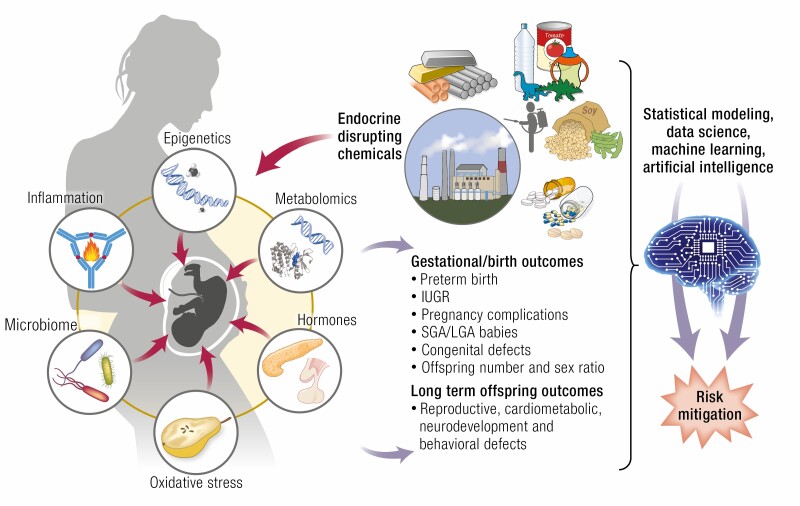
The burden of adverse pregnancy outcomes such as preterm birth and low birth weight is considerable across the world. Several risk factors for adverse pregnancy outcomes have been identified. One risk factor for adverse pregnancy outcomes receiving considerable attention in recent years is gestational exposure to endocrine-disrupting chemicals (EDCs). Humans are exposed to a multitude of environmental chemicals with known endocrine-disrupting properties, and evidence suggests exposure to these EDCs have the potential to disrupt the maternal-fetal environment culminating in adverse pregnancy and birth outcomes. This review addresses the impact of maternal and fetal exposure to environmental EDCs of natural and man-made chemicals in disrupting the maternal-fetal milieu in human leading to adverse pregnancy and birth outcomes-a risk factor for adult-onset noncommunicable diseases, the role lifestyle and environmental factors play in mitigating or amplifying the effects of EDCs, the underlying mechanisms and mediators involved, and the research directions on which to focus future investigations to help alleviate the adverse effects of EDC exposure.
全世界范围内,不良妊娠结局(如早产和低出生体重)的负担都相当沉重。已经确定了一些不良妊娠结局的风险因素。近年来,一个备受关注的不良妊娠结局风险因素是妊娠期接触内分泌干扰化学品(EDCs)。人类会接触到大量具有已知内分泌干扰特性的环境化学物质,有证据表明,接触这些 EDC 有可能破坏母体-胎儿环境,最终导致不良妊娠和出生结局。这篇综述探讨了母体和胎儿暴露于天然和人为化学物质的环境 EDC 对破坏人类母体-胎儿环境的影响,导致不良妊娠和出生结局——这是成年期非传染性疾病的一个风险因素,以及生活方式和环境因素在减轻或放大 EDC 影响方面所起的作用、涉及的潜在机制和介质,以及未来研究的重点方向,以帮助减轻 EDC 暴露的不良影响。