Department of Biology, University of North Carolina at Greensboro, 235 Eberhart Bldg., Greensboro, NC, 27402, USA.
Department of Entomology and Plant Pathology, North Carolina State University, Raleigh, NC, 27695, USA.
Parasit Vectors. 2020 Jun 3;13(1):280. doi: 10.1186/s13071-020-04151-w.
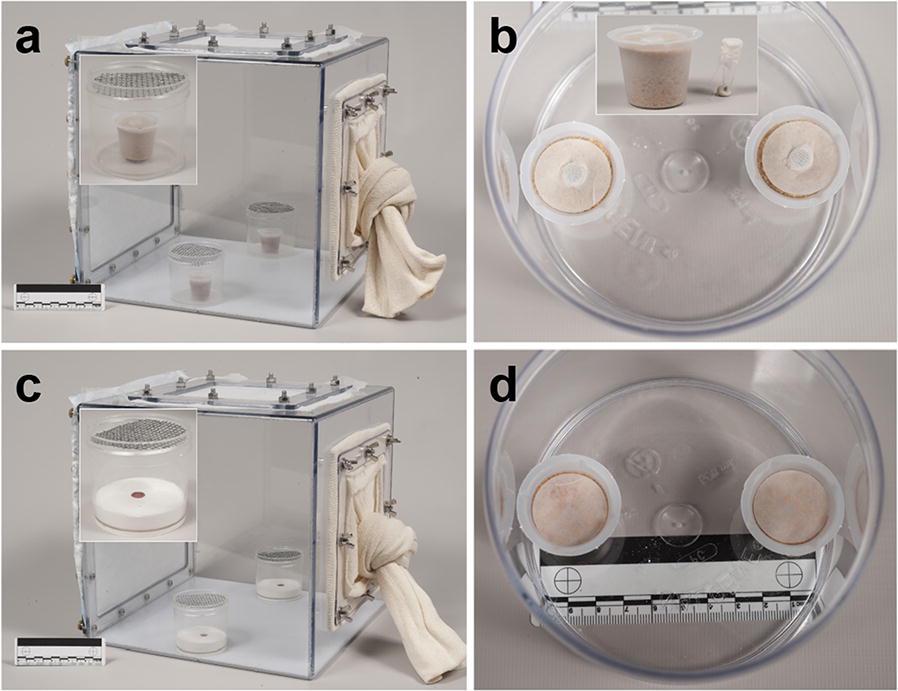
Gravid females assess the conditions of oviposition sites to secure the growth and survival of their offspring. Conspecific-occupied sites may signal suitable oviposition sites but may also impose risk due to competition or cannibalism at high population density or heterogeneous larval stage structure, respectively. Chemicals in the habitat, including chemicals emitted from other organisms, serve as cues for females to assess habitat conditions. Here, we investigated the attraction and oviposition preference of the Old World cutaneous leishmaniasis vector, Phlebotomus papatasi, to young and old conspecific stages, including eggs and evaluated the effect of a semiochemical associated with eggs and neonate larvae.
Attraction and oviposition preference of Ph. papatasi to each of various life stages (eggs, first-, second-, third-, fourth-instar larvae, pupae and male and female adults) was investigated using cage and oviposition jar behavioral assays. Identification of organic chemical compounds extracted from eggs was performed using GC-MS and chemicals were tested in the same behavioral assays in a dose-response manner. Behavioral responses were statistically analyzed using logistic models.
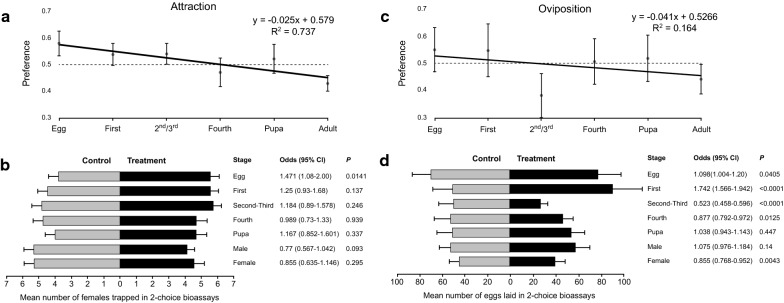
Gravid Ph. papatasi females were significantly attracted to and preferred to oviposit on medium containing young life stages (eggs and first instars). This preference decreased towards older life stages. Dose effect of eggs indicated a hump-shaped response with respect to attraction but a concave-up pattern with respect to oviposition. Chemical analysis of semiochemicals from eggs and first-instar larvae revealed the presence of dodecanoic acid (DA) and isovaleric acid. Sand flies were attracted to and laid more eggs at the lowest DA dose tested followed by a negative dose-response.
Findings corroborated our hypothesis that gravid sand flies should prefer early colonized oviposition sites as indicators of site suitability but avoid sites containing older stages as indicators of potential competition. Findings also supported the predictions of our hump-shaped oviposition regulation (HSR) model, with attraction to conspecific eggs at low-medium densities and switching to repellence at high egg densities. This oviposition behavior is mediated by DA that was identified from surface extracts of both eggs and first-instar larvae. Isovaleric acid was also found in extracts of both stages.
怀孕的雌性会评估产卵地点的条件,以确保其后代的生长和生存。同种生物占据的地点可能是合适的产卵地点,但在种群密度高或幼虫阶段结构不均匀的情况下,也可能会带来竞争或同类相食的风险。栖息地中的化学物质,包括来自其他生物的化学物质,是雌性评估栖息地条件的线索。在这里,我们研究了旧世界皮肤利什曼病传播媒介白蛉埃及亚种对年轻和年老同种生物阶段(卵、第一、二、三、四龄幼虫、蛹和成蚊和雌蚊)的吸引和产卵偏好,并评估了与卵和新生幼虫相关的半化学物质的影响。
使用笼和产卵瓶行为测定法,研究白蛉埃及亚种对各个生命阶段(卵、第一、二、三、四龄幼虫、蛹和成蚊和雌蚊)的吸引和产卵偏好。使用 GC-MS 对从卵中提取的有机化合物进行鉴定,并以剂量反应方式在相同的行为测定中测试化学物质。使用逻辑模型对行为反应进行统计分析。
怀孕的白蛉埃及亚种雌性明显被含有年轻生命阶段(卵和第一龄幼虫)的培养基吸引,并优先在其中产卵。这种偏好随着生命阶段的老化而降低。卵剂量效应表明,在吸引方面呈驼峰形反应,而在产卵方面呈凹形向上模式。对卵和第一龄幼虫半化学物质的化学分析表明,存在十二烷酸(DA)和异戊酸。沙蝇被吸引并在测试的最低 DA 剂量下产卵更多,然后是负剂量反应。
研究结果证实了我们的假设,即怀孕的沙蝇应该更喜欢早期定植的产卵地点,作为地点适宜性的指标,但应避免含有较老阶段的地点,因为这些地点可能是潜在竞争的指标。研究结果还支持了我们的驼峰形产卵调节(HSR)模型的预测,即在中低密度时对同种卵有吸引力,而在高卵密度时则转向排斥。这种产卵行为是由从卵和第一龄幼虫的表面提取物中鉴定出的 DA 介导的。异戊酸也在两个阶段的提取物中被发现。