
致倦库蚊(双翅目:蚊科)孕蚊对同种幼虫化学线索的行为和触角反应。
Behavioural and antennal responses of Aedes aegypti (l.) (Diptera: Culicidae) gravid females to chemical cues from conspecific larvae.
机构信息
Laboratory of Vector Control Research, Institute Pasteur of Guadeloupe-Lieu-dit Morne Jolivière, Les Abymes, Guadeloupe, France.
TERRA, Gembloux Agro-Bio Tech, University of Liège, Gembloux, Belgium.
出版信息
PLoS One. 2021 Feb 24;16(2):e0247657. doi: 10.1371/journal.pone.0247657. eCollection 2021.
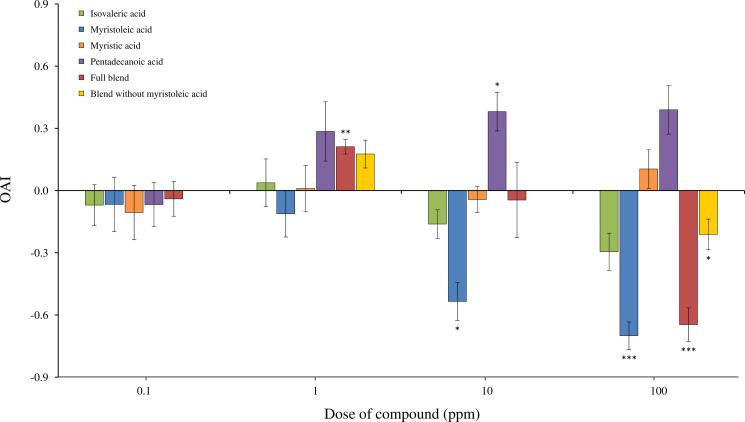
Mass trapping of gravid females represents one promising strategy for the development of sustainable tools against Aedes aegypti. However, this technique requires the development of effective odorant lures that can compete with natural breeding sites. The presence of conspecific larvae has been shown to stimulate oviposition. Hence, we evaluated the role of four major molecules previously identified from Ae. aegypti larvae (isovaleric, myristoleic, myristic [i.e. tetradecanoic], and pentadecanoic acids) on the oviposition of conspecific females, as well as their olfactory perception to evaluate their range of detection. Using flight cage assays, the preference of gravid females to oviposit in water that previously contained larvae (LHW) or containing the four larval compounds was evaluated. Then, compounds and doses inducing the highest stimulation were challenged for their efficacy against LHW. Only isovaleric acid elicited antennal response, suggesting that the other compounds may act as taste cues. Pentadecanoic acid induced significant oviposition stimulation, especially when dosed at 10 ppm. Myristoleic acid and isovaleric acid deterred oviposition at 10 and 100 ppm, while no effect on oviposition was observed with myristic acid irrespectively of the dose tested. When the four compounds were pooled to mimic larvae's chemical signature, they favored oviposition at 1 ppm but negatively affected egg-laying at higher concentrations. When properly dosed, pentadecanoic acid and the blend of compounds may be promising lures for ovitraps as they could compete with LHW. Due to their low volatility, their effect should be further evaluated under field conditions, in addition with long-range attractants for developing effective tools against gravid females.
大量诱捕怀孕雌蚊是开发可持续性防治埃及伊蚊工具的有前途的策略之一。然而,这种技术需要开发有效的气味诱饵,以与天然繁殖地竞争。已经表明,同种幼虫的存在会刺激产卵。因此,我们评估了从埃及伊蚊幼虫中鉴定出的四种主要分子(异戊酸、肉豆蔻油酸、肉豆蔻酸[即十四烷酸]和十五烷酸)对同种雌蚊产卵的作用,以及它们对嗅觉的感知,以评估它们的检测范围。使用飞行笼试验,评估了怀孕雌蚊在先前含有幼虫的水中(LHW)或含有四种幼虫化合物的水中产卵的偏好。然后,用最高刺激剂量的化合物来挑战 LHW 的效果。只有异戊酸引起触角反应,这表明其他化合物可能作为味觉线索。十五烷酸诱导显著的产卵刺激,特别是在 10 ppm 剂量时。肉豆蔻油酸和异戊酸在 10 和 100 ppm 时会阻止产卵,而肉豆蔻酸无论测试剂量如何,对产卵都没有影响。当四种化合物混合模拟幼虫的化学特征时,它们在 1 ppm 时有利于产卵,但在较高浓度时会对产卵产生负面影响。当适当剂量时,十五烷酸和化合物混合物可能是诱卵器的有前途的诱饵,因为它们可以与 LHW 竞争。由于它们的挥发性低,应在野外条件下进一步评估它们的效果,此外还需要使用远程引诱剂来开发针对怀孕雌蚊的有效工具。



 Zotero 插件