University of Kaiserslautern, Germany (Retired), Kühler Grund 48/1, 69126, Heidelberg, Germany.
Arch Toxicol. 2020 Sep;94(9):2939-2950. doi: 10.1007/s00204-020-02794-3. Epub 2020 Jun 3.
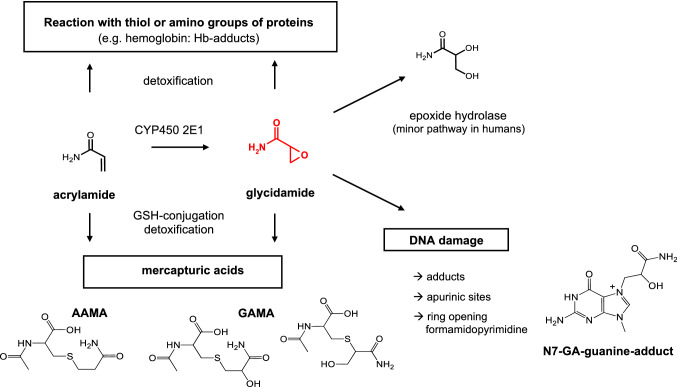
The weight of evidence pro/contra classifying the process-related food contaminant (PRC) acrylamide (AA) as a genotoxic carcinogen is reviewed. Current dietary AA exposure estimates reflect margins of exposure (MOEs) < 500. Several arguments support the view that AA may not act as a genotoxic carcinogen, especially not at consumer-relevant exposure levels: Biotransformation of AA into genotoxic glycidamide (GA) in primary rat hepatocytes is markedly slower than detoxifying coupling to glutathione (GS). Repeated feeding of rats with AA containing foods, bringing about uptake of 100 µg/kg/day of AA, resulted in dose x time-related buildup of AA-hemoglobin (Hb) adducts, whereas GA-Hb adducts remained within the background. Since hepatic oxidative biotransformation of AA into GA was proven by simultaneous urinary mercapturic acid monitoring it can be concluded that at this nutritional intake level any GA formed in the liver from AA is quantitatively coupled to GS to be excreted as mercapturic acid in urine. In an oral single dose-response study in rats, AA induced DNA N-GA-Gua adducts dose-dependently in the high dose range (> 100 µg/kg b w). At variance, in the dose range below 100 µg/kg b.w. down to levels of average consumers exposure, DNA N -Gua lesions were found only sporadically, without dose dependence, and at levels close to the lower bound of similar human background DNA N-Gua lesions. No DNA damage was detected by the comet assay within this low dose range. GA is a very weak mutagen, known to predominantly induce DNA N-GA-Gua adducts, especially in the lower dose range. There is consensus that DNA N-GA-Gua adducts exhibit rather low mutagenic potency. The low mutagenic potential of GA has further been evidenced by comparison to preactivated forms of other process-related contaminants, such as N-Nitroso compounds or polycyclic aromatic hydrocarbons, potent food borne mutagens/carcinogens. Toxicogenomic studies provide no evidence supporting a genotoxic mode of action (MOA), rather indicate effects on calcium signalling and cytoskeletal functions in rodent target organs. Rodent carcinogenicity studies show induction of strain- and species-specific neoplasms, with MOAs not considered likely predictive for human cancer risk. In summary, the overall evidence clearly argues for a nongenotoxic/nonmutagenic MOA underlying the neoplastic effects of AA in rodents. In consequence, a tolerable intake level (TDI) may be defined, guided by mechanistic elucidation of key adverse effects and supported by biomarker-based dosimetry in experimental systems and humans.
本文回顾了将与过程相关的食品污染物(PRC)丙烯酰胺(AA)归类为遗传毒性致癌物的证据权重。目前的膳食 AA 暴露估计反映了暴露限度(MOE)<500。有几个论点支持 AA 可能不作为遗传毒性致癌物的观点,特别是在消费者相关的暴露水平下:AA 在原代大鼠肝细胞中生物转化为遗传毒性丙烯醛(GA)的速度明显较慢,而与谷胱甘肽(GS)解毒偶联。用含有 AA 的食物反复喂养大鼠,每天摄入 100μg/kg 的 AA,导致 AA-血红蛋白(Hb)加合物的剂量相关时间累积,而 GA-Hb 加合物仍处于背景水平。由于通过同时监测尿硫醚氨酸证实了 AA 在肝中的氧化生物转化为 GA,因此可以得出结论,在这种营养摄入水平下,从 AA 在肝中形成的任何 GA 都与 GS 定量偶联,作为硫醚氨酸从尿液中排出。在大鼠口服单次剂量反应研究中,AA 在高剂量范围(>100μg/kg b w)中剂量依赖性地诱导 DNA N-GA-Gua 加合物。相反,在 100μg/kg b.w. 以下的剂量范围内,直到平均消费者暴露水平,仅偶然发现 DNA N-Gua 损伤,没有剂量依赖性,并且接近类似人类背景 DNA N-Gua 损伤的下限。在这个低剂量范围内,彗星试验未检测到 DNA 损伤。GA 是一种非常弱的诱变剂,已知主要诱导 DNA N-GA-Gua 加合物,尤其是在较低的剂量范围内。人们普遍认为,DNA N-GA-Gua 加合物的诱变潜能较低。GA 的低诱变潜力通过与其他过程相关污染物(如 N-亚硝化合物或多环芳烃)的预激活形式的比较进一步得到证明,这些都是强有力的食物相关诱变剂/致癌物。毒代动力学研究没有提供支持遗传毒性作用模式(MOA)的证据,而是表明对啮齿动物靶器官中的钙信号和细胞骨架功能有影响。啮齿动物致癌性研究显示,诱导了与菌株和物种特异性相关的肿瘤,其 MOA 不太可能预测人类癌症风险。总之,总的证据清楚地表明,AA 在啮齿动物中的肿瘤形成作用具有非遗传毒性/非诱变性 MOA。因此,可以定义可耐受摄入量(TDI),该值由对关键不良影响的机制阐明以及在实验系统和人类中基于生物标志物的剂量测定来指导。