Royal Brompton Hospital, London, UK.
National Heart and Lung Institute, Imperial College London, Dovehouse Street, London, SW3 6LY, UK.
Curr Heart Fail Rep. 2020 Aug;17(4):125-132. doi: 10.1007/s11897-020-00467-x.
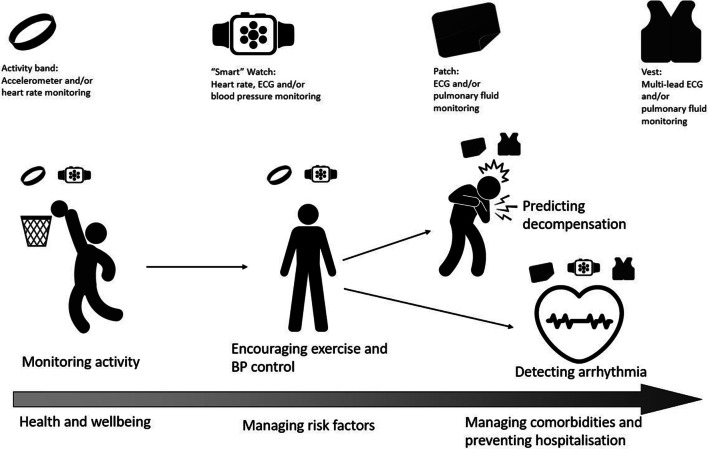
This review discusses how wearable devices-sensors externally applied to the body to measure a physiological signal-can be used in heart failure (HF) care.
Most wearables are marketed to consumers and can measure movement, heart rate, and blood pressure; detect and monitor arrhythmia; and support exercise training and rehabilitation. Wearable devices targeted at healthcare professionals include ECG patch recorders and vests, patches, and textiles with in-built sensors for improved prognostication and the early detection of acute decompensation. Integrating data from wearables into clinical decision-making has been slow due to clinical inertia and concerns regarding data security and validity, lack of evidence of meaningful impact, interoperability, regulatory and reimbursement issues, and legal liability. Although few studies have assessed how best to integrate wearable technologies into clinical practice, their use is rapidly expanding and may support improved decision-making by patients and healthcare professionals along the whole patient pathway.
本文讨论了可穿戴设备(外部贴附于身体以测量生理信号的传感器)如何应用于心力衰竭(HF)护理。
大多数可穿戴设备面向消费者,可测量运动、心率和血压;检测和监测心律失常;并支持运动训练和康复。面向医疗保健专业人员的可穿戴设备包括心电图贴片记录器和背心、贴片以及内置传感器的纺织品,以改善预后和急性失代偿的早期检测。由于临床惰性以及对数据安全性和有效性、缺乏有意义影响的证据、互操作性、监管和报销问题以及法律责任的担忧,将可穿戴设备的数据整合到临床决策中的速度一直很慢。尽管很少有研究评估如何将可穿戴技术最好地整合到临床实践中,但它们的使用正在迅速扩大,并可能支持患者和医疗保健专业人员在整个患者治疗途径中做出更好的决策。